Introduction
Ask ten people on an Oracle Fusion Financials project what they do all day, and you’ll hear ten different answers. That’s why learners at Soft Online Training so often ask us, “Which role is right for me?” It’s a fair worry, because job titles rarely show what the work actually feels like. Before you sign up for Oracle Fusion Financials Training in Bangalore, it helps to know the main roles and what each one involves day to day. So let’s walk through them the way a colleague would explain over a cup of chai.
Start With the Role, Not the Course
Oracle Fusion Financials isn’t one tool that one person looks after. It’s a group of modules: General Ledger, Payables, Receivables, Fixed Assets, Cash Management and a few more. Each needs people who really know it.
A lot of beginners sign up for a course first and think about the job later. We’d suggest flipping that. Once you know whether you want to be the person who configures things, the person who fixes things, or the person who builds things, choosing Oracle Fusion Financials Training in Bangalore (or anywhere else) gets much easier, because you know what to ask the trainer.
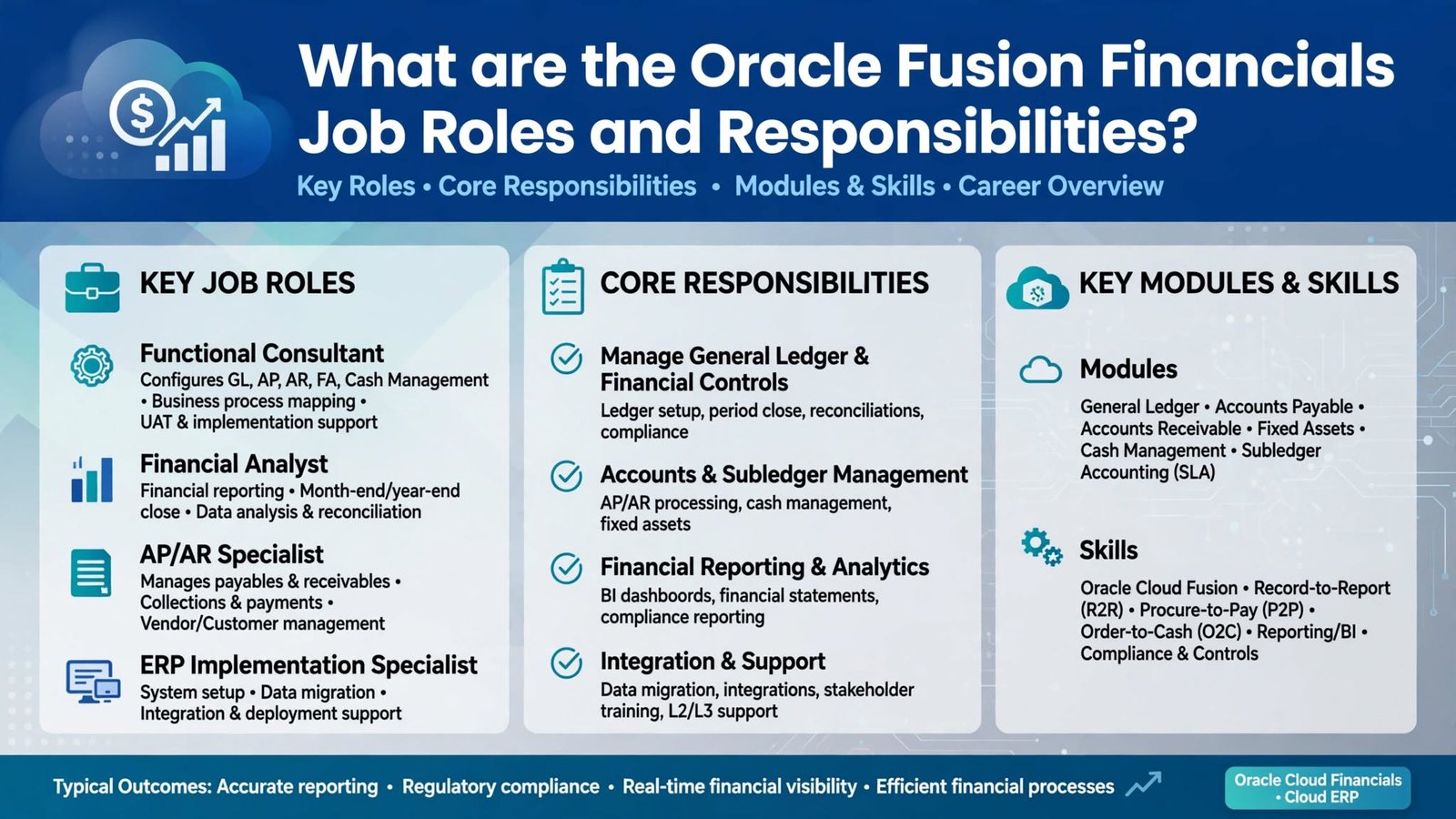
The Functional Consultant
This is the role most people picture first. A functional consultant sits between the finance team and the software. They listen to how the business works, then set up Oracle Fusion so it matches.
In practice, that means a lot of workshops and a lot of documents. You’ll configure ledgers, currencies and the chart of accounts, set up payment terms and tax rules, and write test scripts. When users test the system before go-live, you’re the one answering their “why did it do that?” questions. Then you train them.
The best functional consultants we’ve seen know accounting first and the software second. If you come from a commerce or accounting background, this is probably your most natural way in.
The General Ledger Specialist
Everything ends up in the General Ledger sooner or later. Payables posts there, so do Receivables, and so do Assets. That makes the person who looks after it very important, and very busy around the end.
A GL specialist manages the chart of accounts, opens and closes periods, approves journals, and sets up allocations and revaluations. When the trial balance looks wrong, they’re the first person anyone calls. It’s a role for people who don’t mind chasing a difference of a few rupees until it’s explained.
Payables and Receivables Analysts
These two roles sit side by side but feel different day to day.
On the Payables side, you deal with money going out. You process supplier invoices, clear matching holds, schedule payments and keep supplier records tidy. When a supplier phones to ask where their payment is, you trace that invoice step by step until you find it.
On the Receivables side, it’s money coming in. You raise customer invoices, apply receipts, sort out unapplied cash and work with the collections team on overdue balances.
Both are great starting points for freshers. You learn how the system really behaves, not just how the screens look in a demo.
Why Oracle Fusion Financials Training in Bangalore Works for Role-Based Learning
Bangalore has a huge number of Oracle partners, shared service centers and global capability centers. That matters for learners, because training here tends to follow what companies are actually hiring for. Plenty of trainers have also worked on live implementations, so they can tell you what a real project feels like.
If you’re looking at Oracle Fusion Financials Training in Bangalore, check whether the course is organized around real work. Can you practice a full Payables cycle? A bank reconciliation? A period close? Clicking through setup pages isn’t the same as doing the job, and interviewers can usually tell the difference within five minutes.
Technical and Reporting Consultants
Not every Financial job is about configuration. Some of the most useful people on a project are the ones who build what the standard application can’t do.
Technical consultants load data using File Based Data Import templates during migration, build reports in OTBI and BI Publisher, set up integrations through REST and SOAP services, and write SQL to find out why a number looks odd. If you like solving puzzles and you’re comfortable with a database, this path can suit you well. And people who understand both finance and technology are still fairly rare, which employers notice.
Support Roles After Go-Live
Once the project team leaves, someone has to keep things running. That’s where finance systems analysts and support consultants come in.
They handle user tickets, watch scheduled processes, test Oracle’s quarterly updates before they reach production and manage security roles. They also spot patterns. If the same error shows up every month, they’re the ones who say, “Let’s fix this properly instead of working around it again.” It suits people who enjoy variety and don’t mind being the go-to person.
Choosing Your Role and Your Oracle Fusion Financials Training in Bangalore
Be honest about where you’re starting from. Accountants often do well as functional consultants or ledger specialists. People from an IT background may enjoy the technical side more. Freshers can start in Payables or Receivables and widen their scope as they learn.
Whatever you pick, choose a program that lets you practice. Ask about live scenarios, real-time projects and interview preparation. A few things matter in every role: solid accounting basics, an understanding of how subledgers feed the General Ledger, clear writing (documentation is a big part of the job) and a habit of testing twice before blaming the system.
Conclusion
Oracle Fusion Financials offers far more career variety than most people expect, from configuration and ledger management to development and long-term support. Every role has its own responsibilities, but all of them need people who understand both finance and the system. If you want practical, guided learning that matches the role you’re aiming for, Oracle Fusion Financials Training in Bangalore with Soft Online Training can help you build those skills step by step and get ready for real project work.