Introduction
Just finished college and wondering what comes after learning Oracle Fusion Financials? At Tech Leads IT, freshers ask us this almost every week, and it’s a fair question before you invest months. Starting with Oracle Cloud Financials Online Training can give you a clear, practical footing.
Oracle Fusion Financials is the cloud software companies use to pay suppliers, bill customers, close the books, and track assets. Businesses keep adopting it but struggle to find people who understand both accounting and the system. With the right Oracle Cloud Financials Training Online, a fresher can step into that gap.
Why Freshers Are Taking a Serious Look at Oracle Fusion Financials
Entry-level IT jobs are crowded. Everyone is applying for the same handful of roles, and the résumés start to look identical. Finance applications work differently. A company can’t hand its month-end close to someone who has never seen a ledger, so it values people who know how money actually moves through a business.
That’s good news if you’re starting out. Early work in this field is fairly structured. You follow a process, check data, raise questions, and learn from people who’ve done it for years. Most employers expect to train you. What they want to see is that you know the basics and that you’re willing to get things wrong a few times and learn from it.
Commerce and accounting graduates have an obvious head start, but they aren’t the only ones who do well. We’ve seen engineering and MBA graduates settle in just as comfortably, because a lot of the job is logical thinking and patience.
Know the Main Modules Before You Pick a Direction
Before job titles make sense, you need a rough map of the modules. Your first role usually grows out of one of them.
General Ledger is the center of everything: journals, the chart of accounts, accounting periods, and financial statements. Payables deals with supplier invoices, approvals, holds, and payments. Receivables is the mirror image, covering customer invoices, receipts, and credit memos. Cash Management handles bank accounts and reconciliation. Fixed Assets tracks what the company owns and how it loses value over time. Subledger Accounting sits underneath and turns transactions into journal entries.
Nobody expects a fresher to master all of this at once, and you shouldn’t try. Most people start with Payables, Receivables, or General Ledger and branch out later. Choosing one first makes the whole thing feel a lot less overwhelming.
Getting Started With Oracle Cloud Financials Online Training
The first real step is learning the system properly. Reading documentation on your own sounds appealing, but for a beginner it usually turns into a pile of unfamiliar screens and terms that don’t connect. This is where Oracle Cloud Financials Online Training can save you a lot of time. A decent program takes you through the modules in a sensible order, gives you a live environment to practice in, and explains why each setup step exists instead of just telling you where to click.
When you’re comparing programs, ask a few simple questions. Will you get hands-on practice, or only slides? Are the examples taken from real business situations? Does the trainer show you how a mistake in one module shows up somewhere else? Those answers tell you whether you’ll come out able to pass a quiz or able to handle a real support ticket.
Online learning also suits freshers because you can study around other commitments, like final exams or interview prep, and replay a topic until it finally makes sense.
What the Career Ladder Usually Looks Like
Every company does this a little differently, so treat the following as a rough picture and not a promise.
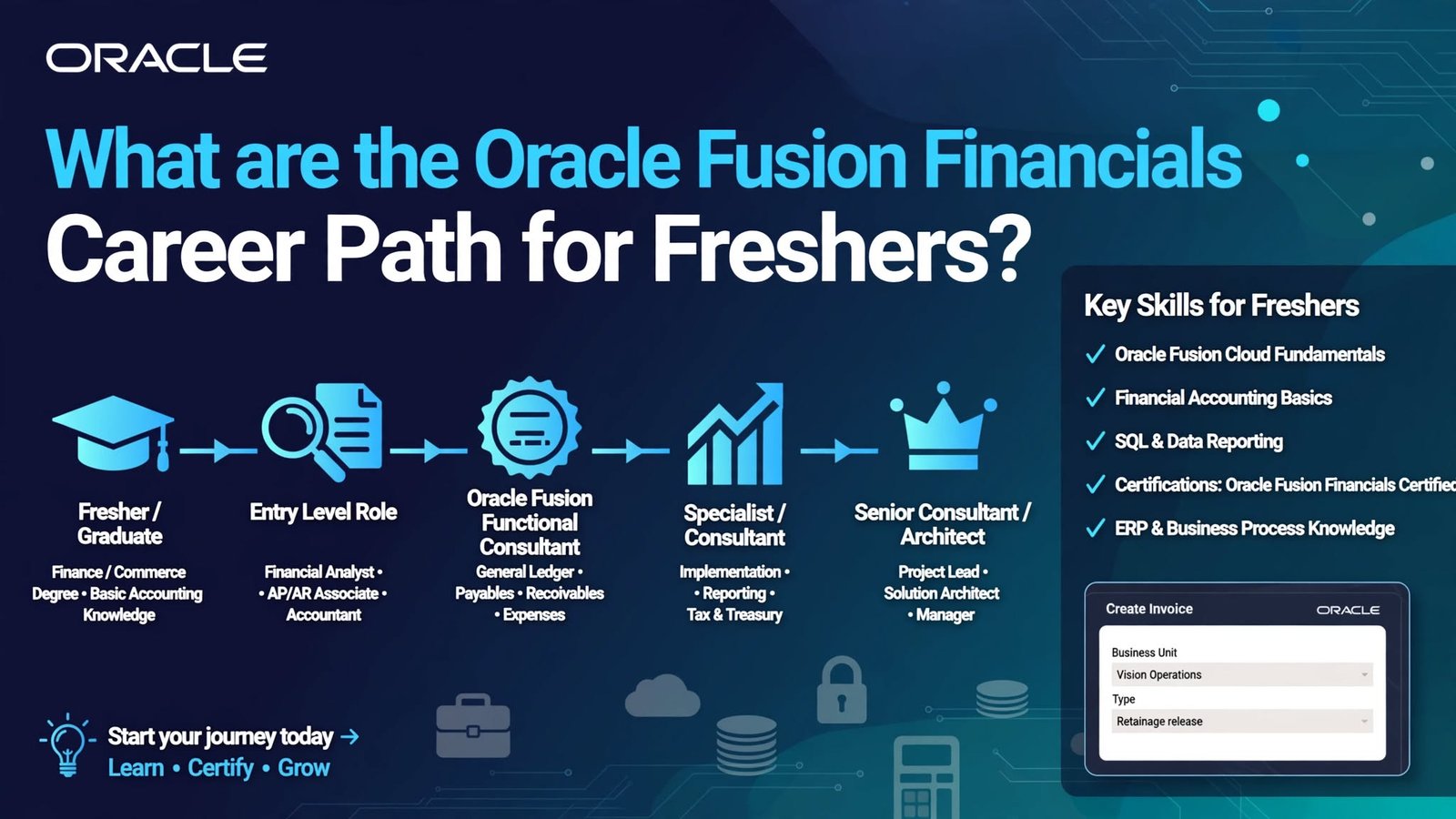
You’ll likely begin as a junior analyst or trainee consultant, usually in your first couple of years. You’ll assist senior consultants, test configurations, prepare data, write test scripts, and work through small support tickets. It can feel like grunt work, and honestly sometimes it is, but it’s also where you learn how projects really run.
After that, many people become functional consultants, somewhere around years two to five. At this point you own a module, or part of one. You sit with business users, work out what they need, set up the system, run testing, and train the people who’ll use it.
Around years five to eight, you might become a senior consultant. You’re designing solutions across several modules, guiding juniors, and getting the calls when something breaks during close. Beyond that, people move into lead, architect, or manager roles, or into pre-sales and advisory work.
None of that is a fixed schedule. Some people move faster because they take on harder problems and keep learning. Others stay happily in one role for years. Both are fine.
Entry-Level Roles a Fresher Can Realistically Apply For
If you’re wondering what to search for on job portals, these titles are good places to start:
- Oracle Financials support analyst
- Junior functional consultant
- Finance systems analyst
- Data migration associate
- Reporting analyst
Support roles often turn out to be the best first job, even though they don’t sound glamorous. You deal with real problems every single day. A user tells you their invoice is stuck, and you have to figure out why. Few things teach faster than that.
The Skills That Help You Move Up Faster
Knowing the software opens the door. What happens next depends on other things.
Accounting basics come first. If debits, credits, accruals, and reconciliations feel shaky, the system will always feel like magic you don’t quite understand. Once the accounting is clear, the software starts to feel logical.
A little SQL and some reporting knowledge help too. You don’t need to be a developer, but being able to read a simple query or understand how a report is built sets you apart quickly.
Then there’s communication, which people underestimate. Much of consulting is explaining something complicated to someone who has five minutes. If you can do that clearly and politely, people will want you on their projects.
And be curious. The consultants who grow fastest are the ones who ask why something broke instead of just fixing it and moving on. Add a habit of writing things down, because notes you keep today will save you and your team hours later.
Do Certifications Actually Matter?
Oracle offers certifications for Financials, and for a fresher they can help. A certificate won’t replace experience, but it tells a hiring manager you took the subject seriously and understand the fundamentals.
Still, don’t chase the certificate for its own sake. If you’ve practiced the modules properly, the exam mostly confirms what you already know. If you only study to pass, the knowledge fades within weeks, and a good interviewer will notice in about five minutes.
Where the Path Can Lead
One nice thing about this field is that it doesn’t trap you. You can stay on the functional side and become a real specialist in Payables, Receivables, or General Ledger. You can learn technical skills by adding reporting, integrations, or data migration. You can move into project management or business analysis. Some people join a client’s finance team and own the system from the inside, and others eventually work as independent consultants.
Because Fusion Financials touches so many business processes, what you learn travels well. The same understanding helps in finance transformation projects, audit support, and process improvement work.
Mistakes Worth Avoiding
A few patterns hold freshers back. Trying to learn every module in a month leaves you with shallow knowledge of everything. Skipping accounting fundamentals makes every later step harder. Memorizing navigation paths instead of understanding the process leaves you lost the day Oracle changes a screen. And waiting until you feel completely ready before applying costs people months they could have spent learning on the job.
Go deep on one area, practice honestly, and start applying while you’re still learning. You’ll never feel fully ready, and that’s normal.
Final Thoughts
A career in Oracle Fusion Financials isn’t a shortcut, but it’s a practical route for freshers willing to learn both finance and technology. Begin with Oracle Cloud Financials Online Training, land a junior or support role, grow into a functional consultant, then choose your direction, whether that’s specialization, leadership, or something in between.
What matters most is having a plan, practicing on real scenarios, and staying curious. If you’re unsure where to start, Tech Leads IT can guide you through Oracle Cloud Financials Training Online, helping you build the right skills and approach your first role with confidence.