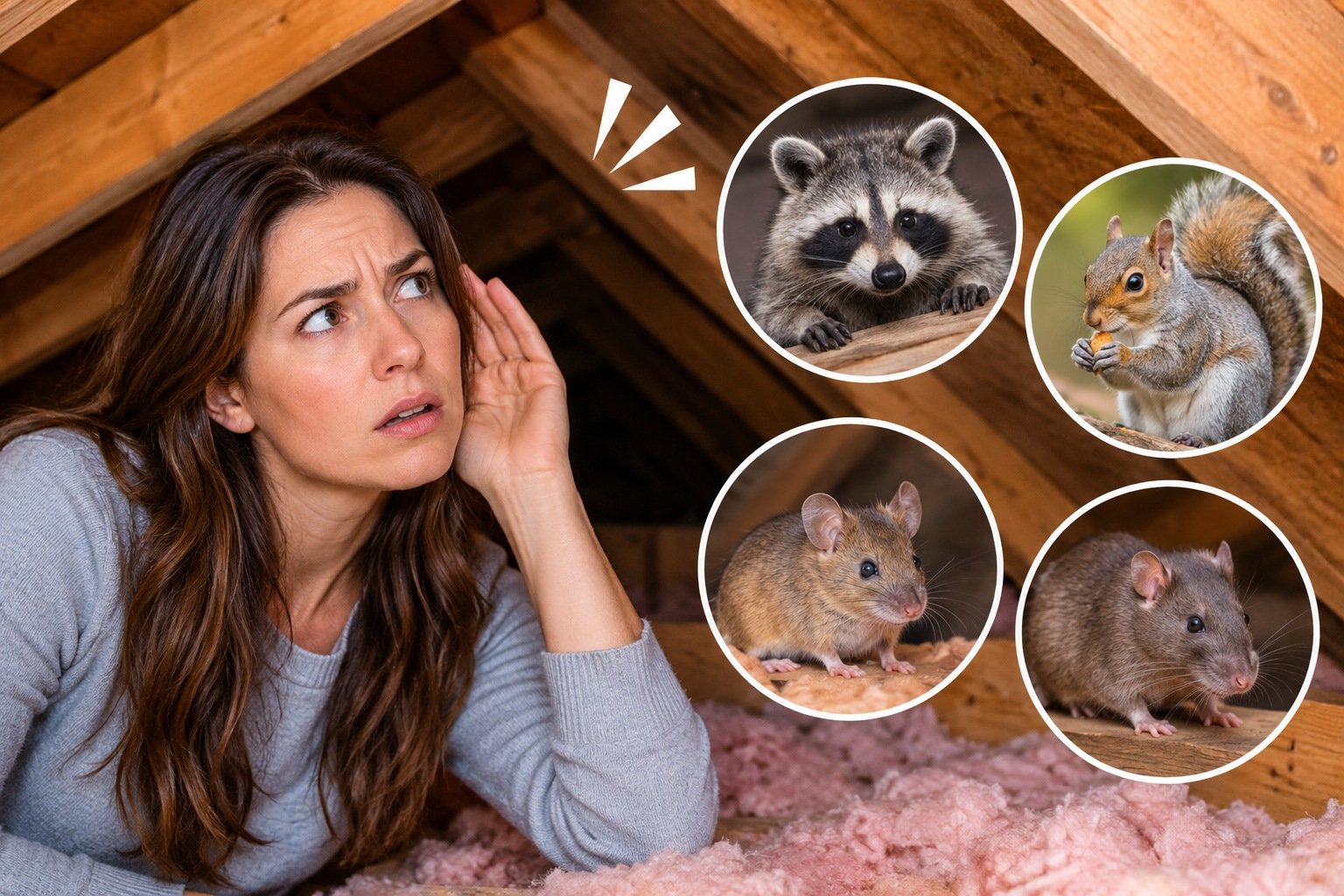
It is 2 a.m. and something is moving above your bedroom. Is it a raccoon, a squirrel, a mouse or a rat? Knowing which animal you are dealing with matters, because each one calls for a different response. A heavy raccoon can tear apart a soffit, a squirrel can chew through wiring, and mice or rats can multiply quickly and contaminate insulation.
This guide shows how to read the clues: the sounds, the time of day, the droppings and the damage. It also explains why you should confirm the animal before you act, and how professional wildlife removal in Toronto and the GTA approaches each case.
Start With the Time of Day
The easiest first clue is when you hear the noise.
- Daytime activity points toward squirrels, which are active in daylight.
- Night-time activity points toward raccoons, mice or rats, which are mostly nocturnal.
- Dusk and dawn can be raccoons, squirrels or rodents, so look for other clues.
Time of day does not give a final answer by itself. Use it alongside the sounds, droppings and damage described below.
Raccoons: Heavy Thumping at Night
Raccoons are large, strong and mostly nocturnal. Their sounds are the easiest to recognize because they are loud.
- Heavy thumping, rolling or dragging sounds, mainly after dark.
- Chattering or crying, especially in spring, which may mean young are present.
- Torn soffits, roof vents or shingles, since raccoons can pull apart weak materials.
- Droppings in one repeated spot, because raccoons often reuse the same latrine area.
- A strong animal odour in a closed attic.
Raccoons can cause serious structural damage, and their droppings can carry parasites. Do not touch droppings or contaminated insulation. For a full guide, see our article on raccoon removal in Toronto.
Squirrels: Daytime Scratching and Scampering
Squirrels are active during the day, so the noise often starts in the morning and fades by evening.
- Quick scratching, scampering and skittering sounds in the daytime.
- Gnawing or chewing sounds from beams, wood or wiring.
- Nesting material and debris near the roofline or a suspected entry point.
- Damaged soffits, fascia or vents, often at the roofline.
- Activity at the same spot each day, especially around sunrise.
Squirrels chew, and that includes electrical wiring, which can create a fire risk. If a light stops working or you suspect wire damage, do not touch the wiring and call a qualified electrician. For more detail, see our guide to squirrels in a porch ceiling and our squirrel removal service.
Mice: Light Scurrying and Squeaking
Mice are small and quick, and they are mostly active at night.
- Light scurrying or pattering in walls, ceilings or attic floors.
- Soft squeaking or scratching, often heard when the house is quiet.
- Very small droppings, roughly the size of a grain of rice, near food sources, along walls or in cupboards.
- Gnawed packaging, paper or insulation.
- Shredded nesting material in sheltered corners.
Mice can squeeze through very small gaps, so they can enter even when the building looks sealed. Because they breed quickly, a small problem can grow if left alone.
Rats: Heavier Scurrying and Gnawing
Rats are larger than mice and tend to make heavier, more deliberate noises.
- Heavier scurrying, scratching or running sounds in walls and ceilings, mostly at night.
- Gnawing, which can be loud in a quiet house.
- Larger droppings than mouse droppings, typically along travel routes and near nests.
- Greasy rub marks along walls and beams where rats travel.
- Gnaw marks on wood, wiring, pipes or stored items.
Rats can damage insulation, wiring and stored belongings, and they can contaminate surfaces with droppings and urine. Because they travel along regular routes, the same noises tend to repeat in the same places.
Quick Comparison: Which Animal Is It?
Use this table as a starting point. Many cases involve overlapping signs, and an inspection is the only way to confirm.
| Clue | Raccoon | Squirrel | Mouse | Rat |
| When it is active | Night | Daytime | Night | Night |
| Typical sound | Heavy thumping, rolling, dragging | Quick scratching and scampering | Light scurrying and soft squeaks | Heavier scurrying and gnawing |
| Droppings | Larger, often in one repeated spot | Small, scattered near nests | Tiny, rice-sized | Larger than mouse droppings, along routes |
| Typical damage | Torn soffits, vents and shingles | Chewed wood and wiring, damaged roofline | Gnawed paper, packaging and insulation | Gnawed wood, wiring and pipes |
| Where it is often found | Attics, chimneys and roof spaces | Attics, soffits and rooflines | Walls, ceilings, kitchens and storage areas | Walls, ceilings, basements and attics |
Droppings, Damage and Other Clues
The noise is only one part of the picture. Look for other clues from a safe distance.
- Entry points on the exterior. Torn vents, damaged soffits, gaps at the roofline or chewed edges can show how the animal got in.
- Greasy rub marks along walls and beams, which can point to rodents.
- Disturbed insulation, which can come from any of the four animals.
- Odours. Raccoons can produce a strong animal smell, and rodent urine can leave a musty or ammonia-like odour.
- Activity near food or garbage, which can attract raccoons and rodents alike.
Do not touch or sweep droppings or contaminated insulation. Dust from droppings can carry health risks. Have the area assessed before any cleanup.
Why Does the Right ID Matter?
It can be tempting to put out a trap or block the hole as soon as you hear something. Getting the animal wrong can lead to the wrong response.
- Raccoons and squirrels in spring may have young. Sealing the opening can trap babies and cause more damage. See our guide to wildlife baby season in Toronto.
- Different animals need different entry-point repairs. A raccoon needs heavy-duty proofing, while mice can exploit gaps far too small for a raccoon.
- Poison and glue products are risky. They can harm pets, non-target wildlife and children, and an animal that dies inside a wall or attic can create odour and contamination.
- A mix of animals is possible. Rodents can move in after larger animals leave, so a full inspection checks for more than one species.
Ontario generally restricts the capture and relocation of live wildlife, with a limited exception for protecting private property. See the province’s guidance on harassing, capturing or killing wild animals damaging private property and on preventing and managing conflicts with small animals.
What Should You Do Next?
- Do not seal the opening. An animal or its young may still be inside.
- Write down what you notice. Time of day, type of sound, location and any droppings or smells are all useful.
- Look from the ground. Check the roofline, vents, soffits and chimney for visible damage. Do not climb onto the roof.
- Do not touch droppings or insulation. Keep pets and children away from the area.
- Do not use poison, glue boards or home remedies as a first step, especially if a larger animal could be involved.
- Book an inspection. A technician can identify the animal, find every entry point and recommend a plan.
If you suspect chewed wiring or a light has stopped working, do not touch the fixture. Contact a qualified electrician.
How Does Professional Wildlife and Rodent Removal Work?
The steps vary by species, but a thorough approach follows a similar pattern.
1. Inspect and Identify
A technician examines the roofline, vents, soffits, chimney, attic and foundation, identifies the animal and finds every entry point. They also check for young before choosing a method.
2. Choose the Right Method
For raccoons and squirrels, humane exclusion with a one-way door is commonly used where appropriate, so the animal can leave but cannot get back in. For mice and rats, the approach focuses on locating entry points and the nesting and travel routes, then controlling the activity and closing the gaps.
3. Confirm the Space Is Clear
Activity is monitored so the technician can confirm the area is empty before permanent sealing.
4. Seal Entry Points
Access points are closed with durable, wildlife-resistant materials suited to the animal and the structure.
5. Clean Up and Restore
If droppings or contaminated insulation are present, cleanup and restoration can be arranged after the animals have been dealt with.
Timelines vary. A single entry point is quicker than a case with young, several openings or contaminated insulation.
How Can You Prevent a Repeat?
- Repair damaged soffits, fascia, vents and roofing promptly.
- Close gaps around pipes, cables and foundations, since mice and rats can use very small openings.
- Cap chimneys and keep vent screens in good repair.
- Trim branches that give squirrels and raccoons easy access to the roof.
- Secure garbage and Green Bin lids and store pet food and bird seed in sealed containers.
- Keep storage tidy. Clutter in basements, garages and attics gives rodents places to hide.
- Investigate recurring activity. Repeat noises usually mean an opening is still available.
These steps reduce attractants and weak points, but they do not replace a full inspection once an animal has moved in.
Real Example: Why the Entry Point Comes First
Residents in East York, Toronto, contacted GTA Pest Solutions after hearing heavy noises and scratching in their attic. The inspection found a roof vent with its cap ripped off by a raccoon, plus scratch marks on other vulnerable roof areas. A one-way door let the raccoon exit safely, and the vulnerable areas were secured to help prevent re-entry. Read the full East York case study.
That result relates to one property and is not a guaranteed outcome or timeline for every home.
Frequently Asked Questions
How do I tell if it’s a raccoon or a squirrel in my attic?
Timing and sound are the best first clues. Raccoons are mostly active at night and make heavy thumping or rolling noises. Squirrels are active in the daytime and make quick scratching and scampering sounds.
How can I tell mice from rats?
Mice make lighter scurrying and soft squeaking sounds and leave very small droppings. Rats make heavier scurrying and gnawing sounds and leave larger droppings and greasy rub marks along their routes. An inspection can confirm which you have.
Is it normal to hear animals in the attic at night?
It is common, but it is not something to ignore. Repeated noises usually mean an animal has found a way in, and the opening and the animal both need attention.
Can squirrels or rodents chew electrical wires?
Yes. Squirrels, mice and rats can chew wiring, which can create an electrical and fire hazard. If you suspect wire damage, avoid the fixture and contact a qualified electrician.
Should I use poison or traps myself?
Be cautious. Poison and glue products can harm pets, non-target wildlife and children, and an animal that dies in a wall or attic can create odour and contamination. If a larger animal such as a raccoon or a squirrel is involved, a professional inspection is the safer approach.
Can I seal the hole myself?
Not until you know the space is empty and it is an appropriate time. Sealing a hole with an animal or its young inside can cause serious harm and bigger damage.
Do you clean up droppings and damaged insulation?
Yes. Cleanup, insulation removal and attic restoration can be arranged after the animals have been dealt with, depending on the condition of the area.
How much does attic wildlife or rodent removal cost in Toronto?
Cost depends on the species, the number of entry points, access to the area, and whether cleanup or restoration is needed. A recommendation and quote usually follow an inspection.
Hearing Something in Your Attic?
Do not guess, and do not seal the hole. An inspection identifies the animal, finds every entry point and sets out a humane plan to get it out and keep it out.
Book a free wildlife inspection or call +1 (437) 430-3007. GTA Pest Solutions serves Toronto, Mississauga, Brampton, Vaughan, Markham, Scarborough, North York, Etobicoke and more, and you can see all areas we serve.