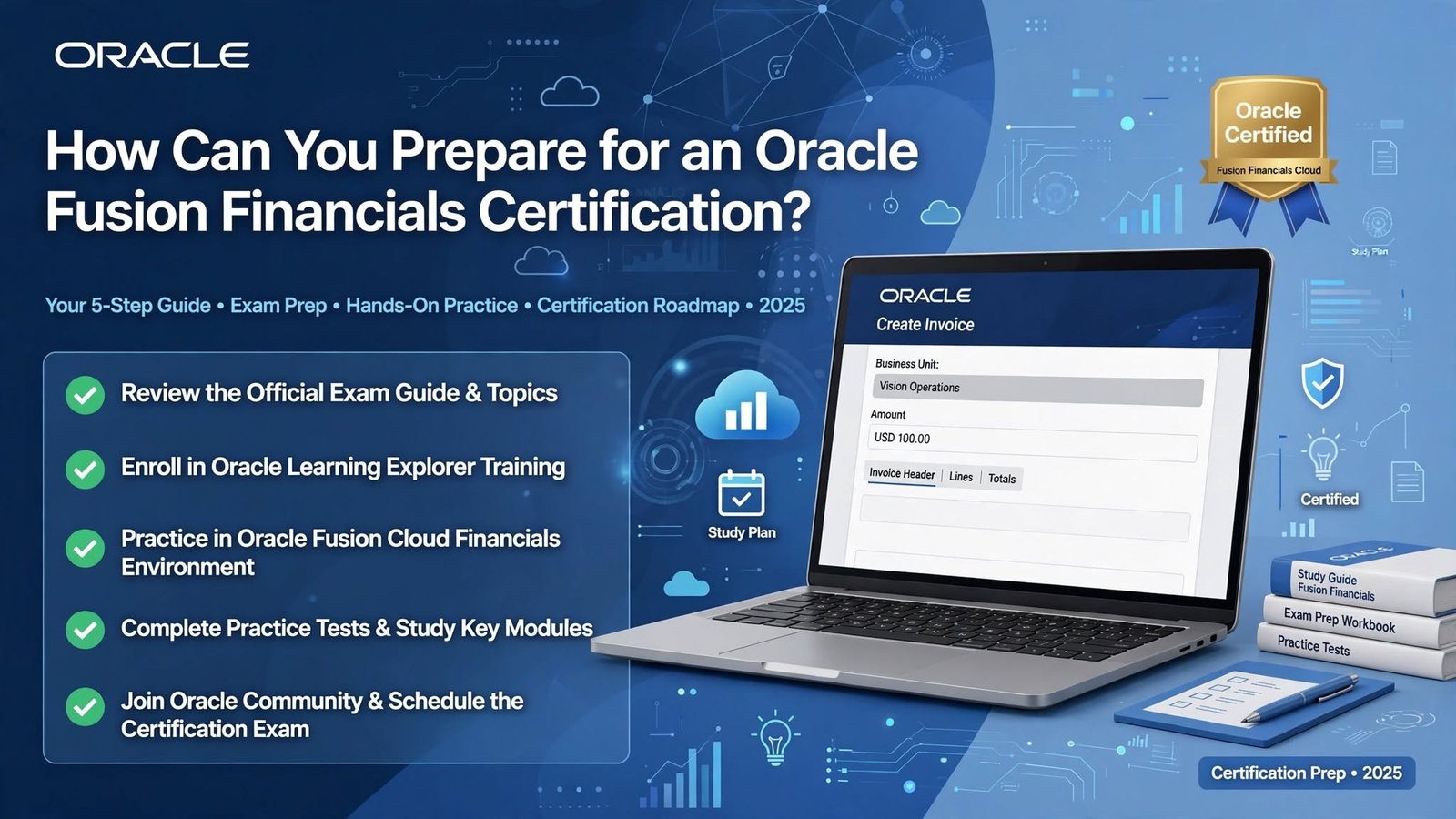
Introduction
Plenty of capable finance professionals take an Oracle certification exam and leave disappointed. The problem is rarely their accounting knowledge. At Tech Leads IT, we have seen candidates fall short because they studied the wrong way. They memorized screen names, skipped hands-on practice, and treated the exam like theory, when it tests how the application actually behaves.
Good Oracle Cloud Financials Online Training gives your preparation structure, with real scenarios and practice that match the exam topics. Oracle Cloud Financials Training Online also lets working professionals learn on their own schedule. This guide shows how to prepare so it sticks.
Start With What the Certification Actually Tests
Before you open a single study guide, find the official exam page for the certification you want and read the exam topics list carefully. Oracle publishes the subject areas along with the approximate weight of each one. That list is your real syllabus, and it is more useful than any third-party summary.
For Financials, the exam usually covers the General Ledger, Payables, Receivables, Assets, Cash Management, and the setup that sits underneath them, such as ledgers, calendars, currencies, chart of accounts structures, and Subledger Accounting. Some questions are about definitions, but many are scenario based. You will be given a business situation and asked which configuration, process, or report solves it.
That tells you something important about how to study. Knowing that a feature exists is not enough. You need to know when you would use it, what it depends on, and what happens if the setup is wrong. Print the topics list, and rate yourself honestly on each line as strong, shaky, or unfamiliar. The shaky and unfamiliar items become your study plan.
Why Oracle Cloud Financials Online Training Works Better Than Reading Alone
Many people start with documentation and a PDF or two. That works, but reading alone has a ceiling. Oracle’s documentation explains features one at a time, while exam questions and real jobs ask you to connect them. An invoice that won’t validate, for instance, may trace back to tax setup, a supplier site, or a ledger period status.
That is where structured Oracle Cloud Financials Online Training earns its place. A good instructor shows the connections, flags topics that keep appearing in exams, and answers the “why does it work this way?” questions. You also get a live practice environment.
When comparing courses, check for hands-on labs, a trainer with real project experience, and alignment with the certification topics. Ask for a sample session. Ten minutes of teaching tells you more than any brochure.
Build a Study Plan Around the Core Modules
Once you know your weak areas, turn them into a schedule. Most working professionals do well with eight to twelve weeks, studying about eight to ten hours a week. If you already work in Oracle Financials day to day, you may need less. If you are coming from another ERP, plan for more.
A simple structure that works:
Weeks 1 and 2: Foundations. Enterprise structures, ledgers, legal entities, business units, the chart of accounts, calendars, and currencies. Everything else rests on these, and a surprising number of exam questions touch them indirectly.
Weeks 3 to 5: Subledgers. Payables and Receivables first, because they carry the most exam weight and the most process detail. Learn the full flow in each, from invoice entry through validation, approval, accounting, and payment or receipt. Then cover Assets and Cash Management.
Weeks 6 and 7: Accounting and reporting. Subledger Accounting, period close, journals, and the main reports. This is also a good time to study how data moves from subledgers into the General Ledger.
Weeks 8 onward: Review and practice. Revisit your weak areas, take timed practice sets, and fix gaps.
Do not spread yourself evenly across every topic. Give the most time to the areas with the highest exam weight and the lowest personal confidence. Strong areas need a refresher, not a deep dive.
Get Hands-On Practice Before You Book the Exam
If there is one habit that separates people who pass comfortably from people who scrape through, it is hands-on time in the application. Clicking through a setup screen once teaches you more than reading about it three times.
Try to run complete cycles rather than isolated tasks. Create a supplier, enter an invoice, validate it, create accounting, pay it, and then trace the entries through to the ledger. Do the same on the receivables side with a customer, a transaction, and a receipt. When something fails, resist the urge to restart. Figure out why it failed. Those small troubleshooting moments are exactly what scenario questions are built from.
You can get practice access through a training provider, through your employer’s test instance, or through Oracle’s own learning resources. Whichever route you take, keep a short notebook of the errors you hit and what fixed them. Reading that notebook the week before the exam is surprisingly effective.
How Oracle Cloud Financials Training Online Fits Around a Full-Time Job
Most people preparing for certification are already working, and that shapes everything. Evenings are tired, weekends are crowded, and a rigid classroom schedule is not realistic for many of them. That is the practical argument for Oracle Cloud Financials Training Online: you can attend live sessions from home, watch recordings when you miss one, and revisit a tricky topic as often as you need.
To get the most out of it, treat the sessions like appointments. Block the time, close other tabs, and take notes by hand or in a simple document. After each session, spend twenty minutes repeating what the trainer demonstrated in your own practice environment, while it is still fresh. That small repeat is what turns watching into knowing.
It also helps to study with at least one other person. A colleague, a batchmate, or someone from an online study group can quiz you and notice the gaps you cannot see yourself. Explaining a process out loud to another person is one of the fastest ways to find out whether you really understand it.
Use Practice Questions the Right Way
Practice questions help, but many candidates use them badly. They check the score, feel good or bad, and move on. The score is the least valuable part.
Review every question you got wrong, plus the ones you guessed right. Write down why the correct answer works and why the others don’t. If you can’t explain it, that topic needs another look. Over a few weeks, patterns will show up, like mixing up two similar features or missing a prerequisite.
Avoid “dump” sites promising real exam questions. Besides the ethical problem, they are often outdated or wrong, and memorizing wrong answers is worse than not studying. Stick to official samples and reputable material.
Finally, take at least two full timed tests, so you learn your pace and practice flagging hard questions for later.
Mistakes to Avoid in the Final Two Weeks
The last stretch before the exam is where preparation often goes sideways. A few things are worth watching for.
Cramming new topics. In the final two weeks, you are consolidating, not learning from scratch. If you find a big gap late, cover the essentials of it, but do not abandon your review of everything else.
Ignoring release changes. Oracle updates Fusion Cloud applications regularly, and exams are tied to specific releases. Skim the latest release notes for Financials so you are not surprised by a renamed feature or a changed process.
Neglecting rest. Exam performance depends on being clear-headed. Sleep properly the night before, and eat something sensible. It sounds basic, but tired candidates make careless reading errors on scenario questions.
Skipping the logistics. Confirm your exam booking, ID requirements, and technical setup well ahead of time, especially if you are taking the exam online. Last-minute surprises drain focus you need for the questions.
Final Thoughts
Passing an Oracle Fusion Financials certification comes down to method, not talent. Begin with the official exam topics, admit where you are weak, and build a schedule that fits your life. Oracle Cloud Financials Online Training can give that plan structure, pairing guided lessons with plenty of hands-on practice. Learn from your mistakes, and keep the last few weeks calm and focused.
Done well, the certification is more than a badge. It shows employers and clients that you can genuinely work in the application. If your days are already full, Oracle Cloud Financials Training Online makes it easier to study at your own pace. Start this week: download the exam topics list, mark your weak areas, and book your first study session.