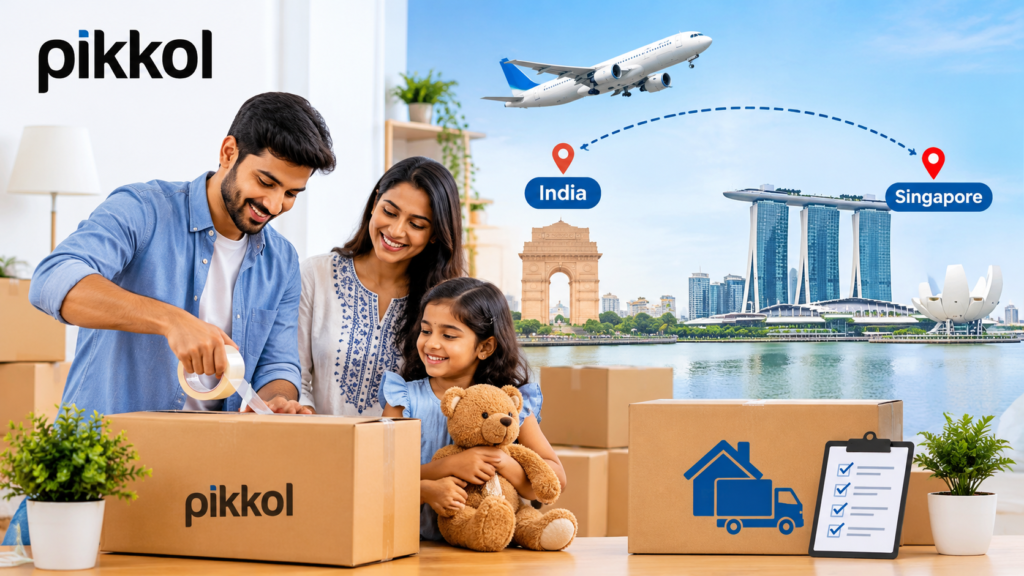
To ship household goods from India to Singapore, you book a mover, get a video survey and written quote, have your goods packed with an inventory, and let the mover handle export clearance, sea or air freight, Singapore customs and delivery to your door.
Here is what to expect:
- Time: about 20–30 days door to door for a full container, 30–45 days for a shared (LCL) shipment, and 4–8 days by air. The sea voyage itself is only about 7–12 days.
- Cost: indicative door-to-door prices start from about ₹1.4 lakh for a 1BHK and reach about ₹4.5 lakh for a 4BHK or villa. Details are below.
- Customs: used household goods generally get GST relief. New items can attract 9% GST.
- The real bottleneck is often your condo. Lift and loading-bay bookings usually set the delivery date.
Want a quote for your move? Get a free quote from Pikkol or message us on WhatsApp.
How does shipping to Singapore work, step by step?
1. Free video survey and written quote. Your coordinator walks through your home on video, estimates the volume in CBM and gives you a line-by-line quote. Pikkol fixes quotes and packing dates 1–2 weeks before packing.
2. Banned-item check and packing. Before packing, Pikkol checks your list for items Singapore bans. The crew then packs your goods, and Pikkol prepares the inventory and customs forms from your packing list.
3. Export clearance and loading. Packing, Indian export customs and loading take about 2–5 days. Goods typically leave from Chennai, Nhava Sheva (JNPT), Cochin or Mundra.
4. Ocean voyage. About 7–12 days port to port. Your coordinator shares the vessel and ETA once your cargo is booked.
5. Singapore customs clearance. Every import needs a Singapore Customs permit, filed electronically by a declaring agent. Pikkol’s Singapore partner handles this. Clearance takes about 2–5 days.
6. Delivery and unpacking. Delivery takes 1–5 days, including your condo’s lift and loading-bay bookings.
One move coordinator stays with you from survey to delivery, so you aren’t chasing several people across two countries.
Which shipping method should you choose?
LCL (shared container) suits up to about 13 CBM, which covers most studios and 1BHKs, and it fits Singapore’s compact apartments well. Frequent consolidation services from Chennai and Nhava Sheva keep waits short.
A 20ft container makes sense from about 14 CBM. Measure first, because a full 3BHK load often doesn’t fit in a Singapore condo.
Air freight works for essentials (about 250 kg), and for anything you need within days of landing.
Many families combine the two: essentials by air so they can settle in, and the rest by sea.
How much does it cost?
These are Pikkol’s indicative door-to-door figures from India to Singapore. They exclude duties and taxes, destination exam or inspection fees, storage and insurance, and your survey confirms the real price.
- 1BHK or studio (about 10.3 CBM, LCL): ₹1.4–2.4 lakh
- 2BHK (about 18.3 CBM, 20ft container): ₹2–3.2 lakh
- 3BHK (about 27.7 CBM, 20ft container): ₹2–3.2 lakh
- 4BHK or villa (about 40.3 CBM, 40ft container): ₹3–4.5 lakh
- Air, essentials only (about 250 kg): ₹75,000–₹1.12 lakh
The price depends mainly on volume. Every item you leave behind lowers your bill, so decide what to ship before you ask for a quote. Our guide to comparing international moving quotes shows how to read a quote line by line.
What are Singapore’s customs and GST rules?
- Used personal and household effects generally get GST relief.
- New, unused items can attract 9% GST, so mark new items on your inventory and avoid shipping things you could buy there.
- Alcohol and tobacco are always taxed, with no relief. Cigarettes must carry Singapore duty-paid markings, so don’t ship them.
- Some medicines need approval from the Health Sciences Authority (HSA). Carry personal prescriptions in your hand baggage.
Rules change, and the officer’s decision at clearance is final. Read the customs, visa and documentation guide for the paperwork at each end.
What can’t you ship to Singapore?
Singapore is strict. Do not pack any of these:
- Chewing gum (except approved dental and medicinal gum)
- E-cigarettes, vapes and refills, which are banned outright
- Firecrackers and fireworks
- Controlled drugs, and some medicines without HSA approval
- Replica or toy guns that look real, weapons and pepper spray
- Hazardous goods such as aerosols, fuel, gas cylinders and paint
Pikkol’s crew runs a banned-item check before packing, but it helps to know the list yourself.
Which documents do you need?
- Your passport copy
- Your Employment Pass, Dependant Pass or In-Principle Approval (IPA)
- A detailed inventory with values, with new items marked (Pikkol prepares it at packing)
- The original Bill of Lading or Air Waybill
- A Singapore Customs import permit, filed by the declaring agent
- HSA approval for any medicines that need it
- A condo or building move-in booking, which you arrange with management
Will your appliances work, and how much should you ship?
Singapore uses 230V/50Hz with Type G plugs. Most Indian appliances work with an adapter. The real limit is space. Many Singapore homes are compact, and large fridges, washing machines and big furniture may not fit. Measure your new home before you decide what to ship, and buy bulky items locally if they won’t fit.
Good candidates to ship: clothes, bedding, kitchenware, books, sentimental items, children’s items and furniture you love that fits. See the high-value move guide for art and valuables.
What about your condo or HDB flat?
Delivery dates are often set by your building, not the ship. Condos require lift and loading-bay bookings through management, and HDB flats have their own rules. Tell your coordinator your building’s name early, and ask your management office about booking slots and any deposits.
Can you bring your car?
Rarely worth it. Used cars generally must be under three years old, and registration involves a Certificate of Entitlement (COE) and substantial taxes. Most people use public transport or buy locally. See vehicle shifting and vehicle shifting to Singapore, and check the rules before you decide.
Can you bring your pet?
Yes, but plan well ahead. Dogs and cats need an import licence from the Animal & Veterinary Service (AVS), a microchip, a rabies vaccination and a titre test, and animals from India typically face a quarantine period. Pikkol advises starting 3–6 months ahead. See pet relocation, pet relocation to Singapore, and Pikkol’s guide to international pet relocation. Pet rules change, so confirm them with the official authority.
What if your Singapore home isn’t ready?
If your goods arrive before you can move in, you can hold them in storage in India before you ship, or ask about storage in Singapore. Ask for access, delivery and insurance terms in writing.
What should you do, and when?
- 2–3 months before you fly: get quotes, book a video survey, decide what to ship, sell or leave. Start pet paperwork if you have a pet.
- 6–8 weeks before: check your medicines against HSA rules, and ask your condo about lift and loading-bay slots.
- 2–4 weeks before: declutter, sell furniture that won’t fit, and confirm your packing date with your coordinator.
- Packing week: supervise packing, check the inventory, and keep documents, valuables and medicines with you.
- After sailing: track your shipment and keep your Bill of Lading.
- On arrival: check your goods against the inventory and report any damage promptly.
Why do families choose Pikkol for Singapore?
- Free video survey and a written, itemised quote before you pay
- One move coordinator from survey to delivery
- A banned-item check before packing, which matters in Singapore
- A Singapore partner that files the customs permit
- Condo coordination, with lift and loading-bay bookings built into delivery
- Options beyond the shipment: storage, pet relocation, vehicle shifting and settling-in services
- Experience: more than 1,00,000 moves since 2015
Learn more about Pikkol, browse the FAQs, or read the settling-in guide and risk guide.
Ready to ship your home to Singapore? Book a free survey and quote or chat on WhatsApp. Tell us your city, home size, building type and date, and we’ll come back with a written plan.
Frequently asked questions
How do I ship household goods from India to Singapore?
Book a video survey, get a written quote, pack with an inventory, and have your mover handle export clearance, freight, Singapore customs and delivery.
How long does shipping to Singapore take?
About 20–30 days door to door for a full container, 30–45 days for LCL, and 4–8 days by air. The sea voyage is about 7–12 days.
How much does it cost to ship from India to Singapore?
Pikkol’s indicative door-to-door range runs from about ₹1.4–2.4 lakh for a 1BHK by LCL to ₹3–4.5 lakh for a 4BHK or villa in a 40ft container. Duties, destination fees, storage and insurance are extra.
Do I pay GST on household goods?
Used personal and household effects generally get GST relief. New items can attract 9% GST, and alcohol and tobacco are always taxed.
What can’t I bring to Singapore?
Chewing gum, e-cigarettes and vapes, fireworks, controlled drugs, realistic replica guns, weapons and hazardous goods, among others.
Do I need a customs permit?
Yes. Every import needs a Singapore Customs permit, which your declaring agent files.
Will my appliances work in Singapore?
Singapore uses 230V/50Hz with Type G plugs, so most work with an adapter. Check each item’s rating, and measure your new home first.
Can I ship just a few boxes?
Yes. Use LCL, air freight or the international parcel service.
Can I bring my car or pet?
Cars are rarely worth bringing. Pets need an AVS licence, a microchip, rabies vaccination and a titre test, and a quarantine period is typical.
How early should I book?
Pikkol fixes quotes and packing dates 1–2 weeks before packing. For a full move, start the survey 2–3 months before you fly, and pet moves need 3–6 months.