Introduction
Starting a career in Oracle Fusion can feel like standing in front of a huge map with no “you are here” marker. Many freshers join a course at Soft Online Training and then ask the same question: where do I actually begin? The answer matters, because the order in which you learn things decides how fast the rest falls into place. If you are searching for Oracle Fusion Technical Training in Hyderabad, this guide lays out a sensible path, one step at a time.
Start With the Big Picture Before Any Tools
Before you open a single tool, spend a few days understanding what Oracle Fusion Cloud Applications are. Fusion is a suite of cloud-based business applications covering finance, HR, supply chain, and procurement. Companies use it to run daily operations, and technical consultants are the people who make it fit their needs.
Learn the basic modules and what each one does. You do not need to be a finance or HR expert, but you should know that Payables handles supplier invoices, Receivables handles customer billing, and HCM covers employees and payroll. This context helps you later, when someone asks you to build a report or load data and you need to understand what that data actually means.
Good Oracle Fusion Technical Training in Hyderabad programs usually begin here too, because a technical consultant who does not understand the business side ends up writing things that technically work but are useless.
Learn SQL First: It Is the Foundation of Everything
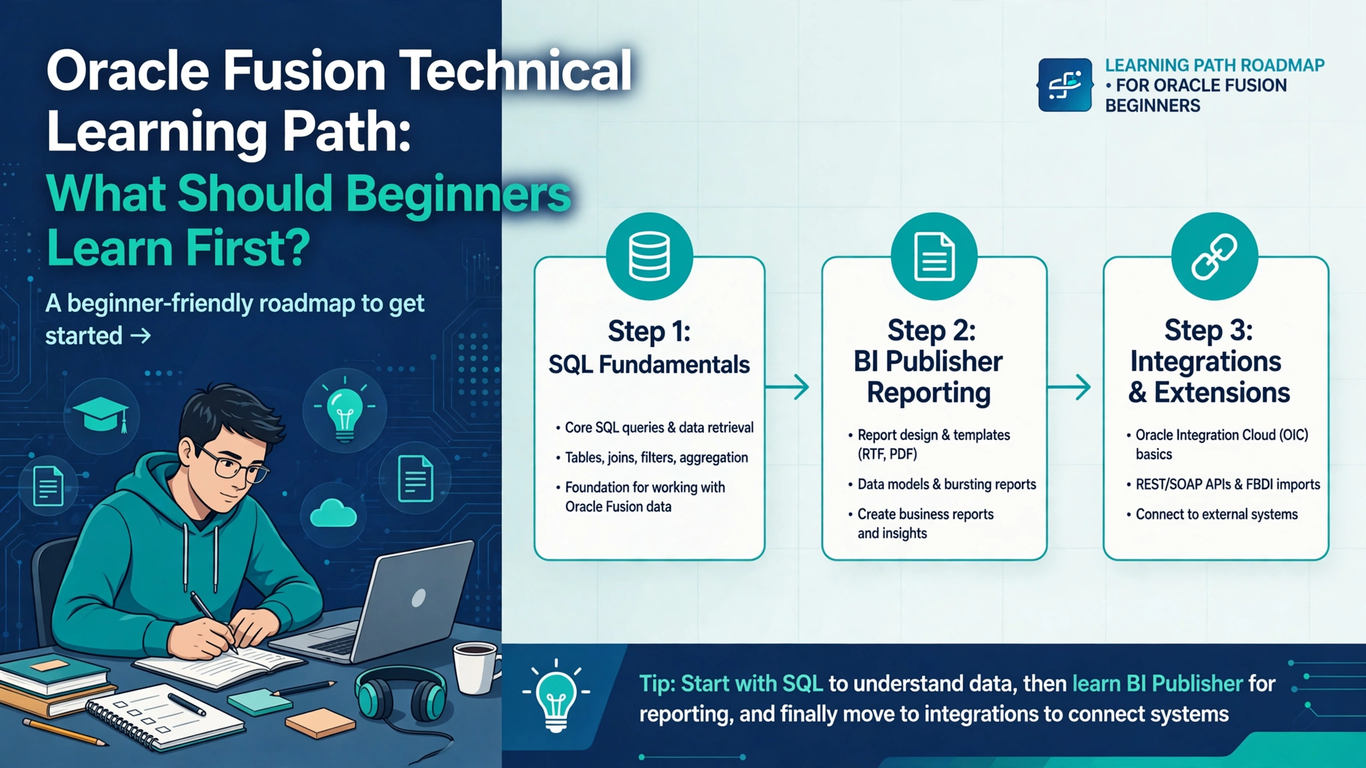
If there is one skill to pick up before anything else, it is SQL. Almost every technical task in Fusion touches data. Reports, extracts, data validation, and troubleshooting all depend on your ability to read and query tables.
Focus on the basics first:
- SELECT statements with WHERE conditions
- Joins between two or more tables
- GROUP BY and aggregate functions like SUM and COUNT
- Subqueries and simple analytic functions
Do not rush into complicated tuning. Write plenty of small queries and get comfortable with how tables relate to each other. Many beginners skip this because it looks boring compared with flashy tools, and they pay for it later. A solid SQL base makes every other topic easier, which is why it sits at the start of any serious Oracle Fusion Technical Training in Hyderabad syllabus.
Pick Up PL/SQL After You Are Comfortable With SQL
Once queries feel natural, move on to PL/SQL. This is Oracle’s procedural extension to SQL, and it lets you write logic: loops, conditions, procedures, functions, and packages.
You will not write huge programs on day one. Start with anonymous blocks, then learn cursors, exceptions, and stored procedures. Understand how to handle errors gracefully, because real projects rarely deliver clean data.
PL/SQL matters in Fusion for validation logic, custom processing, and working with the database layer where it is accessible. Even when a project leans on cloud-native tools, the logical thinking you build here carries over directly.
Understand Reporting Tools: OTBI, BI Publisher, and BICC
Reporting is where most freshers land their first real project tasks, so it deserves early attention. Three tools come up again and again:
- OTBI (Oracle Transactional Business Intelligence): for quick, interactive, self-service analysis.
- BI Publisher: for pixel-perfect, formatted documents such as invoices, statements, and letters.
- BICC (BI Cloud Connector): for extracting large volumes of data out of Fusion for use elsewhere.
Learn what each is meant for before you learn how to build in it. Choosing the wrong tool is a common beginner mistake. A good Oracle Fusion Technical Training in Hyderabad course will let you build a few reports in each so the differences stay in your head.
Learn Data Loading: FBDI and HCM Data Loader
Once you can query and report on data, you need to know how data gets in. Two methods matter most for beginners.
FBDI (File Based Data Import) uses spreadsheet templates to upload bulk data into areas like finance and procurement. HCM Data Loader, often called HDL, does a similar job for HR data using structured files.
Concentrate on understanding the flow: prepare the file, upload it, run the import process, check errors, and correct them. That loop is the heart of data migration work, and it is something nearly every Fusion project needs. Practice reading error logs carefully. Much of a technical consultant’s daily life is figuring out why a file failed.
Get Familiar With Integrations and Web Services
After the basics, explore how Fusion talks to other systems. Start with REST and SOAP web services. Know the difference, understand what a request and response look like, and try calling a simple REST endpoint with a tool like Postman.
Then get an introduction to Oracle Integration Cloud, usually called OIC. It connects Fusion with other applications through prebuilt adapters and visual flows. You do not need to master it immediately. Just understand where it fits and build one or two simple integrations.
This is the area where many learners feel nervous, but if your SQL and data loading foundations are strong, integrations will make far more sense than they would have at the start.
Explore Fast Formula, Extracts, and Security Basics
Once the core is in place, add the supporting topics. Fast Formula is used mainly in HCM for payroll calculations, validations, and eligibility rules. HCM Extracts help produce outbound data files. Security basics, meaning roles, privileges, and data access, help you understand why a user can or cannot see something.
These topics become much easier when you already know the data model and have worked on a few real tasks. That is why a thoughtful Oracle Fusion Technical Training in Hyderabad path leaves them for the middle or later stage rather than the first week.
Conclusion
The best learning path is not the fastest one. It is the one that builds each skill on top of the last. Start with the business context, get strong at SQL, add PL/SQL, then move through reporting, data loading, integrations, and the specialized topics. Practice regularly, build small projects, and read error messages instead of fearing them.
If you want guided support with hands-on practice and a clear roadmap, Soft Online Training can help you work through this sequence step by step. Choosing the right Oracle Fusion Technical Training in Hyderabad is really about finding a path that teaches you the fundamentals properly before the advanced material. Take it one stage at a time, and you will be project-ready sooner than you expect.