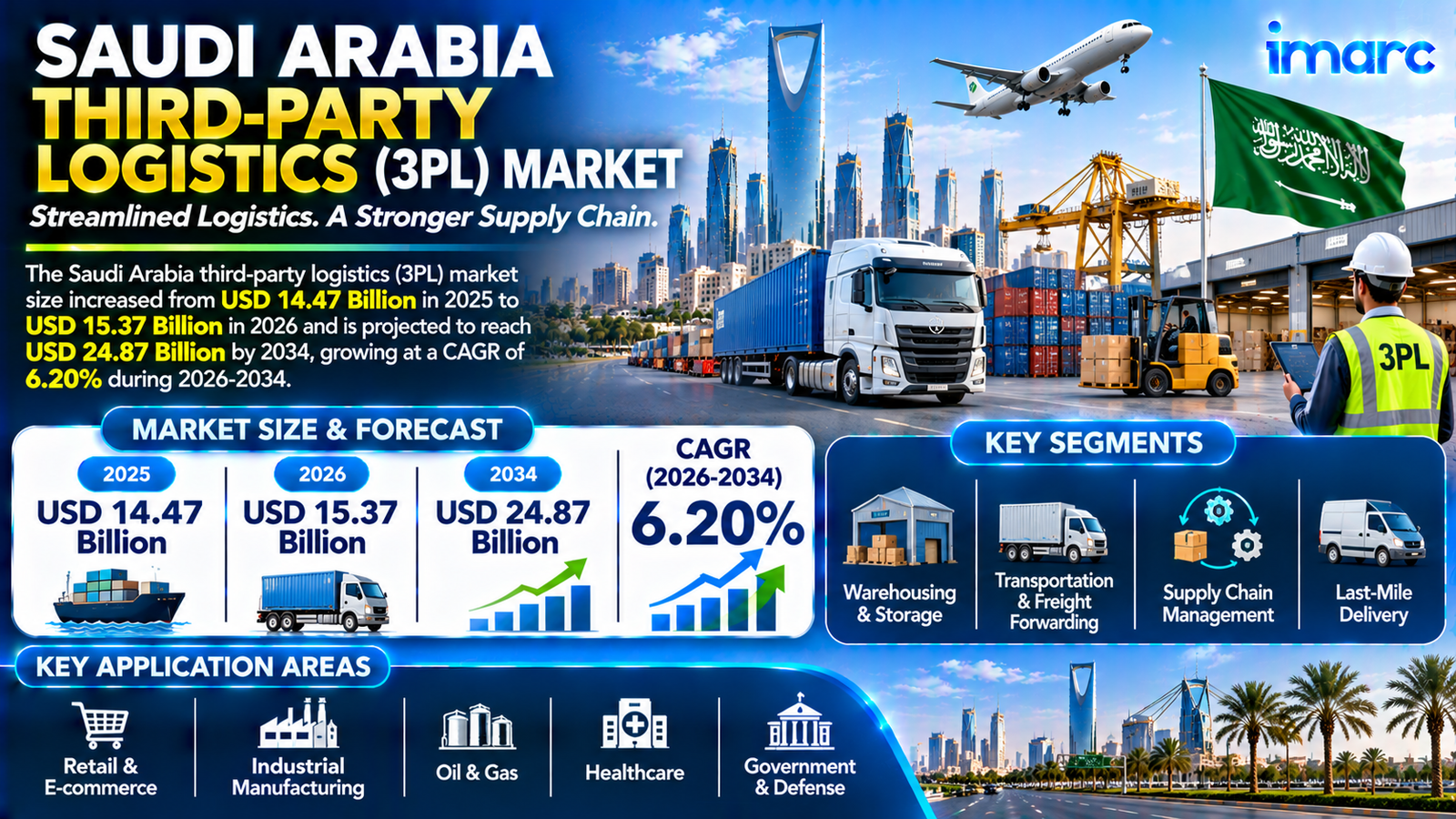
IMARC Group, a leading global market research and management consulting firm, has published its latest market intelligence report on the Saudi Arabia third-party logistics (3PL) market. The Saudi Arabia third-party logistics (3PL) market size increased from USD 14.47 Billion in 2025 to USD 15.37 Billion in 2026 and is projected to reach USD 24.87 Billion by 2034, exhibiting a CAGR of 6.20% during 2026-2034, driven by Vision 2030 infrastructure investment, rising e-commerce penetration, and expanding outsourcing of transportation and warehousing functions across the Kingdom’s manufacturing, retail, and energy sectors.
The market is gaining structural momentum as Saudi manufacturers, retailers, and trading companies increasingly hand off transportation, warehousing, and distribution functions to specialized providers rather than managing supply chains in-house. Domestic Transportation Management anchors the service mix at 44.8% share, reflecting the scale of intra-Kingdom freight movement between industrial cities, ports, and consumption centres, while International Transportation Management is expanding on the back of growing non-oil export activity under Vision 2030. Value-added Warehousing and Distribution, though the smallest service category today, is the fastest-growing at an estimated 7.4% CAGR as e-commerce and cold-chain requirements expand fulfilment infrastructure needs across the Kingdom.
Saudi Arabia Third-Party Logistics (3PL) Market at a Glance:
- Market Size (2025): USD 14.47 Billion
- Market Size (2026): USD 15.37 Billion
- Forecast Market Size (2034): USD 24.87 Billion
- CAGR (2026-2034): 6.20%
- Leading Service (2025): Domestic Transportation Management, 44.8% share
- Leading End User (2025): Distributive Trade, 28.7% share
- Dominant Region (2025): Northern and Central Region, 41.8% share
How AI is Reshaping the Future of the Saudi Arabia Third-Party Logistics (3PL) Market
- AI-Powered Route Optimization and Predictive Fleet Analytics: Saudi 3PL providers are deploying AI-driven Transportation Management Systems that process real-time traffic, weather, and delivery-window data, reducing fuel consumption and improving on-time performance across domestic and cross-border freight corridors linking Riyadh, Jeddah, and Dammam.
- Automated Warehousing and Robotic Fulfilment at Scale: Global operators are rolling out conveyor automation, dimensioning scanners, and cloud-based inventory visibility at new multi-user warehouses, including DHL Supply Chain’s upcoming 53,000 square meter hub at Riyadh’s Special Integrated Logistics Zone, setting a benchmark other 3PL operators are racing to replicate.
- IoT-Enabled Shipment Visibility and Predictive Maintenance: IoT sensors and cloud-based tracking integrated into Transportation and Warehouse Management Systems are giving 3PL clients real-time shipment visibility, a capability increasingly valued by compliance-sensitive chemical, pharmaceutical, and healthcare shippers outsourcing logistics operations.
Grab a sample PDF of this report: https://www.imarcgroup.com/saudi-arabia-third-party-logistics-market/requestsample
Saudi Arabia Third-Party Logistics (3PL) Market Trends and Drivers:
Enterprise outsourcing continues to define the market’s structure, with Domestic Transportation Management commanding 44.8% of the service mix in 2025 as manufacturers, retailers, and distributive trade players hand off intra-Kingdom freight movement to specialized providers. International Transportation Management follows at 31.6%, supported by rising non-oil export activity and cross-border trade ambitions under Vision 2030, while Value-added Warehousing and Distribution, at 23.6% share, is compounding fastest at approximately 7.4% CAGR as e-commerce and cold-chain requirements expand fulfilment infrastructure needs across the Kingdom’s distribution network.
Government-backed infrastructure investment is the clearest structural driver behind the market’s expansion. The National Transport and Logistics Strategy is attracting foreign direct investment and accelerating integrated logistics park development, while continued investment in modern highways, rail networks, and world-class ports, including Jeddah Islamic Port, King Abdulaziz Port at Dammam, and NEOM’s port infrastructure, is reducing transit times and strengthening connectivity between industrial hubs, airports, and seaports for 3PL providers handling both domestic and international freight.
Rising e-commerce penetration is compounding this shift directly, with Saudi e-commerce revenue projected to grow at approximately 13.5% annually through 2027, pushing retailers and distributive trade players, already the leading end-user category at 28.7% share, to rely on specialized 3PL providers for scalable warehousing, order fulfilment, and last-mile delivery. Growing adoption of IoT-enabled devices, cloud-based Transportation and Warehouse Management Systems, and artificial intelligence is simultaneously improving shipment visibility, lowering operational costs, and enabling the technology-enabled fulfilment centers that compliance-sensitive sectors such as pharmaceuticals and chemicals increasingly require.
Government Schemes and Vision 2030 Initiatives Driving Demand:
- National Transport and Logistics Strategy (NTLS): Launched under the Ministry of Transport and Logistics Services, the NTLS targets a top ten global ranking on the Logistics Performance Index by 2030, directly expanding the addressable market for 3PL providers handling outsourced freight, customs clearance, and warehousing.
- Special Integrated Logistics Zone (SILZ): Located next to Riyadh’s King Khalid International Airport, SILZ offers extended tax holidays and rapid customs clearance, and has already attracted DHL Supply Chain’s new multi-user regional hub, positioning the zone as proof that global 3PL operators are anchoring distribution operations inside the Kingdom.
- Logistics GDP Contribution Target: Vision 2030 targets raising the transport and logistics sector’s contribution to Saudi GDP from 6% to 10% by 2030, formally positioning outsourced logistics as one of the Kingdom’s core non-oil growth pillars alongside e-commerce and manufacturing.
- Port and Rail Infrastructure Investment: Continued expansion of Jeddah Islamic Port, King Abdulaziz Port at Dammam, King Abdullah Port, and emerging NEOM port infrastructure is widening the capacity 3PL providers can offer for international transportation management and cross-border freight consolidation.
- Saudi Green Initiative and 2060 Net-Zero Target: 3PL operators aligning with the Kingdom’s 2060 net-zero commitment are integrating electric delivery vehicles and solar-powered warehouses, with Saudi Green Initiative funding creating a direct commercial channel for low-emission logistics service providers.
Saudi Arabia Third-Party Logistics (3PL) Industry Segmentation:
The report has segmented the market into the following categories:
Breakup By Service:
- Domestic Transportation Management
- International Transportation Management
- Value-added Warehousing and Distribution
Domestic Transportation Management commands the largest service share at 44.8% in 2025, driven by the scale of intra-Kingdom freight movement connecting industrial cities, ports, and retail distribution centres, while Value-added Warehousing and Distribution is the fastest-growing category at approximately 7.4% CAGR through 2034 as e-commerce and cold-chain requirements expand fulfilment infrastructure needs.
Breakup By End User:
- Automotive and Manufacturing
- Oil and Gas
- Chemical
- Distributive Trade (Wholesale and Retail Trade, including E-commerce)
- Pharmaceutical and Healthcare
- Construction
- Others
Distributive Trade leads end-user demand at 28.7% share in 2025 as wholesale, retail, and e-commerce players increasingly outsource storage and fulfilment to specialized 3PL providers to meet rising consumer delivery expectations. Oil and Gas follows at 21.4%, reflecting the sector’s continued reliance on specialized bulk and project logistics, while Automotive and Manufacturing accounts for 17.9% through component and finished-vehicle distribution, and Chemical, Construction, Pharmaceutical and Healthcare, and Others collectively represent the remaining demand base.
Breakup By Region:
- Northern and Central Region
- Eastern Region
- Western Region
- Southern Region
The Northern and Central Region dominates the Saudi Arabia 3PL market with a 41.8% share in 2025, anchored by Riyadh’s concentration of population, distribution infrastructure, and government-linked logistics demand. The Eastern Region follows at 25.6%, reflecting industrial and energy-sector logistics activity alongside strong port and cross-border trade movement, while the Western Region’s 21.3% share benefits from established port infrastructure and trade-linked logistics demand, and the Southern Region’s 11.3% share remains an emerging market supported by agricultural trade and expanding regional connectivity.
Competitive Landscape:
The report provides a comprehensive analysis of the competitive landscape in the Saudi Arabia third-party logistics (3PL) market with detailed profiles of all major companies, including:
- Almajdouie
- Deutsche Post AG (DHL Supply Chain)
- Aramex
- SAL
- Agility Logistics
- DB Schenker
Market Concentration Analysis:
- Moderate Concentration: The Saudi Arabia 3PL market is moderately concentrated, with the top players collectively accounting for a meaningful share of domestic transportation and warehousing revenue, while a long tail of smaller operators competes on regional freight and last-mile delivery.
- Expansion Through Joint Ventures and Multi-User Facilities: International players such as Deutsche Post AG and Aramex are scaling primarily through regional headquarters, joint ventures, and multi-user warehousing investment rather than standalone domestic fleet build-out, exemplified by DHL Supply Chain’s new multi-user hub at Riyadh’s Special Integrated Logistics Zone.
- Rising New-Entrant Pressure: Domestic Saudi logistics groups such as Almajdouie continue to hold a strong share of intra-Kingdom freight movement, but concentration is expected to moderate gradually as e-commerce-focused and digitally native 3PL providers scale operations through the forecast period.
What Does The Full Report Cover?
If you are tracking the Saudi Arabia third-party logistics (3PL) market for investment decisions, market entry planning, competitive benchmarking, or strategic advisory, IMARC Group’s report gives you everything in one place:
- Complete market sizing in value terms with forecasts covering the full 2026-2034 projection period
- Quantified growth driver analysis with impact scoring across service, end user, and regional markets
- Sub-segment breakdowns for all three service categories, seven end-use industries, and all four regions of the Kingdom, each with individual share data
- Regional data across the Northern and Central, Western, Eastern, and Southern regions of Saudi Arabia
- Competitive profiles of leading global and national logistics operators with strategic landscape assessment
- Value chain analysis, market concentration assessment, and investment and growth opportunity mapping
- Latest technology trends covering AI-driven route optimization, warehouse automation, IoT-enabled cargo visibility, and Vision 2030-driven infrastructure opportunities shaping market competition across the Kingdom
Recent News and Developments in Saudi Arabia Third-Party Logistics (3PL) Market
- November 2025: DHL Supply Chain signed a 26-year lease agreement to build a new regional logistics and distribution hub at Riyadh’s Special Integrated Logistics Zone, a 53,000 square meter multi-user warehouse connected to King Khalid International Airport via an 8-kilometer bonded corridor, with construction beginning in the first quarter of 2026.
- June 2026: Aramex inaugurated a new regional headquarters office in Riyadh, reinforcing its long-term commitment to Saudi Arabia and the Kingdom’s Vision 2030 ambition of becoming a global logistics hub.
- July 2026: DP World launched operations at its first multi-client third-party logistics warehouse in Saudi Arabia, located in Riyadh and complementing its existing Dammam operations, expanding integrated warehousing and distribution capacity for manufacturing, retail, e-commerce, and technology sector clients.
Note: If you require specific details, data, or insights that are not currently included in the scope of this report, we are happy to accommodate your request. As part of our customization service, we will gather and provide the additional information you need, tailored to your specific requirements. Please let us know your exact needs, and we will ensure the report is updated accordingly to meet your expectations.
Key Questions This Report Answers
- What is the current Saudi Arabia third-party logistics (3PL) market size and what is its projected value through 2034?
- Which service segment holds the largest share of the Saudi Arabia 3PL market?
- What are the key drivers of third-party logistics market growth in Saudi Arabia?
- Which end user and region dominate 3PL demand in the Kingdom and why?
- How is Vision 2030 and the National Transport and Logistics Strategy reshaping outsourced logistics infrastructure and competitive strategy?
- Who are the top third-party logistics providers operating in Saudi Arabia and what are their competitive strategies?
- What are the investment and market entry opportunities across warehousing automation, cold-chain logistics, and digital freight platforms in Saudi Arabia?
About Us
IMARC Group is a global management consulting firm that helps the world’s most ambitious changemakers to create a lasting impact. The company provides a comprehensive suite of market entry and expansion services. IMARC offerings include thorough market assessment, feasibility studies, company incorporation assistance, factory setup support, regulatory approvals and licensing navigation, branding, marketing and sales strategies, competitive landscape and benchmarking analyses, pricing and cost research, and procurement research.
Media and Sales Contact
IMARC Group
Email: sales@imarcgroup.com
United States: +1-201-971-6302
India: +91-120-433-0800
United Kingdom: +44-753-714-6104