
Introduction
At 10:15 a.m., a regional operating account is heading for a shortfall before a same-day payroll file settles. At Tech Leads IT, we treat this as a governance question first, and it is a scenario worth working through in any Oracle Cloud Financials Online Training program. The treasurer wants an emergency transfer from the central concentration account, but the payments lead has to decide whether the clock justifies skipping usual checks.
It doesn’t. Anyone doing Oracle Cloud Financials Training Online will learn that speed matters only when the instruction is verified, the destination comes from trusted records, and an independent person reviews it. The safest path is a controlled exception that leaves a reviewable trail without exposing confidential details in transaction notes.
What Oracle Cloud Financials Online Training Should Teach About Emergencies
A good Oracle Cloud Financials Online Training session doesn’t stop at which button creates a transfer. It asks what has to be true before anyone presses it.
Start with facts, not chat messages. Treasury writes down the forecast deficit, the expected payroll debit, the amount needed to restore the approved buffer, and the latest safe release time. The preparer checks the destination against the maintained bank account record, never against account numbers pasted into an urgent email. The approver confirms the funding account can absorb the transfer without creating a new shortfall somewhere else.
One rule matters more than the rest: if the amount, value date, currency, or destination changes after review, the earlier approval is stale. Review it again. That keeps the emergency narrow, and it gives the team an honest reason for acting outside the normal schedule. Urgency explains the timing. It never turns an unverified instruction into an acceptable one.
Keep the Callback Separate From Transaction Entry
Before release, a second employee makes a callback. The phone number comes from the organization’s trusted directory, not from the transfer request. This person reaches the designated treasury authority, reads the destination back in masked form, and confirms the amount, currency, value date, and purpose. The outcome goes into the evidence record the company already uses.
Some things should stop the transfer cold: a failed call, an unfamiliar voice, pressure to skip normal channels, or a sudden request to use a different account. When any of those appear, pause and escalate.
The callback record can hold the verifier’s name, the time, the outcome, and an internal reference. It should never hold passcodes, security answers, full account numbers, or recorded secrets. Also remember that the callback is an operating control that lives outside the payment fields. Typing a note into a memo neither performs the callback nor enforces it.
Why Roles Stay Distinct, Even Near the Cutoff
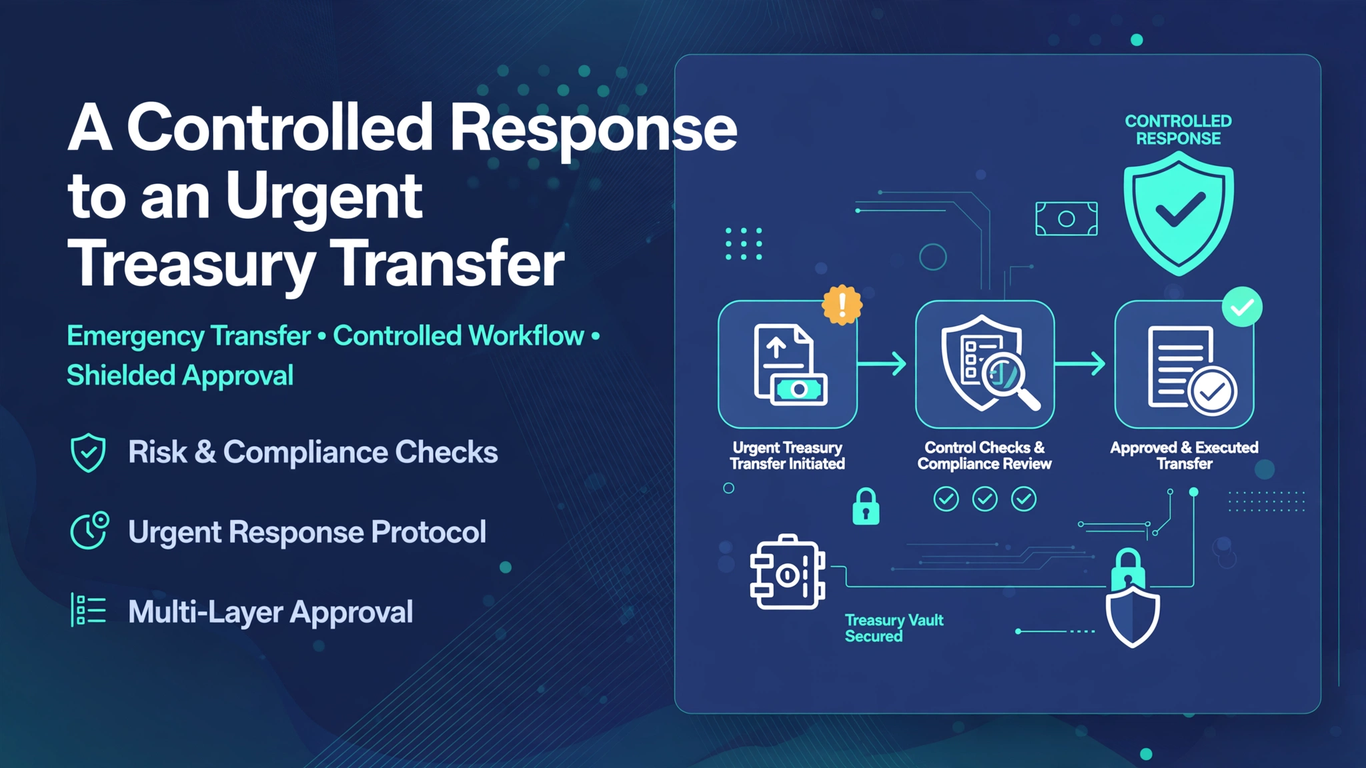
When the deadline is close, it’s tempting to let one person do everything. Resist that. The preparer creates the transfer. The callback verifier confirms the instruction independently. An authorized approver judges both the liquidity need and the control evidence before anything is released.
Small teams sometimes can’t staff all three roles. In that case a documented alternate can combine limited duties, but only under an approved contingency plan, and someone outside the event should review it promptly afterward.
The approver’s job is real comparison, not box-ticking. Check the beneficiary bank account, amount, currency, date, and payment purpose against the confirmed instruction. A field that merely contains a value proves nothing. Screenshots are weak evidence too, since they can hide edits and context. A linked case reference, the approval history, the call back record, and the transaction identifier together tell a much clearer story, and they remove the temptation to paste sensitive material into free-text fields.
Using Payment Attributes Carefully in Oracle Cloud Financials Training Online
Anyone taking Oracle Cloud Financials Training Online will eventually meet the guidance titled Additional Governance for Bank Account Transfers and Ad Hoc Payments. It explains that attributes such as service level, delivery channel, and payment reason can be captured for bank account transfers and ad hoc payments. Which ones are available depends on the payment format, and they are optional when settlements are used.
The same guidance describes initiating transfers in the source bank account currency as a controlled-release capability. It requires a service request. It also notes that the Memo field can carry extra transaction context.
In our payroll scenario, the team should pick only the attributes the chosen format supports. The memo can hold a short internal case reference and a plain, non-sensitive purpose statement. These fields make the transaction easier to read and review later. They do not prove the callback happened, and they are no replacement for approval.
Currency, Channel, and the Cost of Moving Fast
The central account and the regional account are denominated in different currencies, so currency deserves its own look. The team should settle a few questions before release. Does policy allow initiation in the source account currency? Has that controlled capability actually been enabled? Who carries the conversion timing and rate effects?
If the capability hasn’t been enabled, a payroll emergency is the wrong time to experiment in production. Use an approved route instead, or escalate to the designated contingency owner.
Service level and delivery channel deserve the same honesty. Choose them for the real cutoff, not because they happen to be the fastest option on the screen. A faster channel can change fees, settlement timing, rejection handling, and the chance of recalling a payment. The reviewer should confirm the route makes operational sense and that the receiving account can accept the resulting currency treatment.
The Final Stop Check Before Release
Right before release, the approver runs a short stop check, and each question needs a real answer:
- Has the payroll exposure been recalculated?
- Does the transfer amount still fit that exposure and the approved buffer?
- Was the callback completed through a trusted contact path, and does it match the instruction details now on screen?
- Are service level, delivery channel, payment reason, currency, and memo appropriate for the format and policy?
Reject unexplained blanks where policy requires information, but don’t invent values for fields that are optional or unavailable. Respect approval limits and any dual approval requirement as well.
And if the cutoff passes during review, reassess instead of releasing out of reflex. The channel, the value date, and the whole benefit of the transfer may have changed by then.
Monitor, Reconcile, and Learn Afterward
A “submitted” status isn’t the finish line. After release, treasury watches for acceptance, settlement, and the expected balance effect. The payments lead matches the transaction identifier to the bank response and looks out for rejections, repairs, duplicate submissions, or a currency amount that doesn’t look right.
Once the regional account is funded, confirm that payroll settles and that the remaining balance matches the revised forecast. If a duplicate attempt slips through, stop it through the approved bank process. Don’t patch it with an improvised off setting payment.
By the next business day, an independent reviewer reconciles both accounts and goes through the emergency case. The goal is to tell a justified exception apart from a process weakness, record any control failure, and assign corrective action. Nobody should rewrite the original evidence or blur who made each decision.
Conclusion
An urgent transfer works out best when speed and control pull in the same direction. A documented forecast proves the need, maintained bank data anchors the destination, and an independent callback confirms the instruction. Keeping preparation, approval, release, monitoring, and reconciliation with different people stops one mistake from turning into a loss. Anyone taking Oracle Cloud Financials Online Training should remember that memo fields and payment attributes add context, but they never prove the callback happened.
In Oracle Cloud Financials Training Online, this scenario teaches one habit above the rest: plan the exception before the crisis. Stop when key facts change, never assume source-currency initiation is enabled, and keep enough non-sensitive evidence for a reviewer to rebuild the decision.