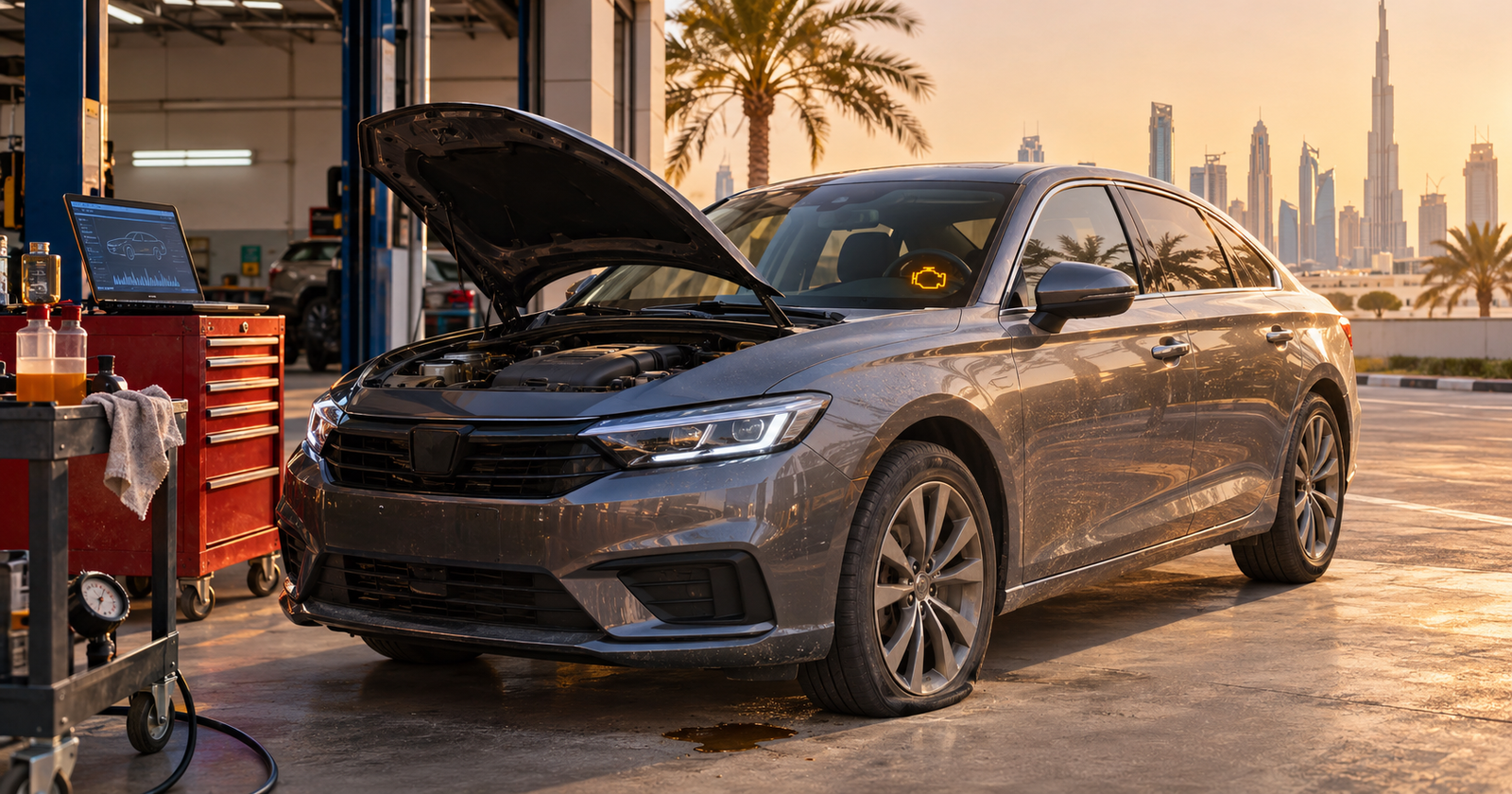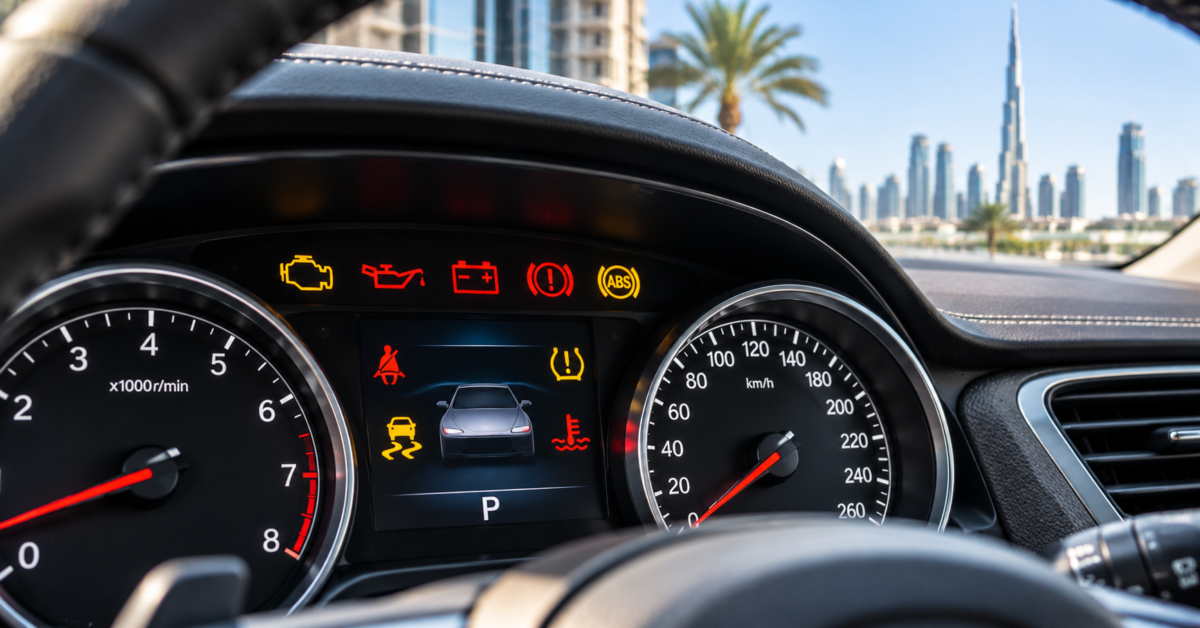
A dashboard warning light is designed to tell the driver that something needs attention. The difficult part is knowing whether the issue can wait until the next service or whether the vehicle should be stopped immediately.
Some lights relate to routine maintenance. Others can indicate problems with oil pressure, engine temperature, brakes, charging, tyres, or safety systems.
In Dubai, where vehicles regularly deal with high temperatures, heavy traffic, long motorway journeys, and extended air-conditioning use, ignoring the wrong warning can turn a manageable problem into an expensive repair.
Understanding the most important dashboard lights can help drivers respond more calmly and make better decisions.
Start With the Colour of the Warning
Dashboard symbols are usually designed to show different levels of urgency.
Red warnings generally deserve the most immediate attention. Amber or yellow warnings often indicate a fault that requires diagnosis but may not always require the vehicle to stop immediately.
Green or blue indicators usually show that a particular system is operating rather than warning of a fault.
However, colour alone should not be the only guide.
A warning light combined with unusual noise, smoke, overheating, loss of power, steering changes, or brake problems should be treated more seriously.
If several lights appear at the same time, the vehicle may also have an electrical or charging-system issue rather than several unrelated failures.
The Oil Pressure Warning Is One of the Most Serious
A red oil-can symbol should not be ignored.
It can indicate low oil pressure, which means the engine may not be receiving enough lubrication.
Continuing to drive with insufficient oil pressure can cause severe internal engine damage. If the oil-pressure warning appears while driving, stop somewhere safe and switch off the engine.
Check the oil level if you know how to do so safely and according to the manufacturer’s procedure. Low oil level may be part of the problem, but adding oil does not automatically resolve a pressure fault.
A damaged oil pump, blocked pickup, sensor problem, leak, or internal engine issue can also trigger the warning.
If the light remains on, the vehicle should not simply be driven to the workshop.
Engine Temperature Warnings Need Quick Action
An overheating warning usually appears as a temperature symbol or a red warning message.
Dubai drivers should take this seriously.
The cooling system works hard in high temperatures, especially when the vehicle is idling in traffic with the AC operating. Overheating can result from coolant loss, radiator problems, cooling-fan failure, thermostat faults, leaking hoses, or water-pump issues.
If the temperature rises unusually, switch off the AC and move the vehicle to a safe place as soon as possible.
Do not remove the coolant cap while the engine is hot. The system may be pressurised and hot enough to cause serious burns.
A vehicle that repeatedly overheats needs proper diagnosis rather than repeated coolant top-ups.
The Check Engine Light Can Mean Many Things
The check engine light is one of the most misunderstood warnings. It can appear for faults ranging from relatively minor sensor issues to problems affecting fuel delivery, emissions, ignition, air intake, or engine performance.
A steady amber light does not always mean the vehicle must stop immediately. However, the way the car behaves matters.
If the check engine light appears together with rough running, severe loss of power, smoke, unusual knocking, overheating, or strong fuel smells, continuing to drive may not be appropriate.
A flashing check engine light is often more urgent and may indicate a fault that can damage components if the vehicle continues operating.
Diagnostic scanning can provide fault codes, but the codes still need to be interpreted alongside actual symptoms and live vehicle data.
Battery and Charging Warnings Should Not Be Dismissed
A battery-shaped warning light usually relates to the charging system rather than simply telling you the battery is old.
Possible causes include alternator failure, belt problems, wiring faults, poor connections, or battery-related issues.
Once that power is exhausted, the engine can stop. Other electrical systems may also begin behaving strangely. Lights may dim. Steering assistance may change on some vehicles. Multiple dashboard warnings can appear.
A routine car service dubai inspection can include battery testing, charging-system checks, fluids, filters, brakes, and diagnostic testing before these faults cause a breakdown.
Brake Warning Lights Need Context
Brake warnings can represent several different conditions. The parking brake may simply still be engaged.
However, a persistent red brake warning can also indicate low brake fluid, hydraulic problems, or another issue affecting the braking system.
If the warning appears with a soft pedal, reduced braking force, pulling, grinding, or fluid loss, stop driving. Brake faults should never be tested by continuing a journey to see whether they improve.
An ABS warning is slightly different. The normal hydraulic braking system may still function, but anti-lock braking assistance could be unavailable.
The vehicle should still be checked, especially if other brake warnings appear at the same time.
Tyre Pressure Warnings Are Easy to Ignore
A tyre-pressure monitoring warning often appears as an amber symbol. Sometimes the problem is simply pressure loss caused by temperature changes or a gradual leak.
Other times, the tyre may have a puncture. Check all tyres visually before continuing.
If one tyre looks noticeably lower than the others, avoid high-speed driving. A tyre can lose pressure without appearing completely flat.
Dubai’s heat can place additional stress on tyres, particularly when they are already underinflated or ageing.
After correcting tyre pressure, the warning may need some driving time or a system reset before disappearing. If it returns, investigate the cause.
AC Problems May Not Always Produce a Warning Light
Not every fault appears on the dashboard. Air-conditioning systems can lose performance without triggering a dedicated warning.
That makes physical symptoms important. Weak airflow, warm air at idle, unusual compressor noise, inconsistent cooling, or unpleasant odours can all indicate a problem.
Dubai drivers often rely heavily on AC for much of the year, so reduced performance should be investigated before the system stops cooling altogether.
Professional car ac repair dubai may involve pressure testing, refrigerant leak checks, compressor diagnosis, condenser inspection, electrical testing, and airflow assessment. Simply adding refrigerant repeatedly may hide the underlying fault rather than solve it.
ABS and Stability Control Lights Can Affect Safety Systems
ABS and stability-control systems help maintain vehicle control during certain braking and traction situations.
If one of these warning lights remains illuminated, the vehicle may have a sensor, wiring, wheel-speed, or control-module issue.
Normal driving may still feel completely unchanged. That does not mean the fault should be ignored.
These systems may only become important during hard braking, slippery surfaces, or emergency manoeuvres. A warning that appears intermittently may still provide useful diagnostic information.
Record when it happens and whether it appears after bumps, rain, washing, or certain driving conditions.
Power Steering Warnings Need Attention
Many modern cars use electric or electronically controlled power steering. A steering warning may indicate that assistance has been reduced or disabled.
The steering wheel may suddenly feel much heavier. If this happens while driving, maintain control and move somewhere safe.
Do not assume the warning will disappear permanently after restarting. Battery voltage, sensors, wiring, steering motors, or control units may all be involved.
If steering feels inconsistent or unusually heavy, the vehicle should be inspected before normal driving continues.
Transmission Warnings Should Not Be Delayed
Transmission warnings may appear as a gearbox symbol, text message, or check-engine warning depending on the vehicle.
They may be accompanied by delayed shifting, harsh gear changes, slipping, reduced acceleration, or the vehicle entering a restricted “limp” mode. A warning does not automatically mean the entire gearbox has failed.
Transmission fluid issues, sensors, solenoids, temperature, control modules, wiring, or engine-management faults can all affect shifting.
However, continuing to drive a transmission that is slipping badly or overheating can increase damage. A proper car repair dubai diagnostic inspection can help separate transmission faults from engine, electrical, cooling, and drivetrain problems.
Airbag Warnings Affect More Than Comfort
An airbag or SRS warning usually means the supplemental restraint system has detected a fault.
The car may still drive normally. However, one or more airbags or seatbelt pretensioners may not operate as intended during a collision.
Common causes can involve seat sensors, wiring, connectors, impact sensors, steering-wheel components, or control units.
Because the system is safety-related, it should be diagnosed rather than ignored simply because normal driving is unaffected. Do not attempt to test or repair airbag circuits without appropriate training and equipment.
Diesel Warning Lights Need Special Attention
Diesel vehicles may show additional symbols for systems such as glow plugs, diesel particulate filters, or emissions controls.
A DPF warning can indicate that the filter needs regeneration or that another problem is preventing normal regeneration.
Repeatedly ignoring the warning can eventually lead to reduced performance or more complicated repairs.
A flashing glow-plug light on some vehicles may also represent an engine-management fault rather than simply cold-start operation.
The exact meaning depends on the manufacturer. Consult the owner’s manual or arrange proper diagnosis rather than relying only on a generic dashboard-symbol chart.
Multiple Warning Lights May Point to One Problem
Seeing several lights at once can be alarming. It does not always mean several systems failed simultaneously.
Low battery voltage or a charging fault can sometimes trigger multiple warnings because electronic control systems depend on stable voltage.
Wheel-speed sensor faults can also affect ABS, traction, and stability systems together. This is why replacing parts based only on dashboard symbols can become expensive quickly. Diagnostic testing should identify the common cause where possible.
What If a Warning Appears Away From a Workshop?
Dashboard warnings often appear at inconvenient times.
The car may be parked at home, at work, in a shopping centre, or somewhere else in Dubai.
For faults that can be assessed safely on-site, a mobile mechanic dubai may be able to check batteries, charging systems, electrical faults, diagnostic codes, brakes, AC systems, and some starting issues at the vehicle’s location.
More complex work involving major engine repairs, transmissions, wheel alignment, or extensive dismantling still requires workshop equipment. The first goal should be determining whether the vehicle is safe to move.
Do Not Simply Clear the Warning Light
Deleting a fault code does not repair the fault.
The light may disappear temporarily and return later.
Worse, clearing codes can remove useful information that helps diagnose an intermittent issue.
A proper diagnostic process should consider the warning, stored fault codes, live data, physical inspection, and the driver’s description of what happened.
Drivers should note when the light appeared and whether anything else changed at the same time.
This information can make diagnosis much easier.
Know Which Warnings Should Stop the Journey
Some warnings deserve immediate caution.
Oil-pressure warnings, severe overheating, major brake faults, steering failure, smoke, burning smells, and significant loss of power can all justify stopping the vehicle.
Other amber warnings may allow the car to be moved carefully for assessment, depending on the symptoms.
The important point is not to judge the warning light in isolation.
Look at how the vehicle feels, sounds, smells, and performs.
Treat Dashboard Lights as Early Information
Dashboard warnings exist to give drivers information before a fault becomes harder to manage.
Some will turn out to be minor.
Others can indicate problems that become significantly more expensive if the vehicle continues operating.
For Dubai drivers, the safest approach is simple: identify the warning, consider the symptoms happening alongside it, and arrange diagnosis before repeatedly clearing or ignoring the light.
A warning light does not always mean the car is about to fail.
But it does mean the vehicle is asking for attention.