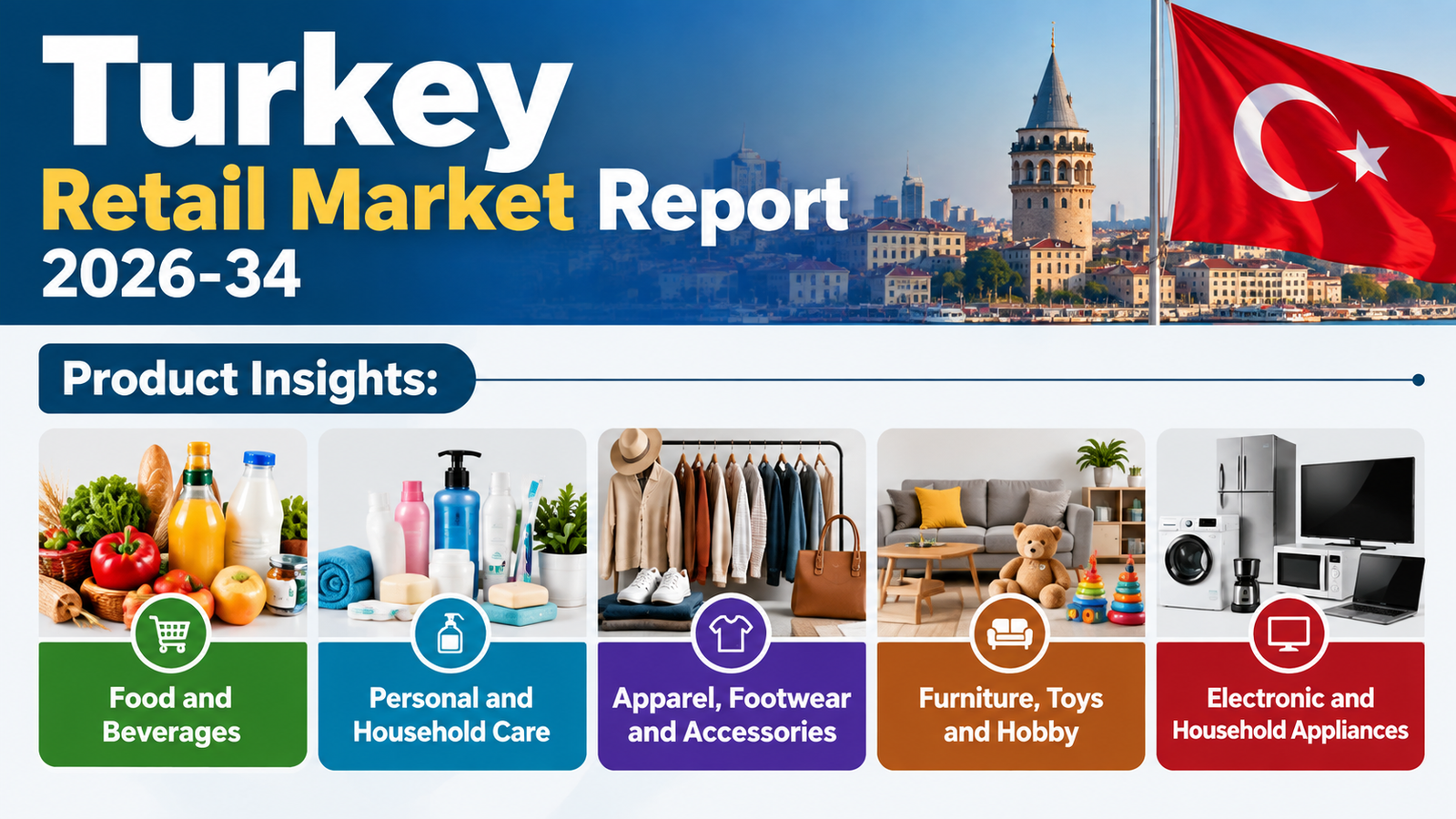
The Turkey retail market supported by rising consumer spending, rapid digitalization of shopping habits and the continued expansion of organized retail chains across the country. Turkey’s large and young population of more than 85 million consumers, together with growing smartphone penetration, is driving demand across grocery, apparel, electronics and household categories. Turkey retail market size reached USD 220.0 Billion in 2025. Looking forward, IMARC Group expects the market to reach USD 455.9 Billion by 2034, exhibiting a growth rate (CAGR) of 8.18% during 2026-2034. Additionally, aggressive store rollouts by discount and supermarket operators, along with the fast growth of online marketplaces, continue to shape consumer preferences and improve retail reach in both metropolitan and smaller cities.
How AI is Reshaping the Future of Turkey Retail Market?
- AI-powered recommendation engines on leading marketplaces such as Trendyol and Hepsiburada personalize product discovery for tens of millions of active customers, improving conversion rates and basket sizes in a market where online sales volume has been expanding at a rapid pace.
- Retail chains are using machine learning for demand forecasting and dynamic replenishment across thousands of stores, reducing stock-outs and food waste in a grocery sector where Migros alone operates more than 3,800 outlets.
- AI-enabled dynamic pricing and promotion analytics help retailers respond to inflation-driven price sensitivity, targeting campaigns such as buy-one-get-one and multi-buy offers more precisely to customer segments.
- Computer vision, smart shelf monitoring and automated checkout pilots are improving store operations, shrinkage control and labor productivity in supermarkets, convenience stores and fashion chains.
- Conversational AI assistants and chatbots are automating customer service, returns handling and order tracking for e-commerce players, supporting the growth of social commerce among younger shoppers.
Grab a sample PDF of this report: https://www.imarcgroup.com/turkey-retail-market/requestsample
Market Growth Factors
The Turkey retail market is driven by strong consumption momentum and a structural shift toward modern, organized retail formats. TurkStat data show that retail trade sales volume rose by 18.8% year-on-year in January, 15.6% in February and 21.2% in March, before moderating to 11.8% in June, reflecting resilient household demand even amid economic volatility. Textiles, clothing and footwear were among the strongest contributors, growing 14.9% annually in January. Discount and proximity formats are expanding quickly to serve price-conscious consumers. Migros, for instance, ended the latest full year with 3,792 stores after opening 259 outlets, and its network reached 3,830 stores by the end of June, up from 3,683 a year earlier. The company plans to open 180 to 200 new stores in the current year, while competitors such as BIM, A101 and SOK continue to add stores across all regions.
E-commerce is the fastest-moving force reshaping the market. Turkey’s total e-commerce volume reached about 4.57 trillion Turkish lira (roughly USD 115.4 Billion), growing 52.2% year-on-year across 5.94 billion transactions, and now represents nearly 6.9% of gross domestic product. Retail e-commerce alone accounted for about 2.46 trillion lira of that volume. Trendyol, which serves more than 30 million active customers and over 230,000 third-party sellers, holds an estimated 34% to 40% share of marketplace volume, followed by Hepsiburada, which is listed on NASDAQ, along with N11, Amazon Turkey and Ciceksepeti. Around 62.5% of online volume is paid by card, and 91.3% of transactions stay within Turkey, pointing to a deep and well-developed domestic digital payments ecosystem. Government programs support this shift. The Ministry of Trade’s ETBIS registry, mandatory e-invoicing and the e-export tax rebate program encourage formalization and help Turkish sellers reach customers abroad.
Evolving lifestyles and rising urbanization continue to support value-added and premium retail. Consumers in Istanbul, Ankara and Izmir increasingly shop through omnichannel journeys that combine physical stores, apps and quick-delivery services, while loyalty programs, private labels and promotional campaigns strengthen retention. Fashion, electronics and home categories benefit from strong brand presence, with retailers such as LC Waikiki, Gratis, Watsons, Bellona and Istikbal expanding their formats and online reach. Retailers are also investing in logistics, fulfillment centers and data infrastructure to shorten delivery times and improve the perfect order rate. Together, these factors are creating a dynamic competitive landscape where discounters, supermarkets, specialty chains and digital platforms all compete for the same growing consumer wallet.
Market Segmentation
Product Insights:
- Food and Beverages
- Personal and Household Care
- Apparel, Footwear and Accessories
- Furniture, Toys and Hobby
- Electronic and Household Appliances
- Others
Distribution Channel Insights:
- Supermarkets and Hypermarkets
- Convenience Stores
- Specialty Stores
- Online Stores
- Others
Regional Insights:
- Marmara
- Central Anatolia
- Mediterranean
- Aegean
- Southeastern Anatolia
- Black Sea
- Eastern Anatolia
Recent Development & News
- August 2026: Migros reported that its real consolidated sales rose 4.5% to TL 241.3 billion in the first six months of the year, supported by ongoing store expansion and growth in its online operations.
- August 2026: TurkStat data showed retail sales volume rising 11.8% year-on-year in June, even as overall trade sales volume fell 4.5% due to weakness in motor vehicle and wholesale trade.
- June 2026: Migros disclosed a total of 3,830 stores as of 30 June, up from 3,683 a year earlier, with net sales area growing 2.3% to 2,101 thousand square meters.
- May 2026: TurkStat reported that retail trade sales volume jumped 21.2% year-on-year in March, one of the strongest monthly readings in recent years.
- April 2026: Retail sales volume increased 15.6% year-on-year in February, according to data released by TurkStat, confirming sustained consumer demand.
- March 2026: Migros held its Capital Markets Day, announcing plans to open 180 to 200 new stores and targeting consolidated sales growth of 5% to 7%, alongside a space growth of 2.5% to 3.5% per year over the medium term.
- December 2025: Migros closed the year with 3,792 stores after opening 259 new outlets, including 22 Macrocenter stores, across all of its formats.
- October 2025: TurkStat data showed retail sales surging 12.2% year-on-year in August, underlining resilient consumption heading into the festive season.
- October 2024: Migros opened 20 new stores (15 Migros, 3 Macrocenter and 2 Mion cosmetics stores) and 1 distribution center, taking its total to 3,563 stores.
If you require any specific information that is not covered currently within the scope of the report, we will provide the same as a part of the customization.
About Us
IMARC Group is a global management consulting firm that helps the world’s most ambitious changemakers to create a lasting impact. The company provide a comprehensive suite of market entry and expansion services. IMARC offerings include thorough market assessment, feasibility studies, company incorporation assistance, factory setup support, regulatory approvals and licensing navigation, branding, marketing and sales strategies, competitive landscape and benchmarking analyses, pricing and cost research, and procurement research.
Contact Us
IMARC Group,
134 N 4th St. Brooklyn, NY 11249, USA,
Email: sales@imarcgroup.com,
Tel No: (D) +91 120 433 0800,
United States: +1-201971-6302