You relocate a warehouse without stopping dispatches by moving in phases instead of all at once. Keep the old site shipping while you build up the new one. Move slow-moving stock first and fast-moving stock last. Run both sites in parallel for a short, planned overlap, then cut over order processing at a pre-agreed point, ideally during your lowest-volume window.
Dispatches only stop when the move is treated as a single weekend event. They keep running when it is treated as a managed, staged operation.
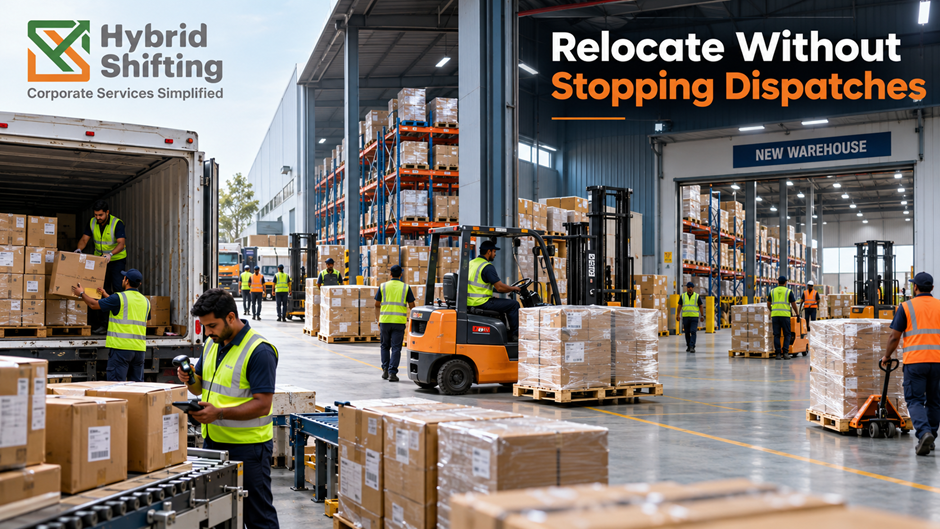
Why do warehouse moves usually interrupt dispatches?
Most dispatch stoppages come from five avoidable causes:
- Single-day “big bang” moves. Everything leaves the old site at once, so nothing is available to ship.
- Unclear inventory. Stock gets moved without a verified count, then can’t be located after the move.
- No parallel operation. The new site isn’t ready to pick and pack when the old one closes.
- WMS and system downtime. Software, scanners and labels aren’t tested before cutover.
- Poor sequencing. Fast-moving SKUs are packed first, so the products customers order most are in transit.
Each of these is a planning failure rather than a logistics limitation, so each one can be designed out.
What is the best method to move a warehouse without downtime?
The most reliable approach is a phased (staged) relocation with parallel operations. It has six stages.
1. Define scope and a dispatch-protection goal
Set the objective in measurable terms, for example: “Maintain 100% of committed dispatch SLAs throughout the move.” Then list what is moving: racking, inventory, equipment, IT hardware and staff. Industry guides on warehouse relocation, such as Mecalux’s relocation planning guide, also stress setting scope and objectives before anything physical happens.
2. Audit and classify your inventory
Segment stock by how fast it moves:
| Category | Description | When to move |
| C-class / slow movers | Rarely ordered | First (Phase 1) |
| B-class / medium movers | Regular but not urgent | Middle (Phase 2) |
| A-class / fast movers | Daily-dispatch SKUs | Last, or split between both sites (Phase 3) |
| Obsolete / damaged | No sales value | Dispose of or liquidate before moving |
Clearing dead stock first reduces the volume you have to move, which means fewer trips and a shorter timeline.
3. Prepare the new warehouse before the first pallet moves
Before any live stock arrives, the new site should have:
- Racking installed and load-tested
- WMS locations configured and bin-labelled
- Barcode scanners, printers and network connectivity tested
- Dock scheduling and a safe layout in place
- Trained staff assigned to receive and put away
4. Move in waves, not all at once
Move stock in planned batches, each with a documented checklist. After each wave, verify counts at the destination before authorising the next wave. For protection during transit, work with a provider that offers professional packing and handling services and tracked transport.
5. Run both sites in parallel for a short overlap
During the overlap:
- The old site keeps fulfilling orders for the SKUs still stored there.
- The new site fulfils orders for the SKUs already moved.
- Order routing in your WMS or ERP sends each order to the right location.
This overlap is what keeps dispatches running, and it is the step most often skipped.
6. Cut over, then stabilise
Pick your lowest-volume window for the final move of fast-moving stock. Run a short “hypercare” period of 3 to 7 days with extra supervisors, daily cycle counts and a clear escalation path.
How long does a warehouse relocation take?
It depends on size, stock complexity and whether racking and automation are involved. As a general guide:
- Small warehouse (under ~5,000 sq. ft.): planning 2–4 weeks, execution a few days to a week
- Mid-size (5,000–50,000 sq. ft.): planning 1–3 months, execution 1–3 weeks
- Large or automated facility: planning 3–6+ months, phased execution over several weeks
These are planning ranges, not guarantees. Your actual timeline should come from a site survey, which a warehouse relocation provider can carry out before quoting.
What should be on your warehouse relocation checklist?
Before the move
- Appoint one project lead and a backup
- Complete a full inventory count and reconcile it with the system
- Classify stock as A / B / C
- Inform customers, carriers and suppliers of the dates and any possible delays
- Confirm insurance coverage for goods in transit
- Obtain permits, vehicle access and dock bookings
- Test the WMS, scanners and network at the new site
During the move
- Label every pallet and carton with a destination location
- Track each wave with a signed handover
- Verify receiving counts the same day
- Keep safety stock available at the active dispatch site
After the move
- Run cycle counts on moved SKUs
- Review dispatch performance against SLA
- Update addresses with carriers, vendors and online listings
- Hold a lessons-learned review
What technology helps keep dispatches running during a move?
- A WMS with multi-location support routes orders to the correct site automatically.
- Barcode or RFID tracking gives a live view of what is in transit, where.
- Real-time inventory visibility prevents overselling stock that is on a truck.
- Shipment and vehicle tracking lets the operations team plan around arrival times.
Hybrid Shifting Solutions, an India-based relocation and logistics company serving both business and individual customers, builds its approach around technology-led visibility and accountability. See our B2B and corporate relocation services for how this works in practice.
How do you avoid the most common mistakes?
- Moving fast-selling SKUs first. Do the opposite.
- Skipping a pilot wave. Move one small batch first to test labelling, transport and put-away.
- Underestimating packing time. Allow generous lead time for packing, especially for fragile or high-value goods.
- Not informing customers. Proactive communication reduces complaints even if a delay occurs.
- No contingency plan. Keep safety stock at the live site and have a backup vehicle and crew on call.
- Forgetting compliance. Check GST e-way bill requirements for stock moving between locations, and any local rules for the new premises.
Should you hire a professional warehouse relocation company?
Consider it if:
- Your operation can’t afford any dispatch disruption
- You are moving racking, heavy machinery or high-value inventory
- You lack internal capacity to run a project alongside daily operations
- You are moving between cities or states
A professional partner brings trained crews, packing materials, vehicles, tracking and a tested method, so your own team can stay focused on shipping orders. You can request a free site survey and quote to see what a phased plan would look like for your facility.
Frequently asked questions
Can you really move a warehouse without stopping dispatches?
Yes. A phased move with parallel operation keeps at least one site fulfilling orders at all times. Brief slowdowns are possible at cutover, but a full stop is avoidable.
What is a phased warehouse relocation?
It is a move carried out in stages. Slow-moving stock goes first, fast-moving stock goes last, and orders are fulfilled from whichever site holds the product.
How do I protect customer orders during the move?
Build safety stock for top SKUs, route orders by location in your WMS, notify customers of any possible delays, and avoid moving high-demand items during peak periods.
When is the best time to relocate a warehouse?
During your lowest-demand period. Avoid festive seasons, sale events and financial year-end.
How much does a warehouse relocation cost?
Cost depends on volume, distance, packing needs, racking dismantling and reinstallation, and the timeline. A site survey is the only reliable way to get an accurate figure.
What happens to inventory accuracy after a move?
Expect some variance unless you count before and after. Cycle counts on moved SKUs within the first week catch most discrepancies early.