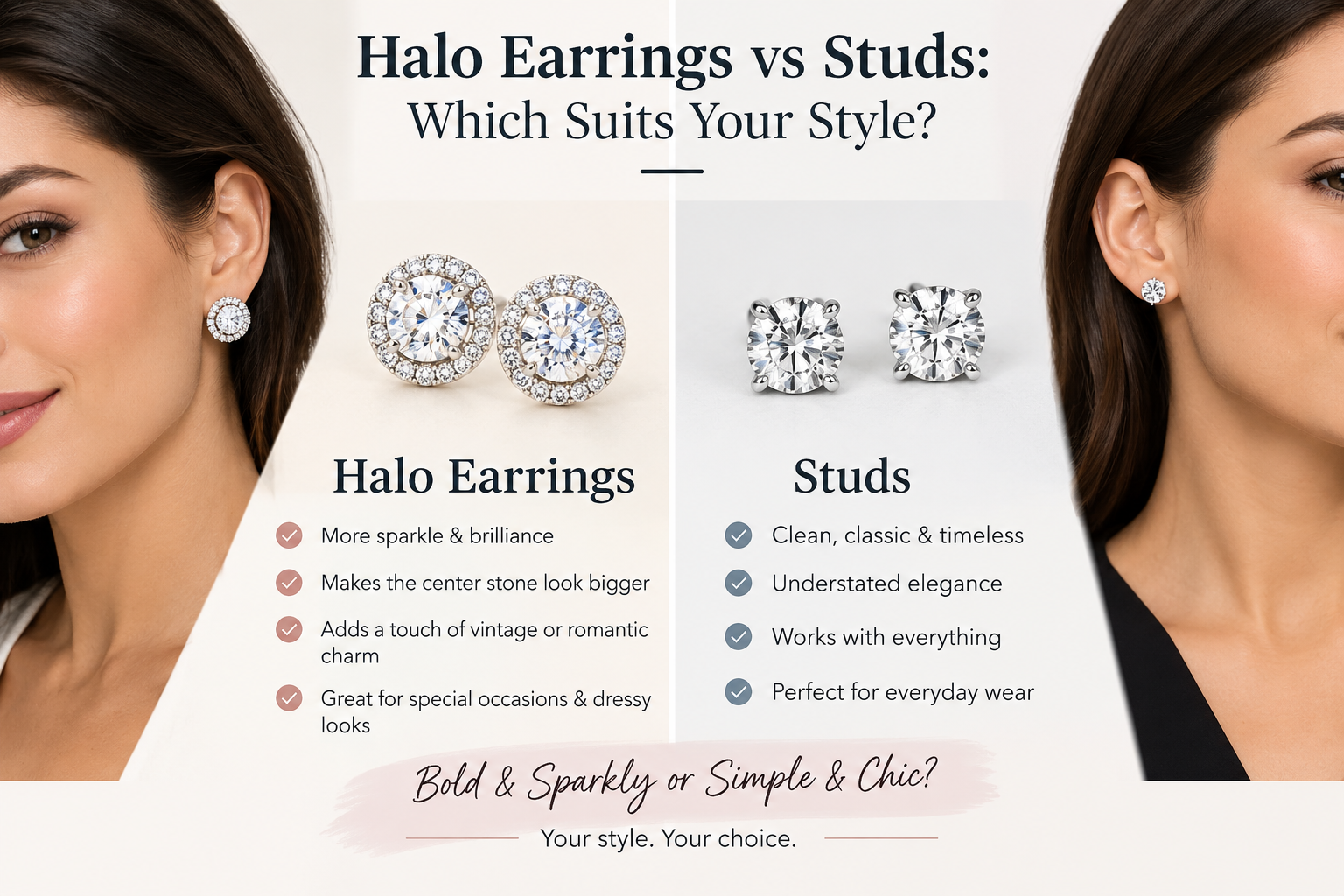
Whether you’re at a jewellery counter, or scrolling late at night, you hit the same fork every time: halo or stud? Both are classics. Both look good with a white shirt and a decent coat. On the ear, though, they behave very differently. A stud is calm and quiet, while a halo adds a ring of small stones that makes the centre gem look larger and catches the light around your face. The short answer is simple. Choose studs for low-effort daily wear and a halo when you want presence.
Below, we’ll compare them on looks, comfort, durability and gemstones, from diamonds to blue sapphire earrings.
What’s The Real Difference Between Halo and Stud Earrings?
A stud is a single stone set close to the lobe. A halo takes that same centre stone and circles it with a ring of smaller ones, so the whole piece looks bigger and sparklier. Studs, on the other hand, provide a soft and minimal feel. Halos are decorative and draw the eye. Plenty of people end up owning both.

How a stud is built
A stud is the simplest design in jewellery: one stone, held by claws or a bezel, on a post with a butterfly back. There’s nothing around the stone, so its quality does all the talking. Cut, colour and clarity are on show with no supporting cast.
You’ll find studs in gold or platinum, set with diamonds or coloured stones such as rubies and emeralds.

How a halo is built
A halo adds a border of small stones around the centre gem. The effect is easy to spot. A modest centre stone can look noticeably larger once it’s framed, and the ring of tiny stones bounces extra light back into the centre. That’s handy if the main stone is a touch pale.
Cluster designs sit somewhere in between. They group several stones together without the strict ring, which gives you the fuller look with a softer outline.
Which Style Suits Your Face, Hair and Wardrobe?
Studs suit minimal wardrobes, short hair and anyone who wants jewellery they forget they’re wearing. Halos suit people who like a statement, wear their hair up or tucked back, and favour plain necklines that leave room for the earrings to shine. Your daily outfits matter more than your face shape.
Face shape and hair
Halos add a rounded outline, which can soften a very angular jawline. Studs maintain a clean appearance and complement a strong jawline or a sharp bob effectively. If your hair usually covers your ears, a stud will still twinkle through the strands, whereas a larger halo can become lost or tangled.
Necklines and colours
Think about what you wear most. Crew necks, shirts and knitwear pair happily with studs. Boat necks, V-necks and strapless dresses leave space for a halo to do its job.
Metal matters too. Yellow gold looks warm against olive and deeper skin tones. Platinum and white gold read cooler and crisper. Whatever you choose, try to match the metal to the jewellery you already wear every day, such as a watch or wedding band.
Office versus evening
To be honest, halo isn’t automatically the upgrade. A pair of well-cut studs with a lovely centre stone will beat a halo wrapped around a mediocre one every time, because the surrounding stones can’t fix a dull centre. If your budget is fixed, spend it on the centre stone first.
That said, a halo is difficult to beat for evenings, weddings and anniversaries, when you want the earrings noticed from across the table.
Which Is More Practical for Everyday Wear?
Studs are more practical. They sit flush, rarely catch on scarves or hair, and take seconds to clean. A halo is perfectly wearable day to day, but its small surrounding stones collect skin oils, soap and dust, so it needs more regular cleaning and a gentler hand when you’re getting dressed.
Snagging and comfort
A larger halo has more surface to catch on a collar, a hat or a phone held to the ear. It’s also a little heavier. Plenty of people wear halo earrings daily without a second thought, but if you’re sensitive to weight or you’re constantly pulling jumpers over your head, a stud is kinder.
Secure backs matter either way. A loose butterfly is the most common reason an earring goes missing.
Cleaning and upkeep
A simple routine works for most pieces. Soak them in warm water with a drop of washing-up liquid, brush gently with a soft toothbrush, rinse and dry with a lint-free cloth. Halos require a brush to clean underneath the small stones, so make sure to use it every couple of weeks if you wear them frequently.
Many jewellers advise against ultrasonic cleaners and steam for softer or treated stones, so check before you use either.
Hardness and everyday knocks
Hardness is the quiet factor behind durability. On the Mohs scale, diamond rates 10, sapphire rates 9, and tanzanite sits at around 6.5 to 7. That’s a big gap, therefore, if you’re considering tanzanite earrings UK retailers stock, remember that a softer stone is more likely to scratch or chip with daily knocks.
For a stone like that, a halo’s surrounding ring can offer some protection around the edge, though it won’t make the gem indestructible.
Which Gemstones Work Best in Studs and Halos?
Hard, richly coloured stones, such as sapphires, suit both styles well. Softer stones like tanzanite are better placed in a halo or saved for occasions, where the setting offers a little extra protection. Diamonds are the safest choice in either style. Ruby works well too, though emerald is more brittle.
Blue sapphire

Sapphire is a variety of corundum, and it’s one of the toughest coloured gemstones you can buy. That makes blue sapphire earrings a strong pick for studs you plan to wear most days. Deep, saturated blues look rich against navy and grey. Lighter, brighter blues sparkle more in daylight, so it’s worth viewing a pair in both indoor and natural light before you decide.
Tanzanite

Tanzanite is a violet-blue gemstone found in one place: the Merelani Hills, near Mount Kilimanjaro in Tanzania. It was identified in 1967, and Tiffany & Co. launched it commercially in 1968. Its colour shifts between blue and violet depending on the light, which is lovely but worth seeing in person.
If you’re drawn to tanzanite earrings, UK buyers often wear for weddings and dinners, a halo is a sensible companion, and the occasion-wear approach suits the stone’s softness.
Diamond, ruby and emerald
Diamonds are the all-rounder. A diamond stud is probably the most versatile pair you can own, and a diamond halo is the classic dressed-up version. Ruby is tough enough for daily wear. Emerald looks wonderful but tends to carry natural inclusions, so it’s gentler to treat it as a special-occasion stone.
Expect a halo pair to cost somewhat more than studs with the same centre stone, since you’re paying for the extra stones and the setting work.
Frequently Asked Questions
Are halo or stud earrings better for sensitive ears?
The metal matters more than the style. Nickel is the usual culprit for irritation, so look for solid gold or platinum posts. Studs are better because only the post touches skin, but a good halo on a quality post is just as comfy for most.
Can I wear a stud and a halo in the same ears?
Yes, and it can look polished. Put a small stud in the lobe and a slightly larger halo in a second piercing, if you have one. Keep the metals consistent, such as all yellow gold, so the combination looks deliberate rather than accidental.
Does a halo make a diamond look bigger?
Visually, yes. The ring of small stones frames the centre and increases the overall surface sparkle, so the earring appears larger. It doesn’t change the carat weight of the main stone, though. Always check whether a quoted carat figure refers to the centre stone alone or to the total of all stones.
How do I stop heavier earrings tilting forward?
Use a snug, secure back, such as a screw back or a locking style, and make sure the post length suits your lobe. A back that’s too loose lets the weight pull the front of the earring forward. If tilting persists, a lighter stud may simply suit your ears better.
Summing up
To sum up, the question comes to: which should you choose?
While on one hand, studs excel in comfort, simplicity, and low maintenance, allowing the quality of a single beautiful stone to shine through.
While on the other hand, the halo wins on presence, on making a centre stone look larger, and on making a pair feel dressed for an occasion. Halo earrings aren’t automatically better, but they are brilliant when the moment calls for them.
Think about your wardrobe, your daily routine and the stone you love most. Put a hard, well-cut stone in a stud for every day, keep a halo for the evenings, and you’ll rarely regret either choice.