IMARC Group, a leading global market research and management consulting firm, has published its latest market intelligence report on the Turkey e-commerce market size was valued at USD 93.5 Billion in 2025 and is projected to reach USD 644.1 Billion by 2034, growing at a compound annual growth rate of 23.20% from 2026-2034. Growth is driven by widespread smartphone use and mobile-first shopping among a young population, government digital transformation programs and e-export incentives, a flexible payment ecosystem built on installments and buy-now-pay-later, and rapid expansion of marketplaces, grocery delivery, and cross-border selling.
The market is gaining strong momentum as online shopping becomes a mainstream habit across Turkish households and businesses. Trade Ministry data from the Electronic Commerce Information System (ETBIS) show total e-commerce volume of 3.16 trillion lira (about USD 89.6 Billion), supported by 5.91 billion transactions. The sector accounts for 6.5% of GDP and 19.1% of total trade. Retail e-commerce alone reached 1.62 trillion lira across 1.85 billion transactions. Platform scale reinforces the trend. Trendyol serves more than 40 million customers and about 250,000 sellers, while Hepsiburada handled 87.5 million orders from about 11.8 million active customers and more than 100,000 merchants.
How is AI Reshaping the Future of the Turkey E-commerce Market?
- AI-Assisted Product Discovery and Purchase Decisions: Turkish shoppers are relying more on AI tools to search for products, compare prices, and decide what to buy. With inflation making consumers more price-sensitive, AI-driven comparison and recommendation engines help buyers find the best deal across marketplaces such as Trendyol, Hepsiburada, and Amazon, and give platforms a way to keep customers engaged.
- Personalization and Merchant Enablement at Scale: Large marketplaces are using machine learning to personalize storefronts, optimize delivery promises, and support small sellers with demand and pricing insights. Kaspi.kz’s additional TRY 4.17 billion (about USD 97.6 Million) investment in Hepsiburada in December 2025 is aimed at building digital tools and services for SMEs and retailers selling on the platform.
- Fraud Detection and Trust: As online payments grow, AI-based fraud screening and identity checks are becoming essential. Cybersecurity concerns and digital fraud risks remain a known restraint, so platforms and payment providers are investing in real-time risk scoring to protect consumer trust.
Grab a sample PDF of this report: https://www.imarcgroup.com/turkey-e-commerce-market/requestsample
Turkey E-commerce Market Trends and Drivers:
The Turkey e-commerce market is expanding steadily, fueled by a young, digitally active population, deep mobile adoption, and a retail landscape that is moving online across categories. Smartphones are central to the shopping journey, and mobile apps from Trendyol, Hepsiburada, n11, and ÇiçekSepeti make browsing, comparing, and paying seamless. Grocery and rapid delivery have emerged as high-growth areas, with players such as Getir and major supermarket chains competing on speed. Fashion, footwear, and accessories remain the largest online shopping categories, while food delivery and quick commerce have recorded significant growth.
Government policy is shaping the market from both the promotion and the regulation side. Digital transformation programs and e-export incentives, including subsidies for businesses in underserved areas, help smaller sellers reach domestic and overseas buyers. The Trade Ministry tracks the sector through ETBIS, which gives authorities a detailed view of transaction volumes. At the same time, customs rules for cross-border parcels have tightened. In August 2024, the value limit for individual B2C postal and express shipments was cut from 150 euros to 30 euros, with flat duties of 30% on goods from EU countries and 60% on goods from other countries. An October 2025 circular excluded toys, footwear, and leather goods from the simplified system, and from February 2026 the simplified declaration route for non-commercial parcels was removed entirely under Presidential Decision No. 10813. The Trade Ministry cited high noncompliance and safety concerns, noting that lab tests found 81% of 182 cross-border items failed safety standards. These steps are widely expected to benefit domestic marketplaces and local sellers as low-cost overseas orders from platforms such as Temu, AliExpress, and Shein become costlier.
The payment ecosystem further supports adoption. Credit cards with installments remain the most common way to pay, while buy-now-pay-later options and digital wallets are gaining ground among younger shoppers and cash on delivery is declining. Domestic card networks and instant payment systems keep checkout friction low. Consolidation and fresh capital are also reshaping the field, as seen in the Kaspi.kz and Hepsiburada transaction. Challenges remain, including inflation that erodes purchasing power, evolving compliance requirements that weigh on smaller operators, and cybersecurity risks that can dent consumer confidence.
Turkey E-commerce Industry Segmentation:
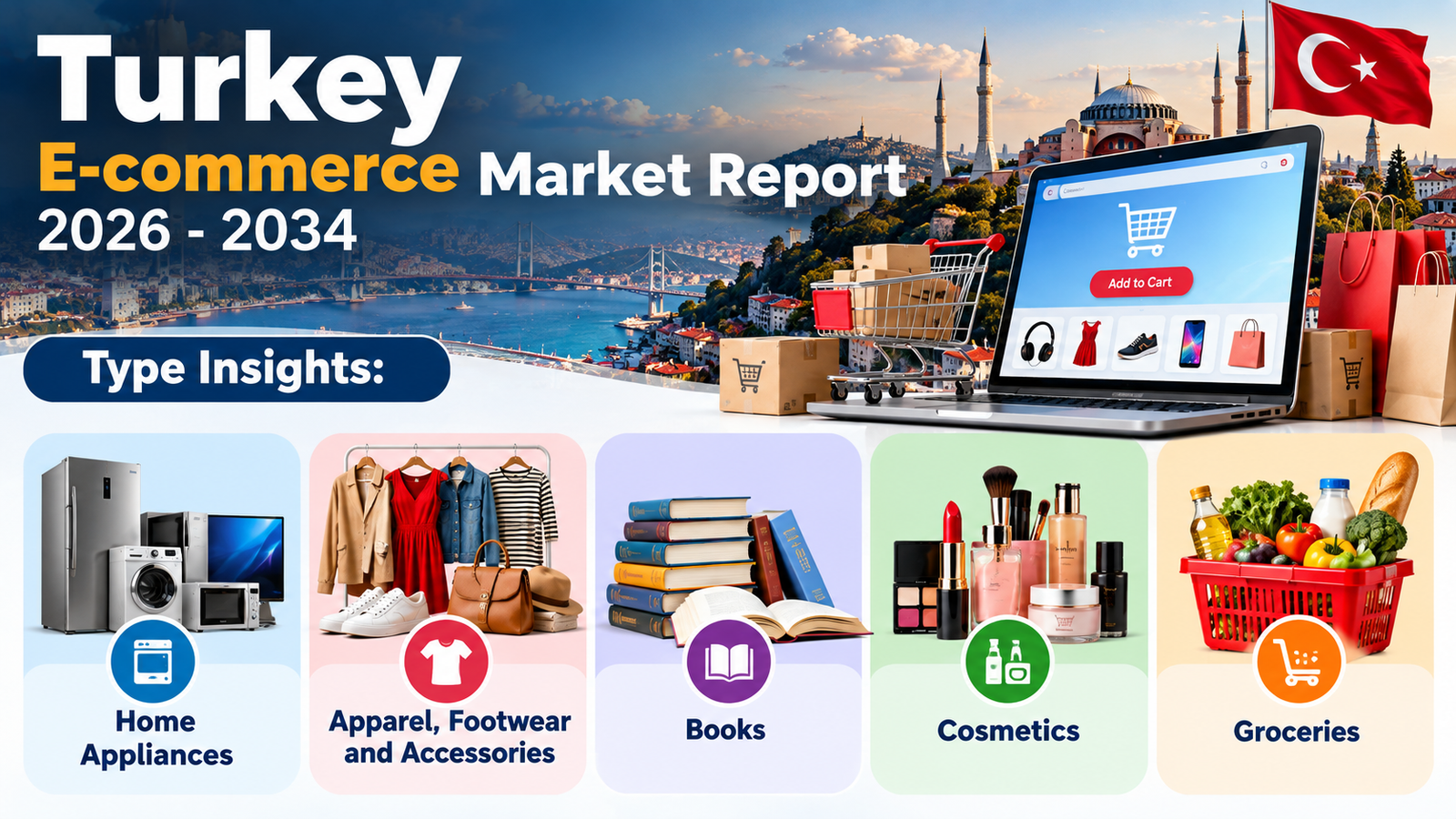
The report has segmented the market into the following categories:
Breakup By Type:
- Home Appliances
- Apparel, Footwear, and Accessories
- Books
- Cosmetics
- Groceries
- Others
Groceries account for the largest type segment with a 23.04% share, driven by the shift toward online supermarkets, rapid delivery services, and the convenience of scheduled replenishment for busy urban households.
Breakup By Transaction:
- Business-to-Business
- Business-to-Consumer
- Consumer-to-Consumer
- Others
Business-to-business leads the transaction segment with a 78.02% share, reflecting the digitization of wholesale trade, procurement, and supplier networks across Turkish industry and retail.
Breakup By Region:
- Marmara
- Central Anatolia
- Mediterranean
- Aegean
- Southeastern Anatolia
- Black Sea
- Eastern Anatolia
Marmara dominates the regional landscape with a 28.02% share, supported by the concentration of population, businesses, logistics hubs, and technology talent around Istanbul and surrounding cities.
Competitive Landscape:
The report provides a comprehensive analysis of the competitive landscape in the Turkey e-commerce market with detailed profiles of major companies. Prominent participants shaping the market include:
- Trendyol
- Hepsiburada
- Amazon Turkey
- n11
- ÇiçekSepeti
- Getir
Domestic marketplaces compete with global platforms and quick-commerce specialists on assortment, delivery speed, seller tools, and installment offers. Strategic investment, logistics expansion, and SME enablement programs are central to competitive positioning.
Recent News and Developments in Turkey E-commerce Market
- April 2026: Turkish media reported that e-commerce continues to accelerate as shoppers rely more on AI tools for product searches and purchase decisions, while inflation pushes buyers to compare prices more often. Trendyol, Hepsiburada, and Amazon remain the leading platforms.
- February 2026: Türkiye ended the simplified customs system for low-value overseas parcels under Presidential Decision No. 10813, requiring standard customs procedures for non-commercial shipments from foreign e-commerce platforms.
- December 2025: Kaspi.kz injected an additional TRY 4.17 billion (about USD 97.6 Million) into Hepsiburada to develop digital tools and services for SMEs and retailers selling on the platform.
- October 2025: A Trade Ministry circular excluded toys, footwear, and leather goods from the simplified customs system for cross-border parcels.
- August 2024: Türkiye cut the allowed value limit for individual B2C postal and express e-commerce shipments from 150 euros to 30 euros and raised the applicable flat duties, with the change effective from 21 August 2024.
Note: If you require specific details, data, or insights that are not currently included in the scope of this report, we are happy to accommodate your request. As part of our customization service, we will gather and provide the additional information you need, tailored to your specific requirements. Please let us know your exact needs, and we will ensure the report is updated accordingly to meet your expectations.
About Us:
IMARC Group is a global management consulting firm that helps the world’s most ambitious changemakers to create a lasting impact. The company provides a comprehensive suite of market entry and expansion services. IMARC offerings include thorough market assessment, feasibility studies, company incorporation assistance, factory setup support, regulatory approvals and licensing navigation, branding, marketing and sales strategies, competitive landscape and benchmarking analyses, pricing and cost research, and procurement research.
Media and Sales Contact
IMARC Group
Email: sales@imarcgroup.com
United States: +1-201-971-6302
India: +91-120-433-0800
United Kingdom: +44-753-714-6104