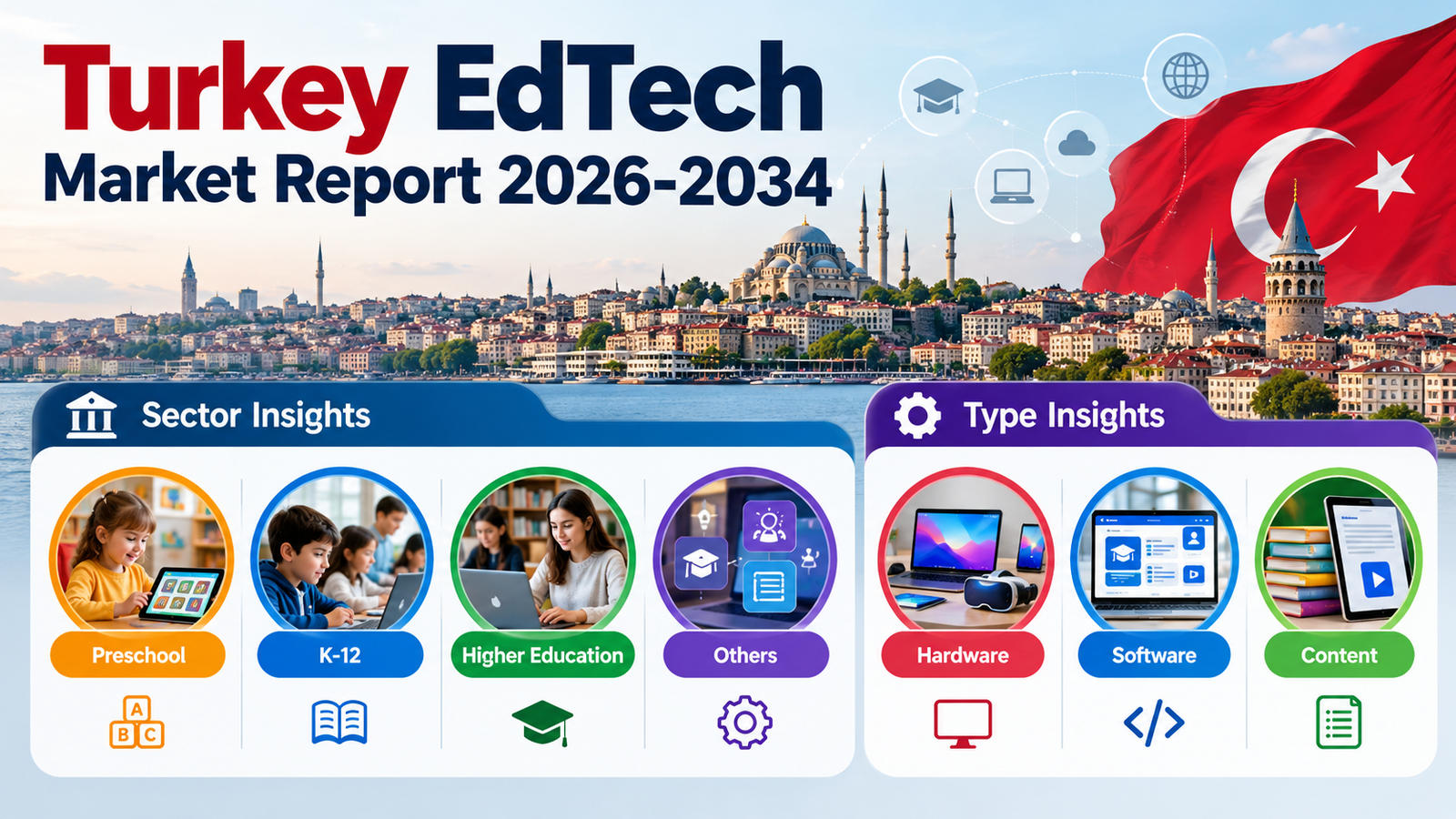
The Turkey EdTech market driven by Rising internet access, strong government backing for digital learning, and a large student base are driving adoption. Turkey EdTech market size reached USD 3.6 Billion in 2025. The market is projected to reach USD 9.5 Billion by 2034, exhibiting a growth rate (CAGR) of 10.90% during 2026-2034. TurkStat reports that 92.3% of individuals aged 16 to 74 use the internet, and the Ministry of National Education (MEB) serves more than 17.7 million students in formal education. Together, these factors are creating steady demand for online platforms, AI-enabled learning tools, and digital content across schools, universities, and workplaces.
How AI is Reshaping the Future of Turkey EdTech Market?
- MEB’s AI-powered individual learning platform, MEBİ, recorded 5.676 million user logins in its latest academic year. It offers AI-generated study plans, video lessons, and practice exams. This shows how personalized, adaptive learning is moving into the mainstream for middle school, high school, and university exam preparation.
- The Ministry released an AI in Education Policy Document and is working with an education technology sector that covers around 1,280 firms. This gives local developers a clearer framework for building AI-based assessment, tutoring, and analytics products.
- Türk Telekom is deepening its education technology presence through its subsidiary SEBİT and its venture arm TT Ventures. SEBİT applies AI algorithms to personalized learning for private school chains and education groups. The startups in the TT Ventures portfolio have a combined valuation of USD 576 million.
- Global platforms are adding Turkish-language, skills-based content. Udemy, ranked 78th on TIME’s list of the World’s Top EdTech Companies, serves more than 69 million learners and 16,000 companies worldwide, and offers courses in Turkish. AI-driven recommendations on such platforms support upskilling for working professionals.
- AI is also improving accessibility. The TahtApp project, which helps visually impaired students follow classroom lessons, has expanded to 100 additional schools across 22 provinces, extending digital learning to students who were previously underserved.
Grab a sample PDF of this report: https://www.imarcgroup.com/turkey-edtech-market/requestsample
Market Growth Factors
Growing digital access is a major driver of the Turkey EdTech market. TurkStat data show that 92.3% of individuals aged 16 to 74 use the internet and 60.0% buy goods or services online, which points to strong comfort with digital payments and services. Online learning participation among individuals has also increased, with 17.7% taking part in learning activities over the internet within a three-month window, up 3.9 percentage points from the prior year. The formal education base is large, with 17.7 million students, 1.2 million teachers, and 75,012 schools. Private schools alone enroll about 1.49 million students, creating a sizeable segment of institutions willing to invest in digital classrooms and learning software.
Government programs continue to anchor demand. The FATIH Project has distributed more than 2.1 million tablet sets and equipped classrooms with interactive whiteboards. The Education Informatics Network (EBA) has been used by about 12.9 million students and over 1 million teachers in a single academic year. MEB is also modernizing around 1,980 information technology classrooms whose equipment has reached the end of its service life, and is developing EBA Akademi to support students’ personal development outside the curriculum. The Türkiye Century Maarif Model has introduced a skill-based curriculum, which increases the need for interactive content, assessment tools, and teacher training platforms. The share of vocational and technical education in formal secondary education has also risen from 37.56% to 39.51%, supporting demand for practical, simulation-based, and skills-focused digital content.
Private investment and international partnerships are widening the supplier ecosystem. The Turkish startup ecosystem recorded 360 deals worth USD 1.4 billion in its latest annual review, and artificial intelligence led deal counts in the most recent quarterly review. Local education technology ventures are attracting global acquirers, such as Constructor Tech, which acquired Advancity and Perculus, two startups founded at Özyeğin University. Mobility-focused platforms such as Leverage Edu are targeting the more than 50,000 Turkish students studying abroad. Together, these developments are encouraging innovation in learning management systems, virtual classrooms, adaptive assessment, and test preparation across both consumer and institutional segments.
Market Segmentation
Sector Insights:
- Preschool
- K-12
- Higher Education
- Others
Type Insights:
- Hardware
- Software
- Content
Deployment Mode Insights:
- Cloud-based
- On-premises
End User Insights:
- Individual Learners
- Institutes
- Enterprises
Regional Insights:
- Marmara
- Central Anatolia
- Mediterranean
- Aegean
- Southeastern Anatolia
- Blacksea
- Eastern Anatolia
Recent Development & News
- October 2024: The Ministry of National Education launched MEBİ, an AI-powered individual learning platform for high school students and graduates preparing for the university entrance exam. The platform tracks each student’s learning experience and reshapes the study plan accordingly, and it is accessible on the web and through mobile app stores.
- February 2025: Leverage Edu expanded to Turkey with the launch of LeverageTürkiye, offering AI tools for counselors and a consumer app for students pursuing higher education abroad. The move targets the more than 50,000 Turkish students studying overseas.
- April 2025: Constructor Tech, a Switzerland-based technology company, acquired the education technology startups Advancity and Perculus, which were co-founded at Özyeğin University in Istanbul. The team will remain headquartered in Türkiye.
- June 2025: At the Türkiye Education Technologies Summit, MEB shared its AI in Education Policy Document and highlighted collaboration with an education technology sector of about 1,280 firms. It also announced the renewal of around 1,980 information technology classrooms.
- February 2026: Türk Telekom strengthened its education technology investments through SEBİT and TT Ventures. The TT Ventures portfolio reached a combined valuation of USD 576 million, while the TahtApp project expanded to 100 additional schools in 22 provinces.
- July 2026: MEB reported that MEBİ reached 5.676 million user logins in the 2025-2026 academic year, including middle school, high school, and graduate users preparing for university entrance.
If you require any specific information that is not covered currently within the scope of the report, we will provide the same as a part of the customization.
About Us
IMARC Group is a global management consulting firm that helps the world’s most ambitious changemakers to create a lasting impact. The company provide a comprehensive suite of market entry and expansion services. IMARC offerings include thorough market assessment, feasibility studies, company incorporation assistance, factory setup support, regulatory approvals and licensing navigation, branding, marketing and sales strategies, competitive landscape and benchmarking analyses, pricing and cost research, and procurement research.
Contact Us
IMARC Group,
134 N 4th St. Brooklyn, NY 11249, USA,
Email: sales@imarcgroup.com,
Tel No: (D) +91 120 433 0800,
United States: +1-201971-6302