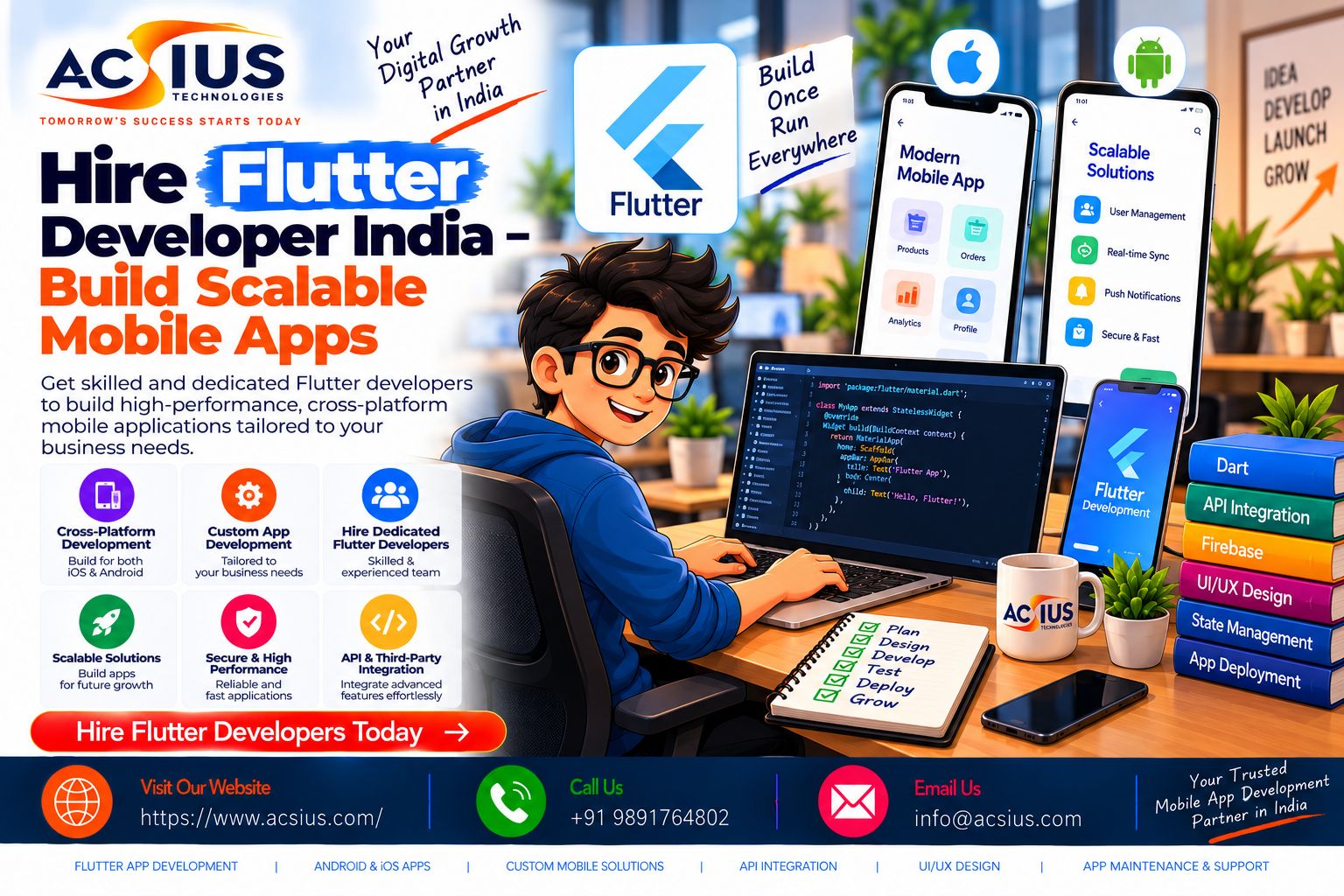
Choosing a mobile development framework used to mean accepting a tradeoff: native performance with double the development cost, or cross-platform efficiency with compromised user experience. Flutter, Google’s open-source UI toolkit, has fundamentally changed that calculation. By compiling directly to native ARM code and rendering its own UI components through the Skia graphics engine, Flutter delivers genuinely native-level performance and pixel-perfect design consistency from a single codebase, without the compromises that plagued earlier cross-platform attempts.
This combination of performance, visual control, and development efficiency has made Flutter one of the fastest-growing frameworks for building scalable, production-grade mobile applications. India has correspondingly become a major hub for Flutter talent, with development teams building everything from early-stage startup MVPs to complex, high-traffic consumer apps. Businesses that want to move quickly without sacrificing quality increasingly choose to hire flutter developers in India who bring genuine production experience, rather than treating framework expertise as an afterthought in the hiring process. This guide explains why Flutter has become such a strong choice for scalable app development, what genuine expertise looks like, and how to evaluate the broader ecosystem of development options available.
Why Flutter Has Become a Leading Choice for Scalable Apps
Flutter’s architecture sets it apart from other cross-platform frameworks in a few meaningful ways. Because Flutter renders every UI element itself rather than relying on platform-native components, apps built with it look and behave identically across iOS and Android, without the subtle inconsistencies that can emerge when a framework bridges to each platform’s native component library separately. This also means Flutter apps tend to maintain consistent performance across both platforms, since there’s no dependency on how well a given native component bridge happens to be implemented.
The framework’s hot reload feature dramatically accelerates development speed, allowing developers to see code changes reflected almost instantly without losing application state, a genuine productivity advantage during active development and iteration. Flutter’s widget-based architecture also encourages a highly composable, reusable approach to building interfaces, which pays off significantly as an app’s complexity grows and development teams need to maintain consistency across dozens or hundreds of screens. For businesses planning for real growth rather than just an initial launch, this architectural foundation matters considerably more than it might appear during an app’s early, simpler stages.
What Scalability Actually Requires in Flutter Development
Building an app that works well in a demo is very different from building one that remains fast, stable, and maintainable as user numbers, feature complexity, and team size all grow simultaneously. Genuine scalability in Flutter development depends on several specific technical decisions made early in a project.
State management architecture forms the foundation of a scalable Flutter app. Options like Provider, Riverpod, Bloc, and GetX each offer different tradeoffs between simplicity and structure, and experienced developers choose based on an app’s actual complexity rather than defaulting to whatever’s currently trending in the Flutter community. Apps that start with inadequate state management architecture often require painful refactoring once they’ve grown too complex for an overly simple approach to handle cleanly.
Modular code structure separates a scalable codebase from one that becomes increasingly difficult to maintain as it grows. Organizing code by feature rather than by file type, with clear boundaries between business logic, UI components, and data layers, allows multiple developers to work on different parts of an app simultaneously without constant merge conflicts or unintended side effects.
Efficient widget rebuilding directly affects app performance at scale. Flutter’s declarative UI model rebuilds widgets in response to state changes, and poorly structured apps can suffer from excessive, unnecessary rebuilds that degrade performance as screens grow more complex. Experienced developers understand how to scope state changes precisely, using tools like const constructors and selective rebuilding to keep performance smooth even in data-heavy, frequently updating interfaces.
Robust API and data layer architecture needs to handle real-world conditions gracefully, poor network connectivity, API failures, data caching for offline functionality, rather than assuming the happy path of a fast, reliable connection that demo environments often take for granted.
Flutter vs. React Native: Making the Right Choice
Flutter isn’t the only strong cross-platform option, and a genuinely good development partner should help evaluate which framework actually fits a specific project rather than defaulting to whichever one they happen to specialize in. Understanding the practical differences helps clarify this decision.
Flutter tends to have an edge for apps requiring highly custom, pixel-perfect designs or complex animations, since its self-rendering approach gives developers complete control over every visual detail without being constrained by platform-native component behavior. This makes it particularly strong for apps where brand-specific visual design is a significant differentiator.
React Native, by contrast, often appeals to teams with existing React or JavaScript expertise, since much of that knowledge transfers directly, and it benefits from a larger, more established ecosystem of third-party libraries built up over a longer period of market presence. For businesses still weighing both options, it’s worth consulting a development partner who can genuinely hire react native developer talent alongside Flutter expertise, since an honest, side-by-side assessment of project requirements, design complexity, team background, and long-term plans, leads to a better outcome than a framework recommendation driven by which technology a particular agency happens to specialize in. The right choice depends genuinely on the specifics of each project rather than one framework being universally superior to the other.
Core Skills That Separate Expert Flutter Developers from Beginners
Flutter’s relatively approachable learning curve means there’s a wide range of actual skill levels among developers who list it on their resume. Identifying genuine expertise during hiring requires looking beyond basic framework familiarity.
Custom widget development beyond Flutter’s built-in component library demonstrates a developer’s ability to build genuinely unique, brand-specific interfaces rather than relying entirely on default Material Design or Cupertino components that can make an app feel generic.
Platform channel proficiency for native integrations matters when an app needs functionality beyond what Flutter’s plugin ecosystem already covers, requiring developers who can write native Swift/Kotlin code and bridge it properly into the Flutter layer for specific hardware access or platform-specific capabilities.
Animation and custom rendering expertise separates developers who can deliver the kind of polished, fluid motion design that makes an app feel genuinely premium from those who stick to basic, default transitions throughout an entire app.
Testing discipline, including unit tests, widget tests, and integration tests, indicates a development approach built for long-term maintainability rather than one that will accumulate increasingly fragile technical debt as the app grows and changes over time.
CI/CD pipeline experience for automated building, testing, and deployment reflects a mature development process capable of supporting frequent, reliable releases rather than manual, error-prone deployment procedures that slow down iteration speed as a product matures.
Backend Infrastructure: The Foundation Scalable Apps Depend On
A beautifully built Flutter app is only as scalable as the backend infrastructure supporting it. As user numbers grow, the backend needs to handle increased load, data storage, and real-time functionality without becoming a bottleneck that undermines the quality of the mobile experience itself.
Cloud infrastructure choices made early significantly affect how smoothly an app scales as it grows. Many Flutter apps are built on backend infrastructure hosted on AWS, taking advantage of services like Lambda for serverless compute, DynamoDB or RDS for data storage, and Cognito for authentication. For businesses building a Flutter app that needs genuinely scalable backend architecture, it’s worth working with a team that can also hire aws certified developer talent to design infrastructure capable of handling growth without requiring a disruptive migration later. A development partner capable of coordinating both the mobile frontend and cloud backend coherently, rather than treating them as entirely separate engagements, consistently produces a more reliable, better-integrated final product.
Common Use Cases Where Flutter Delivers Strong Results
Flutter has proven particularly effective across several categories of applications where its specific strengths, visual consistency, performance, and development speed, provide genuine competitive advantage.
Consumer apps with distinctive brand identities benefit from Flutter’s rendering control, allowing design teams to implement unique visual experiences without being constrained by platform-native component limitations. Fintech and banking apps take advantage of Flutter’s performance and security capabilities, along with the consistent, trustworthy user experience that pixel-perfect design control across platforms helps establish. On-demand and marketplace apps benefit from Flutter’s ability to handle complex, data-heavy interfaces, real-time updates, and location-based features while maintaining smooth performance even as feature complexity grows. Internal enterprise tools increasingly use Flutter as well, taking advantage of its growing desktop and web support to potentially extend a single codebase beyond just mobile into broader platform coverage.
The Development Process for Scalable Flutter Apps
A structured, professional Flutter development engagement typically moves through several distinct phases designed to reduce risk and ensure the final product genuinely meets both immediate launch needs and longer-term growth plans.
Technical discovery and architecture planning should happen before significant development begins, establishing state management approach, backend integration strategy, and a clear technical roadmap rather than starting to code based on a feature list alone.
Design system development alongside or before UI implementation ensures visual consistency is built into reusable components from the start, rather than requiring extensive rework later as inconsistencies accumulate across different screens built at different times.
Incremental, sprint-based development with regular stakeholder demos allows course correction throughout the project rather than discovering misalignment only after a long, uninterrupted development cycle concludes.
Performance testing under realistic conditions, not just on high-end development devices, ensures the app performs acceptably across the actual range of devices and network conditions real users will experience.
Scalability-focused code review, evaluating not just whether code works but whether it will remain maintainable and performant as the app grows, catches architectural issues while they’re still inexpensive to fix rather than after they’ve become deeply embedded in a larger codebase.
Cost and Engagement Models for Flutter Development in India
Flutter development costs in India vary based on project complexity, developer experience level, and engagement structure. Fixed-price engagements suit well-defined, smaller projects with stable requirements, offering budget predictability. Dedicated team models work well for larger or ongoing projects, providing direct, continuous access to developers who become genuinely familiar with the codebase and business context over time. Time and materials billing offers flexibility for projects with evolving scope, though it requires more active client involvement in managing priorities throughout development.
Rather than focusing purely on hourly rates, it’s worth evaluating total project value, factoring in code quality, architectural decisions that affect long-term maintenance costs, and the development team’s ability to actually deliver a scalable result rather than just a functional initial launch.
Final Thoughts
Flutter has earned its position as a leading framework for scalable mobile app development by genuinely delivering on the promise of native performance and pixel-perfect design consistency from a single, efficient codebase. The gap between a mediocre Flutter app and an exceptional one comes down almost entirely to the technical depth of the development team, their understanding of state management architecture, performance optimization, and the backend infrastructure decisions that determine whether an app can actually handle real growth.
Whether you’re building a new Flutter app designed for scale from day one, need backend infrastructure to support it, or want an honest comparison against alternative frameworks for your specific project, ACSIUS brings production-tested Flutter expertise and the broader technical capability needed to build a mobile app that genuinely grows with your business.