
Fine bubble diffusers are essential components of modern wastewater treatment systems, providing efficient oxygen transfer for biological treatment processes. Understanding fine bubble diffuser specifications helps engineers, consultants, plant operators, and procurement professionals select the right aeration equipment for sewage treatment plants (STPs), effluent treatment plants (ETPs), and industrial wastewater treatment facilities.
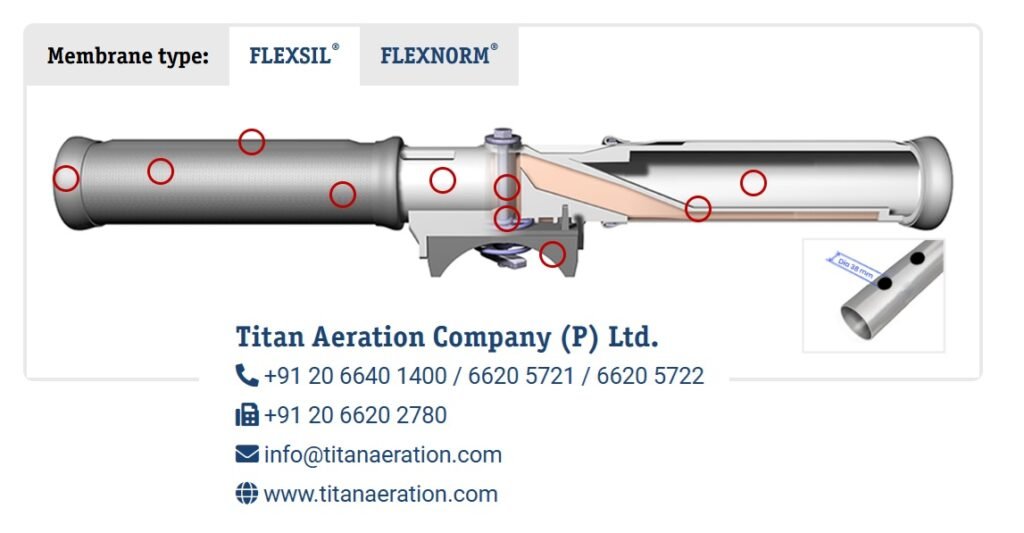
At Titan Aeration, we recognize the importance of selecting reliable aeration equipment that delivers consistent performance, supports energy efficiency, and reduces long-term operating costs. The right diffuser specification can improve oxygen transfer, maintain uniform air distribution, and help wastewater treatment facilities achieve their operational objectives.
This comprehensive guide explains the most important fine bubble diffuser specifications, including diffuser types, membrane materials, bubble size, airflow capacity, operating pressure, oxygen transfer efficiency, installation requirements, maintenance, and selection criteria.
What Is a Fine Bubble Diffuser?
A fine bubble diffuser is an aeration device designed to release air into wastewater as numerous small bubbles. These bubbles rise through the water, transferring oxygen into the liquid and supporting the microorganisms responsible for biological treatment.
Fine bubble diffusers are commonly installed at the bottom of aeration tanks. They receive compressed air from blowers through a network of distribution pipes and release it through perforated membranes or other specialized air-release surfaces.
The smaller bubbles generally provide a larger combined gas-liquid contact area and longer residence time than larger bubbles under comparable conditions. Consequently, fine bubble aeration can deliver effective oxygen transfer while reducing the amount of air required for certain treatment applications.
The overall performance of an aeration system depends on several factors, including diffuser design, membrane material, wastewater characteristics, submergence depth, air distribution, and blower efficiency.
Why Are Fine Bubble Diffuser Specifications Important?
Reviewing technical specifications before purchasing diffusers helps ensure compatibility with the treatment process and existing aeration infrastructure.
Incorrect diffuser selection may result in uneven air distribution, excessive blower pressure, insufficient oxygen supply, frequent maintenance, or premature membrane deterioration.
A properly specified diffuser system can offer several advantages:
- Improved oxygen transfer: Supports the biological processes responsible for reducing organic pollutants.
- Energy efficiency: Helps minimize the energy required to supply the necessary air, subject to actual system conditions.
- Uniform aeration: Distributes air throughout the treatment tank when the system is correctly designed.
- Reliable operation: Uses suitable materials and operating limits for the wastewater environment.
- Lower maintenance requirements: Appropriate materials and operating conditions can reduce premature wear and cleaning frequency.
- Flexible installation: Available in configurations suitable for new treatment plants and retrofit projects.
For these reasons, diffuser specifications should be evaluated alongside blower capacity, treatment requirements, tank dimensions, and the expected operating schedule.
Types of Fine Bubble Diffusers and Their Specifications
Fine bubble diffusers are available in several configurations. The most suitable option depends on tank geometry, airflow demand, installation constraints, wastewater characteristics, and maintenance preferences.
1. Fine Bubble Disc Diffuser Specifications
Disc diffusers feature a circular membrane mounted on a supporting base. They are commonly installed in grids across the floor of an aeration tank.
Typical technical characteristics include:
- Configuration: Circular disc with a perforated membrane.
- Common nominal diameters: Approximately 200 mm and 270 mm, with other sizes available.
- Membrane materials: EPDM, silicone, or other application-specific elastomers.
- Air distribution: Designed to release air through multiple small openings.
- Installation: Usually mounted on air distribution laterals.
- Applications: Municipal sewage treatment, industrial wastewater treatment, and biological aeration.
The actual airflow capacity, pressure loss, oxygen transfer performance, and recommended operating range vary by model.
Disc diffusers are often suitable for installations requiring a compact layout and a large number of aeration points. Their performance depends on the spacing between units, tank depth, membrane characteristics, and the uniformity of air supplied to the diffuser grid.
2. Fine Bubble Tube Diffuser Specifications
Tube diffusers use an elongated perforated membrane supported by a tubular structure. They can provide an extended aeration surface and may be suitable for treatment plants that require linear air distribution.
Common characteristics include:
- Configuration: Cylindrical or tubular diffuser assembly.
- Membrane materials: EPDM, silicone, or other compatible elastomers.
- Supporting structure: Commonly manufactured using suitable polymers or corrosion-resistant materials.
- Air distribution: Distributed along the active membrane length.
- Installation: Mounted horizontally or in another manufacturer-approved orientation.
- Applications: STPs, ETPs, industrial wastewater treatment, and aeration tank retrofits.
Tube diffuser specifications should identify the active membrane length, overall dimensions, recommended airflow range, connection size, operating pressure, and membrane material.
Longer diffusers may provide more aeration surface per installation point, but airflow distribution and pressure losses must be evaluated carefully. A suitable design should prevent excessive airflow variation along the diffuser and across the complete tank.
3. Fine Bubble Panel and Other Diffuser Configurations
Certain applications use panel-style or specialized membrane diffuser arrangements. These configurations may be designed for particular tank layouts, process conditions, or equipment constraints.
When evaluating these products, we recommend confirming the effective aeration area, membrane replacement procedure, connection requirements, cleaning method, and manufacturer-tested performance data.
The diffuser configuration should always be selected according to the treatment system’s engineering requirements rather than appearance or dimensions alone.