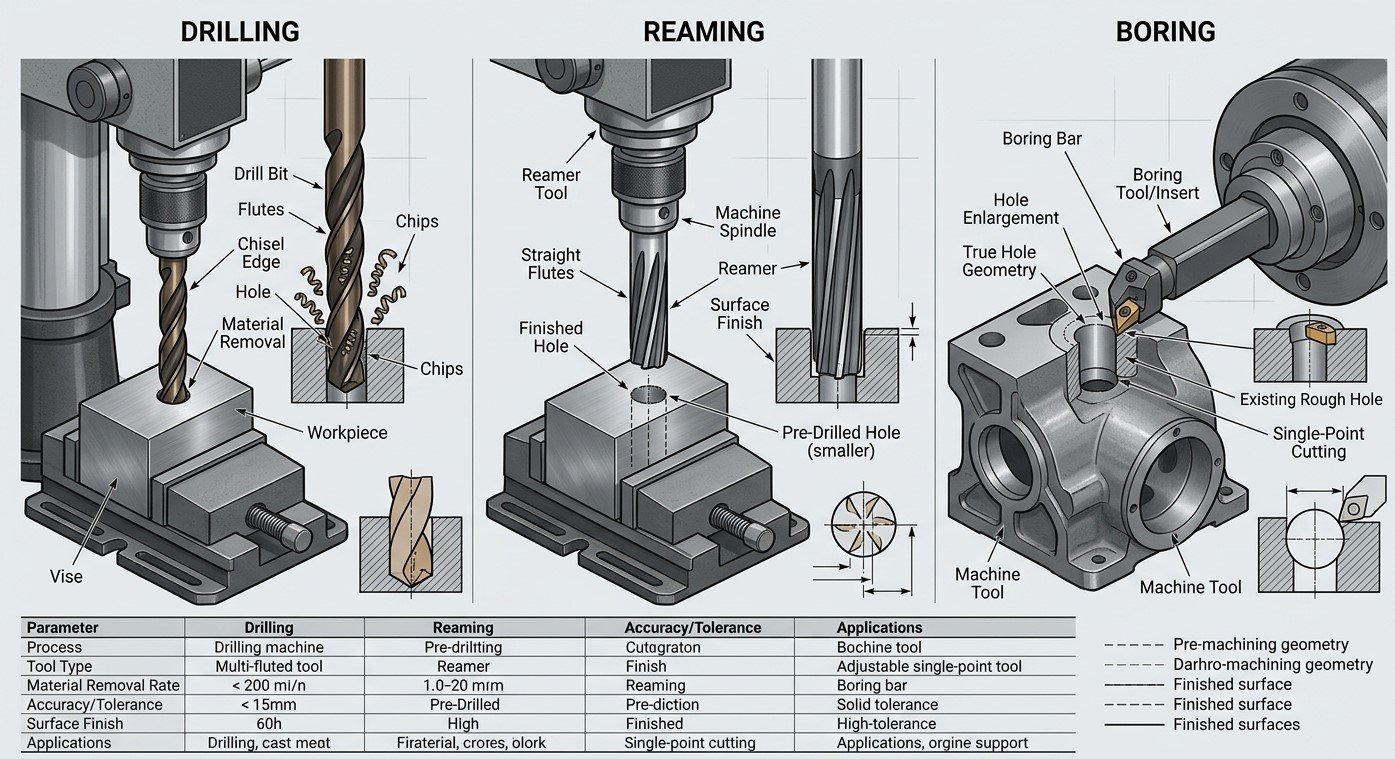
Hole-making is one of the most common operations in CNC machining and industrial manufacturing. However, creating a hole is not always enough to meet the required dimensional accuracy, surface finish, and assembly specifications. Depending on the application, manufacturers may need to use drilling, boring, or reaming to achieve the desired result.
Although these three machining processes all remove material, each serves a different purpose. Drilling creates an initial hole, boring enlarges or corrects an existing hole, and reaming improves the size accuracy and surface finish of a hole.
Understanding these differences helps machinists choose the right cutting tools, reduce production errors, and improve machining efficiency. Khokhawala Trading LLC, an Industrial Tools Supplier in Dubai, recognises the importance of selecting suitable industrial tools for accurate and reliable manufacturing operations.
This guide explains how drilling, reaming, and boring work, compares their advantages, and helps you determine which process is best for your machining application.
Table of Contents
- What Is Drilling?
- What Is Boring?
- What Is Reaming?
- Key Differences Between Drilling, Reaming, and Boring
- When Should You Use Each Process?
- Can Drilling, Boring, and Reaming Be Used Together?
- Common Mistakes to Avoid
- Frequently Asked Questions
- Conclusion and Call to Action
1. What Is Drilling?
Drilling is a machining process used to create a hole in a solid workpiece using a rotating cutting tool called a drill bit. It is often the first step in producing holes for fasteners, shafts, fittings, and other mechanical components.
During drilling, the cutting edges remove material as the drill advances into the workpiece. The chips are carried away through the drill’s flutes.
Common Types of Drilling Tools
- Twist drills: Widely used for general-purpose hole-making.
- Carbide drills: Suitable for demanding applications and compatible machining conditions.
- Indexable drills: Designed for efficient production and replaceable cutting edges.
- Centre and spot drills: Used to prepare or accurately locate the starting position for subsequent drilling.
Advantages of Drilling
- Creates holes quickly.
- Removes material efficiently.
- Supports a wide range of hole diameters and depths.
- Works with many materials when the correct drill and cutting conditions are selected.
Limitations of Drilling
Drilled holes may not achieve the final diameter, straightness, or surface finish required for precision assemblies. When tighter tolerances are needed, an additional boring or reaming operation may be necessary.
2. What Is Boring?
Boring is a machining process used to enlarge an existing hole and improve its dimensional accuracy or geometry. It commonly uses a boring bar or boring head equipped with a cutting edge.
Unlike drilling, boring does not normally create a hole from solid material. Instead, it removes material from the internal surface of a previously drilled, cast, or otherwise formed hole.
Common Boring Tools
- Boring bars: Used for internal turning and precision hole enlargement.
- Boring heads: Commonly used on milling machines to adjust and control bore diameter.
- Fine boring tools: Designed for applications requiring precise dimensional control.
- Damped boring bars: Help control vibration when machining deep bores.
Advantages of Boring
- Provides adjustable control over the hole diameter.
- Can improve hole roundness and alignment.
- Helps correct certain positional errors in an existing hole.
- Supports larger diameters and specialised internal machining operations.
Limitations of Boring
Boring can require careful setup, suitable tool rigidity, and controlled cutting conditions. Long tool overhangs may cause vibration or deflection, affecting the finished bore.
Boring is particularly valuable when the hole’s location, axis, or geometry must be improved rather than simply finished to a fixed diameter.
3. What Is Reaming?
Reaming is a finishing operation that removes a small amount of material from an existing hole to improve its diameter accuracy and surface finish. It uses a multi-edge cutting tool called a reamer.
Reaming is commonly performed after drilling or boring when the hole needs to meet a specific size or fit requirement.
Common Types of Reamers
- Hand reamers: Used for manual finishing applications.
- Machine reamers: Designed for use with machine tools.
- Carbide reamers: Suitable for compatible high-performance machining applications.
- Adjustable reamers: Allow limited diameter adjustment within their designed range.
- Spiral-fluted reamers: Can help manage chip flow in suitable applications.
Advantages of Reaming
- Improves hole diameter consistency.
- Produces a smoother internal surface.
- Supports precise fits for pins, shafts, and other components.
- Can be efficient when many holes require the same finished size.
Limitations of Reaming
Reaming removes relatively little material and generally follows the existing hole. It is not the preferred process for correcting major positional errors, significant misalignment, or substantial variations in hole diameter.
The pre-existing hole must have an appropriate size and condition, and the correct reaming allowance must be established for the tool and material.
4. Key Differences Between Drilling, Reaming, and Boring
The main difference is the purpose of each operation: drilling creates a hole, boring controls and refines an existing hole, and reaming finishes a hole to a more precise size.
| Feature | Drilling | Boring | Reaming |
|---|---|---|---|
| Primary purpose | Creates a hole | Enlarges or corrects an existing hole | Finishes an existing hole |
| Main tool | Drill bit | Boring bar or boring head | Reamer |
| Material removal | Usually removes the bulk of the material | Removes material to adjust diameter or geometry | Removes a small amount of material |
| Diameter control | Depends on drill and process conditions | Adjustable through tool setup | Generally determined by reamer size |
| Geometry correction | Limited | Can correct certain geometric or positional errors | Limited; generally follows the existing hole |
| Surface finish | Depends on the drill and conditions | Can improve the internal finish | Often produces a finer finish |
| Typical application | General hole-making | Precision bores and hole enlargement | Accurate finished holes and fits |
Actual accuracy and surface finish depend on the machine, tooling, workpiece material, cutting conditions, and setup. No single process guarantees a particular tolerance in every application.
5. When Should You Use Each Process?
Choose Drilling for Creating New Holes
Use drilling when a hole needs to be created in solid material. It is often the most efficient starting point for fastener holes, clearance holes, and holes that will undergo further machining.
Choose Boring for Diameter and Geometry Control
Use boring when an existing hole needs to be enlarged or when better control over its diameter, roundness, or alignment is required. It is particularly useful for bearing housings, precision machine components, and larger internal features.
Choose Reaming for Final Hole Finishing
Use reaming when a hole is already close to its required size and needs improved dimensional consistency and surface finish. It is useful for suitable dowel-pin holes, precision fittings, and other assemblies that require controlled hole dimensions.
The choice should be based on the engineering drawing, tolerance requirements, material, production volume, and the condition of the existing hole.
6. Can Drilling, Boring, and Reaming Be Used Together?
Yes. These processes can be combined when a component requires a high level of precision.
A typical machining sequence may be:
- Drill: Create the initial hole and remove most of the material.
- Bore: Enlarge the hole or improve its geometry when necessary.
- Ream: Remove a small amount of material to achieve the specified finished diameter and surface quality.
For example, a manufacturer producing a precision housing may drill an initial hole, bore it to improve alignment and prepare the diameter, and then ream it to meet the required fit.
However, not every hole requires all three operations. If drilling meets the drawing requirements, additional machining may be unnecessary. Likewise, boring alone may be sufficient when it can achieve the required diameter, geometry, and finish.
Selecting only the necessary operations can reduce tooling costs and production time.
7. Common Mistakes to Avoid
Avoid these common mistakes when selecting hole-making processes:
- Using drilling alone when the application requires tighter dimensional control.
- Choosing reaming to correct a significantly misaligned or poorly formed hole.
- Removing too much material during reaming.
- Selecting an unsuitable drill, boring bar, or reamer for the workpiece material.
- Ignoring chip evacuation and coolant requirements.
- Using excessive boring-bar overhang, which can increase vibration.
- Failing to measure the finished hole against the engineering drawing.
- Adding unnecessary operations that increase cycle time without improving the required result.
Careful tool selection, correct machining parameters, and appropriate inspection procedures help produce consistent holes and reduce rework.
8. Frequently Asked Questions
Q1. What is the main difference between drilling and boring?
Drilling creates a new hole in solid material, while boring enlarges or refines an existing hole and provides greater control over its diameter and geometry.
Q2. What is the difference between boring and reaming?
Boring uses a cutting tool to enlarge or correct an existing hole. Reaming removes a small amount of material to improve the final hole size and surface finish.
Q3. Which process provides the best surface finish?
Reaming often produces a finer finish than conventional drilling and may provide a suitable finish for precision fits. However, the result depends on the tool, material, setup, and machining conditions.
Q4. Is reaming necessary after drilling?
No. Reaming is only necessary when the hole requires additional dimensional accuracy or surface finish beyond what drilling can provide.
Q5. Can boring correct a hole that is out of position?
Boring can correct certain hole-position or alignment errors when the setup and toolpath allow the cutting axis to be repositioned appropriately. The amount of correction depends on the original hole, available material, and machining setup.
Q6. Which operation is best for precision-fit holes?
Reaming is often suitable for holes requiring a controlled diameter and smooth finish, provided the existing hole is correctly prepared. Boring may be needed first if the hole requires greater geometric or positional correction.
Q7. Which tools are used for these machining operations?
Drilling uses drill bits, boring uses boring bars or boring heads, and reaming uses reamers. The correct tool depends on the workpiece material, hole dimensions, machine capability, and required tolerances.
9. Conclusion and Call to Action
Drilling, boring, and reaming are essential hole-making processes, but each serves a different purpose. Drilling creates the initial hole, boring improves its diameter and geometry, and reaming provides final sizing and surface finishing where required.
Understanding these differences helps manufacturers select the right tools, avoid unnecessary machining steps, and achieve consistent component quality. By matching the process to the drawing requirements and maintaining suitable cutting conditions, workshops can improve efficiency and reduce rework.
Khokhawala Trading LLC supports businesses seeking industrial tooling solutions for machining and manufacturing applications. If you are looking for an Industrial Tools Supplier in Dubai, consider your hole-making requirements, tool compatibility, and precision targets when selecting drilling, boring, and reaming tools.
Contact Khokhawala Trading LLC to discuss your industrial tooling requirements and find suitable solutions for your machining operations.