
Introduction
Picture a bank statement line for 25,000. At Tech Leads IT, we show learners how two transactions can match it on amount and date, though only one is the expected receipt. If a broad rule grabs those fields before a tighter rule compares references, auto-reconciliation can choose a pairing that is technically valid but wrong for the business.
That is why rule sequence belongs in control design, not just configuration. Anyone taking Oracle Cloud Financials Online Training should learn that fields, grouping, tolerances, and candidate volume all matter, but order decides which rule acts first. Good Oracle Cloud Financials Training Online also teaches you to explain and reproduce every match.
What Oracle Cloud Financials Online Training Should Teach About Defining a Valid Match
Start with the statements you actually receive, not a vague wish to automate everything. Customer receipts might carry deposit numbers, payment references, and exact amounts. Bank fees may have dependable transaction codes but no system transaction until someone creates one. A payroll withdrawal might roll several internal items into a single bank line.
For each pattern, write down what a valid match looks like:
- Cardinality: one-to-one, one-to-many, many-to-one, or many-to-many.
- Required references: which fields must agree before the match is considered.
- Date window: how far apart the dates can be.
- Amount tolerance: how much difference is acceptable, if any.
- Currency: whether it must be identical.
Then ask the question that matters most: what makes this match unique? Amount alone almost never does, especially with round numbers or recurring payments.
The bank account also shapes the problem. A rule that works well on a quiet account can behave very differently on a busy collections account. A five-day date window might produce two candidates on one and dozens on the other. Before you turn on automatic action, look at the statement source, transaction source, cash account, currency, and the usual spread of values, and count the candidates a rule would see. If several transactions meet the same conditions and nothing in the business logic can separate them, the item should stay an exception. A person should decide it, not a coin flip hidden inside a rule.
Put Narrow Rules Before Broad Fallbacks
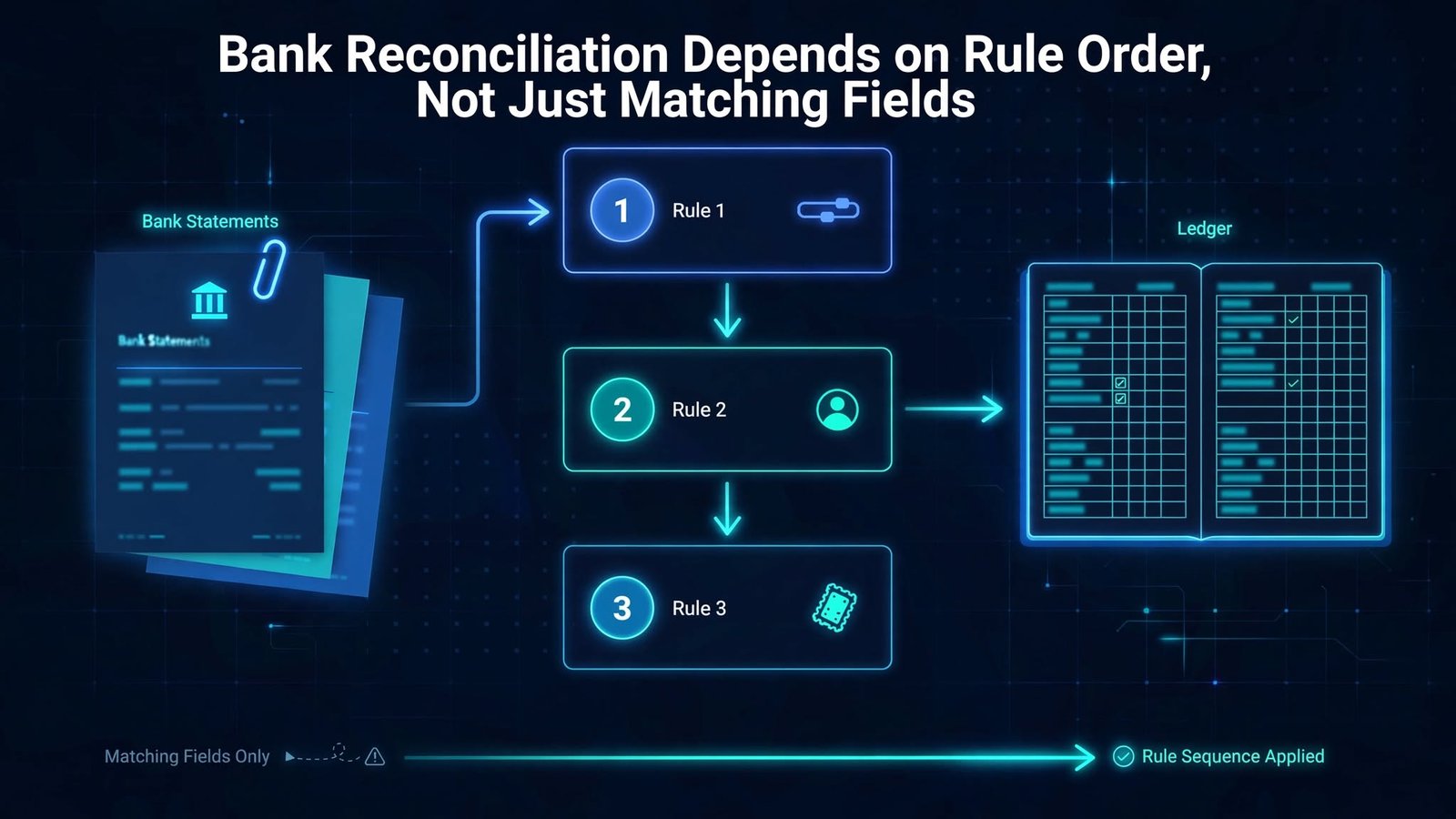
Oracle’s Automatic Reconciliation uses the rule set assigned to a bank account to match statement lines with system transactions. It helps to think of that rule set as a queue, not a pile of independent checks. Whichever rule runs first gets the first claim on a line.
So the sensible arrangement is to put rules built on strong identifiers and tight conditions at the top. Rules that lean on common amounts or wide date ranges go further down, and the broadest ones are best reserved for low-risk patterns or left to manual review. Write down why each rule sits where it does. Otherwise, months later, someone will move a handy fallback to the top of the list and quietly undo the protection you built.
Here is a simple example with three rules for incoming receipts:
- Rule A: exact bank reference plus amount.
- Rule B: amount, a two-day date window, and a unique customer identifier.
- Rule C: amount plus a five-day window.
If Rule C runs first, it can claim lines that A or B would have matched with far better evidence. If A runs first, the strongest evidence is used before weaker evidence is even considered. Same rules, different order, different outcome.
That’s why testing should go beyond “did everything reconcile?” Build cases where candidates deliberately overlap. A good test shows which rule acted, why that line was eligible for it, and why the competing candidates were turned down.
Treat Tolerances as Policy
Tolerances look like small settings, but they are decisions about how much imprecision the business will accept. They should trace back to a real cause. Settlement delays can justify a date window. Bank charges, currency conversion effects, or rounding might justify a small amount difference, as long as the process behind it is approved.
A tolerance without a stated reason is really just permission for near matches. For each one, record the cause it covers, the maximum exposure, the accounts it applies to, who reviews it, and a few examples that sit right at the boundary. Then test just inside and just outside each limit. Test repeated amounts too. A one-unit tolerance may be harmless on an account with varied values and risky on one where many daily transactions look alike.
Grouping adds another layer of risk. One deposit on the statement may equal several receipts, and several bank lines might represent a single system transaction that is settled in stages. You need to define how records get grouped and what stops unrelated items from adding up to the same total. Date, reference, currency, legal entity, and source often matter more than whether the arithmetic works out.
A useful test here is to build synthetic data where a correct group and an incorrect combination produce identical totals. If your rule can’t tell them apart, it isn’t ready for automatic reconciliation. Either add a stronger attribute or leave that population for review. Don’t accept whichever combination the system happens to find first.
Why Oracle Cloud Financials Training Online Should Include Exception and Match Review
Exceptions tell you where the weak spots are, whether in the statement data, the system data, or the rule design. Sort unmatched lines by cause: missing reference, date outside tolerance, amount difference, wrong account, duplicate statement entry, missing system transaction, or multiple candidates. Also note which rule you expected to handle each one. Patterns show up quickly once you do this.
Don’t stop at the exceptions, though. Successful matches deserve a sample check, particularly after a rule change or a jump in volume. For each sampled match, look at the bank line, the transactions selected, the rule that acted, the attributes it used, and the alternatives that were available. A low exception rate can feel reassuring while hiding a broad rule that reconciles almost anything. The goal is accuracy, and throughput is only part of that.
Change Rules Carefully, Not Casually
Any change to a rule set should go through a controlled process. Keep the previous rule set, the proposed condition, the expected population, a test statement, the predicted matches, the expected exceptions, and a reviewer’s approval. Run the old and new versions against the same historical sample, without creating duplicate reconciliation entries, and compare what each one does.
Be willing to reject a change that looks good on paper. If the match rate goes up but ambiguous candidates also go up, or reference evidence gets weaker, the change is a step backward. Schedule activation for a time when you know the unreconciled volume, and decide in advance what triggers a rollback if results differ materially.
Also keep the rule version or effective date alongside your reconciliation evidence. Later on, a reviewer may need to understand why a line matched under logic that is no longer active. And when a change widens a tolerance or removes a reference field, get a second reviewer involved. Those edits can turn exceptions that used to be visible into silent matches.
Conclusion: Order Turns Matching into Control
Automatic bank reconciliation depends on rule order just as much as on fields and tolerances. Anyone going through Oracle Cloud Financials Online Training should learn to build from real statement patterns, define what evidence makes a match unique, and put specific rules ahead of broad fallbacks. From there, test overlapping candidates, equal-total groups, tolerance boundaries, and repeated amounts. Watch which rule acted, and sample successful matches instead of treating a high match rate as proof of quality.
Back to the 25,000 line from the start: the defensible answer is the transaction chosen on stronger reference evidence, not whichever item shared the amount. When the logic is ordered and testable, reconciliation stops being convenient matching and becomes a cash control you can stand behind in an audit.