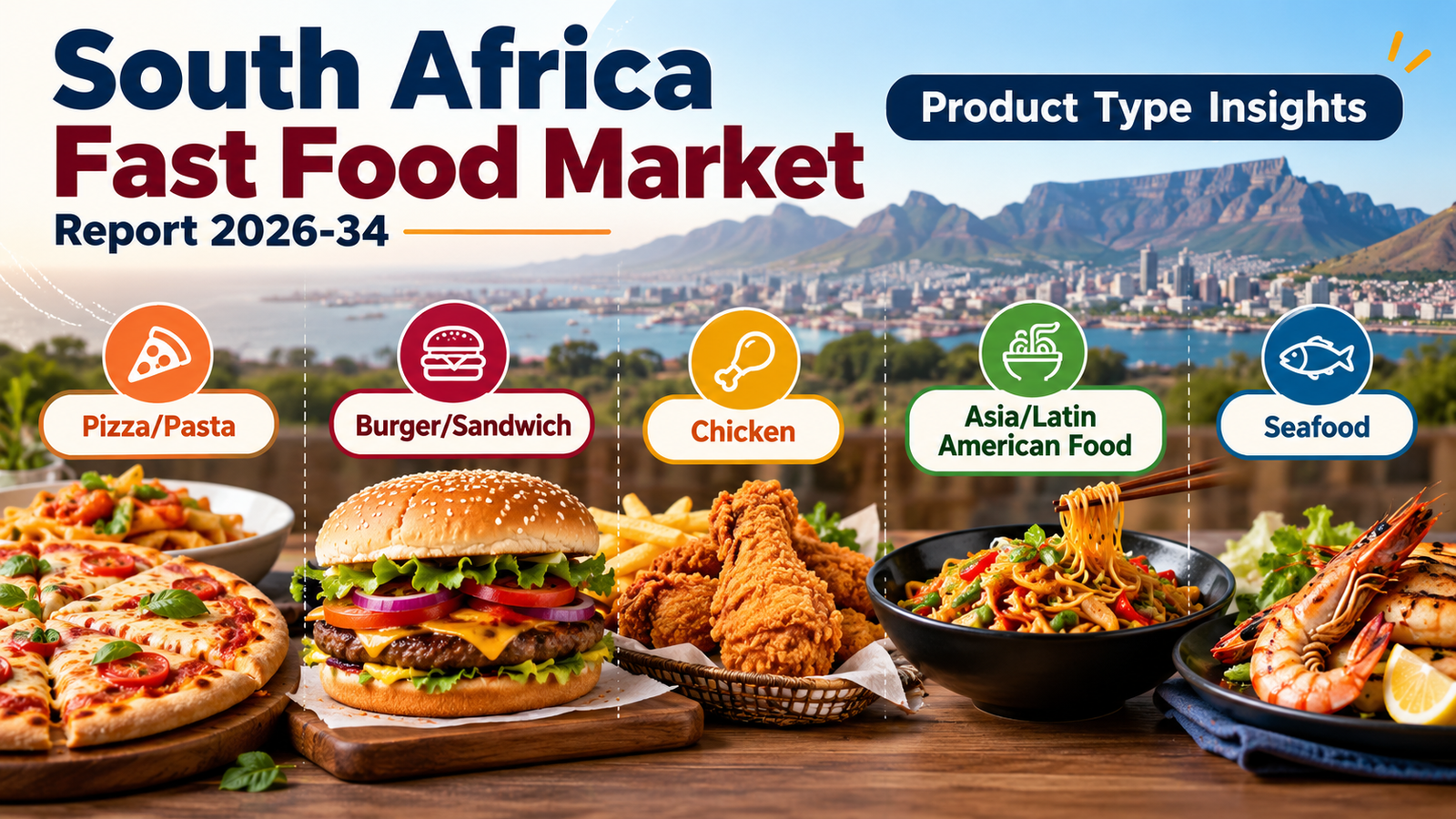
The South Africa fast food market is expanding as urban lifestyles, convenience-led consumption, established franchise networks, and digital food ordering reshape eating habits. The country’s broader foodservice industry generated about USD 5.5 billion in sales, highlighting the scale of commercial food consumption. Demand is supported by strong consumer familiarity with quick-service restaurants, price-focused meal deals, takeaway formats, and delivery platforms. South Africa fast food market size reached USD 6.5 Billion in 2025. Looking forward, IMARC Group expects the market to reach USD 8.3 Billion by 2034, exhibiting a growth rate (CAGR) of 2.60% during 2026-2034. South Africa also maintains one of Africa’s most developed restaurant franchise ecosystems, with domestic and international brands competing across chicken, burgers, pizza, sandwiches, and other convenient meal categories.
How AI is Reshaping the Future of South Africa Fast Food Market?
- AI-powered demand forecasting is helping fast food operators analyze ordering patterns, store traffic, weather, promotions, and local preferences. Restaurants can use these insights to optimize ingredient purchasing, staffing, and food preparation, helping reduce waste while improving service during peak periods.
- Personalized digital ordering is becoming increasingly important as restaurants use customer data to recommend meals, combinations, upgrades, and promotions based on previous purchases. This approach complements South Africa’s expanding online food ordering environment, where delivery platforms provide consumers with easier access to fast food and convenience meals.
- AI-enabled restaurant operations can improve kitchen efficiency through automated order routing, inventory monitoring, predictive maintenance, and digital menu optimization. These applications are particularly relevant for high-volume quick-service restaurants where preparation speed and order accuracy directly influence customer satisfaction.
- Data-driven location planning is allowing franchise operators to evaluate population density, spending patterns, delivery demand, traffic flows, and competitor locations before opening new outlets. South Africa’s extensive franchise infrastructure creates substantial opportunities for analytics-based expansion. For example, Famous Brands had more than 2,600 restaurants in South Africa across its portfolio, demonstrating the scale of organized restaurant networks in the country.
- AI-driven marketing and loyalty programs enable fast food companies to segment consumers, automate promotional offers, predict repeat purchases, and optimize advertising expenditure. Digital menu boards, mobile applications, rewards programs, and targeted meal promotions are increasingly important tools for attracting value-conscious customers.
Grab a sample PDF of this report: https://www.imarcgroup.com/south-africa-fast-food-market/requestsample
Market Growth Factors
The South Africa fast food market is benefiting from a deeply established quick-service restaurant culture and extensive franchise networks. Domestic brands such as Steers, Debonairs Pizza, and Chicken Licken compete alongside global operators such as KFC, McDonald’s, and Burger King, providing consumers with broad product and price choices. The scale of the ecosystem is illustrated by Famous Brands, which operates thousands of restaurants across its overall network and maintains a particularly large footprint in South Africa. High-density commercial areas, shopping centers, transport corridors, townships, and suburban locations provide operators with multiple expansion formats. Franchise models also enable companies to extend geographic coverage while combining standardized menus with local preferences. Chicken, burgers, pizza, takeaway meals, and affordable combination offers remain particularly relevant as operators compete for frequent purchases from working consumers, students, families, and younger demographics.
Digitalization is another important factor supporting the market as consumers increasingly combine physical restaurant visits with app-based ordering, takeaway, and home delivery. South Africa’s digital commerce environment has experienced substantial development, while food delivery platforms have expanded access to both fast food and convenience meals. Restaurants are responding by integrating digital ordering systems, loyalty programs, personalized promotions, cashless payments, and delivery partnerships into their operating models. These channels allow brands to reach consumers beyond conventional restaurant catchment areas while generating valuable information on ordering frequency, meal preferences, spending patterns, and promotional response. Digital platforms also provide smaller restaurant operators with an additional route to customers without requiring extensive physical expansion. For large chains, data from online transactions supports menu optimization, targeted discounts, demand forecasting, and improved customer retention, strengthening omnichannel competition across the South Africa fast food market.
Changing consumer preferences are encouraging operators to balance affordability with menu innovation. South African consumers remain highly price-sensitive, making promotions, bundled meals, loyalty rewards, and entry-level products important competitive tools. At the same time, restaurants are introducing differentiated chicken products, premium burgers, sauces, beverages, snack formats, and locally relevant flavors to increase customer engagement. Chicken remains especially important within quick-service restaurant menus, while global operators continue investing in product innovation. KFC, for example, announced a global menu refresh centered on flavor customization and a portfolio of more than 20 internationally inspired sauces, with its Dunked concept already associated with South Africa. Restaurant groups are also investing in responsible sourcing, transformation, supply-chain capabilities, and community initiatives. Famous Brands reported achieving a Level 1 B-BBEE rating, illustrating the importance of transformation within South Africa’s organized restaurant sector.
Market Segmentation
Product Type Insights:
- Pizza/Pasta
- Burger/Sandwich
- Asian/Latin American Food
- Chicken
- Seafood
- Others
End User Insights:
- Food-Service Restaurants
- Quick Service Restaurants
- Caterings
- Others
Regional Insights:
- Gauteng
- KwaZulu-Natal
- Western Cape
- Eastern Cape
- Mpumalanga
- Limpopo
- North West
- Free State
- Northern Cape
Recent Development & News
August 2024: South African foodservice company Bidcorp reported a 15.1% increase in revenue to R225.9 billion, while trading profit increased 15.9% to R12.2 billion. The company also recorded nearly 6% volume growth after adjusting for food inflation, highlighting resilient activity within the broader foodservice supply ecosystem.
June 2025: South Africa-based Famous Brands continued to demonstrate the scale of organized restaurant franchising, with its network encompassing brands such as Debonairs Pizza, Steers, Wimpy, Fishaways, and Mugg & Bean. The group had more than 2,600 restaurants in South Africa, supported by manufacturing and logistics infrastructure serving its restaurant network.
June 2026: KFC announced a major global menu and restaurant refresh focused on personalization, new beverages, restaurant experience, and flavor innovation. The strategy included a global sauce portfolio containing more than 20 sauces and further expansion of its Dunked menu, a concept already available in South Africa.
If you require any specific information that is not covered currently within the scope of the report, we will provide the same as a part of the customization.
About Us
IMARC Group is a global management consulting firm that helps the world’s most ambitious changemakers to create a lasting impact. The company provides a comprehensive suite of market entry and expansion services. IMARC offerings include thorough market assessment, feasibility studies, company incorporation assistance, factory setup support, regulatory approvals and licensing navigation, branding, marketing and sales strategies, competitive landscape and benchmarking analyses, pricing and cost research, and procurement research.
Contact Us
IMARC Group,
134 N 4th St. Brooklyn, NY 11249, USA,
Email: sales@imarcgroup.com,
Tel No: (D) +91 120 433 0800,
United States: +1-201971-6302