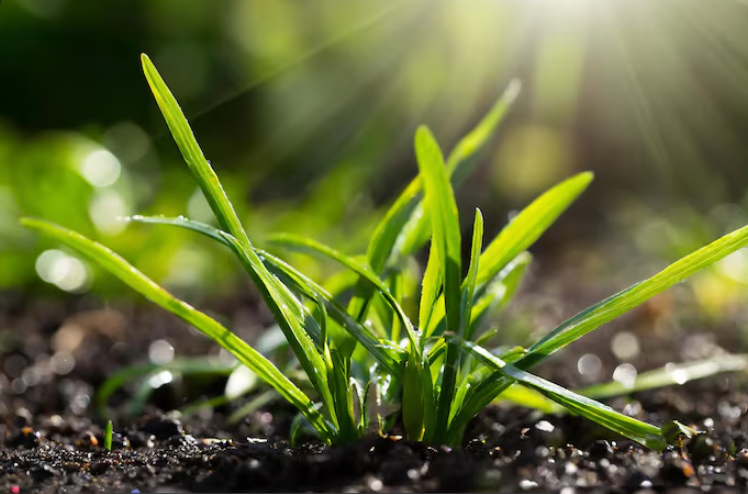
Grass seed germination time is the question that arrives about nine days after seeding, usually from somebody standing in the yard wondering if they wasted their money. The answer depends almost entirely on which species went down and how warm the soil is, and the spread between the fastest and slowest grasses in a typical mix is wide enough to alarm anyone not expecting it.
A homeowner who seeded a four-way mix and sees patchy green at day eight is looking at a partial result rather than a partial failure, though nothing on the bag explains that.
Germination Times by Species
The ranges below assume soil temperature sitting in the right band and consistent moisture throughout, both of which get covered further down because they stretch every number when they are off.
The Faster Species
Perennial ryegrass germinates in five to ten days and is the fastest cool-season grass by a clear margin, which is why it appears in nearly every mix sold here. It covers ground quickly, holds soil against erosion on slopes, and gives the homeowner something visible while slower species work underground.
Tall fescue follows at seven to twelve days, middling on speed and strongest on durability, with deep roots that handle heat and drought better than the alternatives. Because it grows in clumps rather than spreading sideways, density from tall fescue comes entirely from how much seed went down.
The Slower Species
Fine fescues run seven to fourteen days and cover several related species used primarily for shade tolerance, establishing reasonably quickly and holding on in low-light areas where other cool-season grasses thin annually.
Kentucky bluegrass is the outlier at fourteen to twenty-one days and can stretch to thirty under cooler conditions. It is the slowest common choice and the source of the most anxious phone calls. It earns that patience by spreading through underground stems, filling bare spots on its own between seedings in a way bunch-type grasses cannot, so nothing is wrong on day fifteen.
Why a Mix Sprouts in Waves
Most Northeast lawns get seeded with a combination of species, which means germination arrives in distinct stages rather than all at once. Around day six the ryegrass appears as a thin green haze that barely reads as grass. By day ten or twelve the fescues join it and coverage looks considerably less patchy. Past day fifteen the bluegrass comes through and the stand begins reading as turf rather than scattered seedlings in dirt.
Homeowners who do not expect this sequence frequently conclude at day eight that half the seed failed. Then, either they reseed over what is already working or abandon the area, when the remaining species are simply on a different clock.
Soil Temperature Sets the Clock
Everything above assumes the soil is in range, and when it is not, every number stretches or stops. Cool-season grasses germinate best when soil sits between roughly 55 and 70 degrees. The measurement that matters is soil warmth rather than air temperature, a distinction that catches people out in spring when the air feels warm enough to plant and the ground has not caught up.
Below 50 degrees, germination slows dramatically or halts. Seed put into cold November ground sits dormant rather than dying outright, and some comes through the following spring, though a meaningful share rots in wet soil over winter. Above 75 degrees the problem reverses, since seedlings that emerge face heat stress severe enough to kill a good portion before they root. Across New England, soil holds the useful range from late August into mid-October and again briefly from mid-April into May.
What Slows Germination Down
Beyond temperature, four factors account for most delays and failures. Inconsistent moisture is the largest, because seed that absorbs water, begins germinating, then dries out completely is dead seed that will not restart. The top half inch needs to stay damp for the first ten to fourteen days, which means light watering once or twice daily rather than the deep schedule an established lawn prefers.
Poor seed-to-soil contact comes second, since seed resting on thatch or hard ground has nothing holding moisture against it during the hours that matter. This is why seeding into aeration holes outperforms broadcasting by such a margin, as seed inside a hole has soil contact on every side rather than underneath only.
Seed buried too deep is less common but real, since grass seed needs light and should sit at or barely below the surface. Old or low-quality seed matters more than people assume, as germination rates decline with age and bargain mixes carry filler alongside annual ryegrass that dies within a season. The tag states germination percentage and test date, and both are worth reading.
When to Worry That Nothing Is Coming Up
A reasonable point to begin investigating is roughly twenty-five days after seeding with nothing visible, assuming soil temperatures stayed in range and watering was consistent. Before concluding the seeding failed, dig up a few seeds and look at them closely, because they will tell you which problem you have.
Seeds that have swollen and show a white root emerging are alive and on schedule. Seeds looking exactly as they did coming out of the bag never started, which points at moisture. Mushy or moldy seeds absorbed water and then sat in ground too cold or too saturated. Confirm which species you planted as well, since a pure bluegrass seeding sitting quiet at day twenty is normal.
From Sprout to Established Lawn
Germination is the beginning rather than the finish, and that gap is where most seeding projects get judged prematurely. New grass is usually tall enough for a first cut around week four at roughly three and a half inches, taking no more than a third of the height with sharp blades, since dull ones tear young grass out roots and all.
Foot traffic should stay off for two to three weeks because walking on seedlings breaks them at the crown, and nothing containing pre-emergent goes down until the grass has been mowed two to four times, since those products stop grass seed exactly the way they stop weed seed.
Root development continues well after top growth slows in late fall, so seed put down in September keeps building underground through October and November and wakes the following April already rooted. Full density on a badly thinned lawn generally takes two or three consecutive seasons.
The regional companies pair seeding with aeration on a multi-year cycle for that reason, Stateline LawnCare in Haverhill among them.
What the Timeline Actually Means
The practical value in knowing these numbers is that it prevents the two mistakes that waste a seeding. The first is reseeding at day eight over ground where slower species are still germinating, which costs money and crowds what was already working. The second is concluding at day twenty that the whole thing failed and abandoning the watering schedule right as the bluegrass was about to come through.
Grass seed runs on soil temperature and moisture rather than the calendar in anyone’s head, and a homeowner who knows which species went into the ground and keeps the surface damp for two weeks has already done the part that decides the outcome.