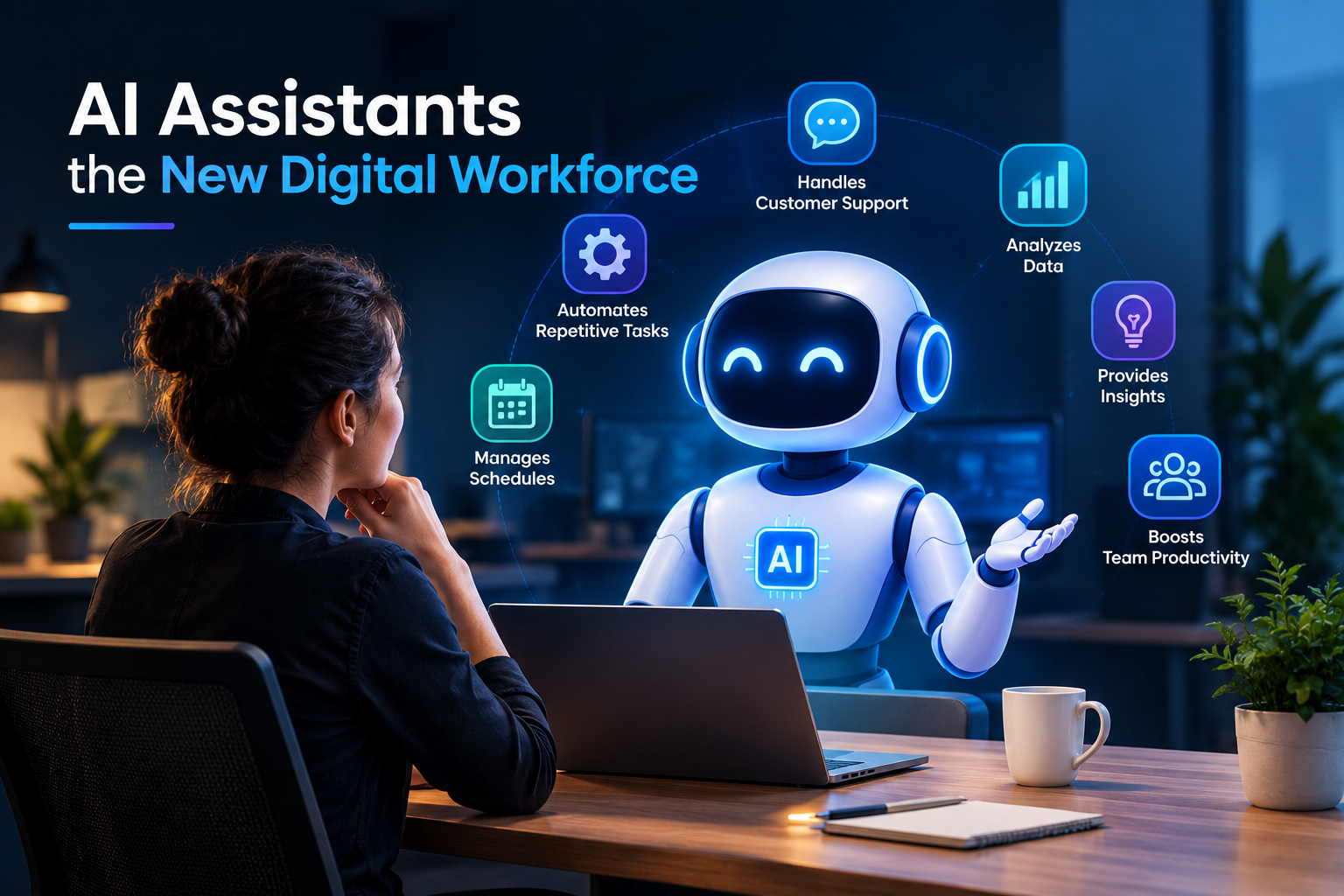
Artificial intelligence is changing how businesses approach everyday work. Tasks that once required hours of manual effort can now be supported by intelligent systems capable of understanding information, generating content, answering questions, and assisting with workflows. Among these technologies, AI assistants are becoming increasingly important as businesses look for practical ways to improve productivity without removing human oversight.
Modern AI assistants go beyond simple chatbots. They can connect with business systems, process information, support decision-making, and perform specific tasks based on defined instructions. As the technology continues to evolve, AI assistants are increasingly becoming part of the digital workforce.
What Is an AI Assistant?
An AI assistant is a software system designed to understand user requests and provide useful responses or perform specific actions. Depending on its purpose, an assistant may answer questions, summarize documents, schedule activities, retrieve information, generate content, or interact with other business applications.
Unlike traditional automation, AI assistants can handle more flexible and natural interactions. They can interpret language and use context to determine what a user is trying to accomplish.
For example, a customer support assistant could identify the intent behind a customer’s question, retrieve relevant information from a knowledge base, and suggest an appropriate response to a support agent.
Why Businesses Are Adopting AI Assistants
Businesses generate enormous amounts of information every day. Employees often spend significant time searching for information, responding to repetitive requests, preparing documents, and moving data between systems.
AI assistants can support these activities by acting as an intelligent layer between employees and business information.
Improving Employee Productivity
An AI assistant can help employees find information quickly, draft emails, summarize meetings, organize notes, and complete repetitive administrative tasks.
This allows employees to spend more time on activities that require human judgment, creativity, and collaboration.
Supporting Customer Service
AI assistants can help customer service teams respond to common questions, summarize customer interactions, identify relevant information, and recommend possible next steps.
Human agents can remain involved when a situation requires empathy, complex reasoning, or specialized knowledge.
Making Business Information Easier to Access
Employees often need information from multiple systems. An AI assistant can provide a conversational interface that helps users retrieve relevant information without navigating through multiple applications.
This can make internal knowledge more accessible while reducing time spent searching.
Key Components of AI Assistant Development
Building an effective assistant requires more than connecting an application to a language model.
Natural Language Understanding
The assistant needs to understand different ways users may phrase the same request. Natural language processing and modern language models can help interpret these interactions.
Business Knowledge
An assistant needs access to reliable information. This may include company documentation, product information, policies, databases, or knowledge bases.
The quality and relevance of this information directly affect the usefulness of the assistant.
System Integrations
Modern assistants can become more valuable when connected to business applications. Depending on the use case, integrations may include CRM systems, ticketing platforms, calendars, databases, communication tools, and internal applications.
Security and Access Controls
AI assistants may interact with sensitive business information. Appropriate authentication, authorization, data protection, and access controls should therefore be considered during development.
These considerations are an important part of responsible AI Assistant Development.
How to Build an Effective AI Assistant
Businesses considering an AI assistant should begin with a clearly defined use case instead of trying to automate everything at once.
1. Identify a Specific Business Problem
Start by identifying repetitive or time-consuming activities where an assistant could provide measurable value.
2. Define the Assistant’s Responsibilities
Clearly establish what the assistant can and cannot do. Defined boundaries can improve reliability and reduce unintended actions.
3. Select the Right AI Model
Different use cases may require different models, tools, or architectures. Factors such as accuracy, speed, cost, context handling, and privacy should influence the decision.
4. Connect Relevant Data
Provide access to reliable and relevant business information while applying appropriate security controls.
5. Test With Real Scenarios
Testing should include realistic user questions, unexpected requests, incomplete information, and situations where the assistant should hand the task to a human.
6. Monitor and Improve
AI assistants should be continuously evaluated after launch. User feedback, performance metrics, errors, and changing business requirements can guide ongoing improvements.
AI Assistant Services and Business Adoption
Organizations that do not have the required internal expertise may explore AI Assistant Services to support planning, development, integration, and deployment.
However, choosing a provider should involve more than evaluating technical capabilities. Businesses should consider whether the team understands their workflows, security requirements, users, data environment, and long-term product objectives.
For larger or more specialized projects, AI Assistant Development Services may include custom integrations, knowledge retrieval, workflow automation, model optimization, monitoring, and ongoing maintenance.
Companies such as CodeCones combine AI development with software engineering, data, cloud, and product development capabilities, which can be relevant when an AI assistant needs to operate as part of a broader digital product.
The Future of the Digital Workforce
AI assistants are unlikely to replace every aspect of human work. Instead, their role is increasingly focused on supporting people by handling repetitive activities, providing information, and assisting with defined workflows.
The most useful implementations are likely to combine AI capabilities with human oversight. Employees can remain responsible for decisions that require judgment, empathy, accountability, or specialized expertise, while AI handles suitable routine tasks.
Conclusion
AI assistants are evolving from basic question-and-answer tools into intelligent systems capable of supporting real business workflows. Their potential extends across customer service, internal operations, knowledge management, productivity, and many other areas.
Successful implementation depends on choosing the right use case, defining clear responsibilities, connecting reliable data, implementing security controls, and continuously improving the system.
For businesses considering an AI assistant, the practical starting point is to identify one meaningful workflow where intelligent assistance can create measurable value. From there, organizations can gradually expand capabilities based on real user needs and results.