
Introduction
Every finance team knows the feeling of seeing a wall of green on a close dashboard, but a green indicator only confirms that a task has reached a status. It does not prove that every dependency is finished or that every balance has cleared. At Tech Leads IT, we teach finance professionals to look behind the colors before approving the next step in the close.
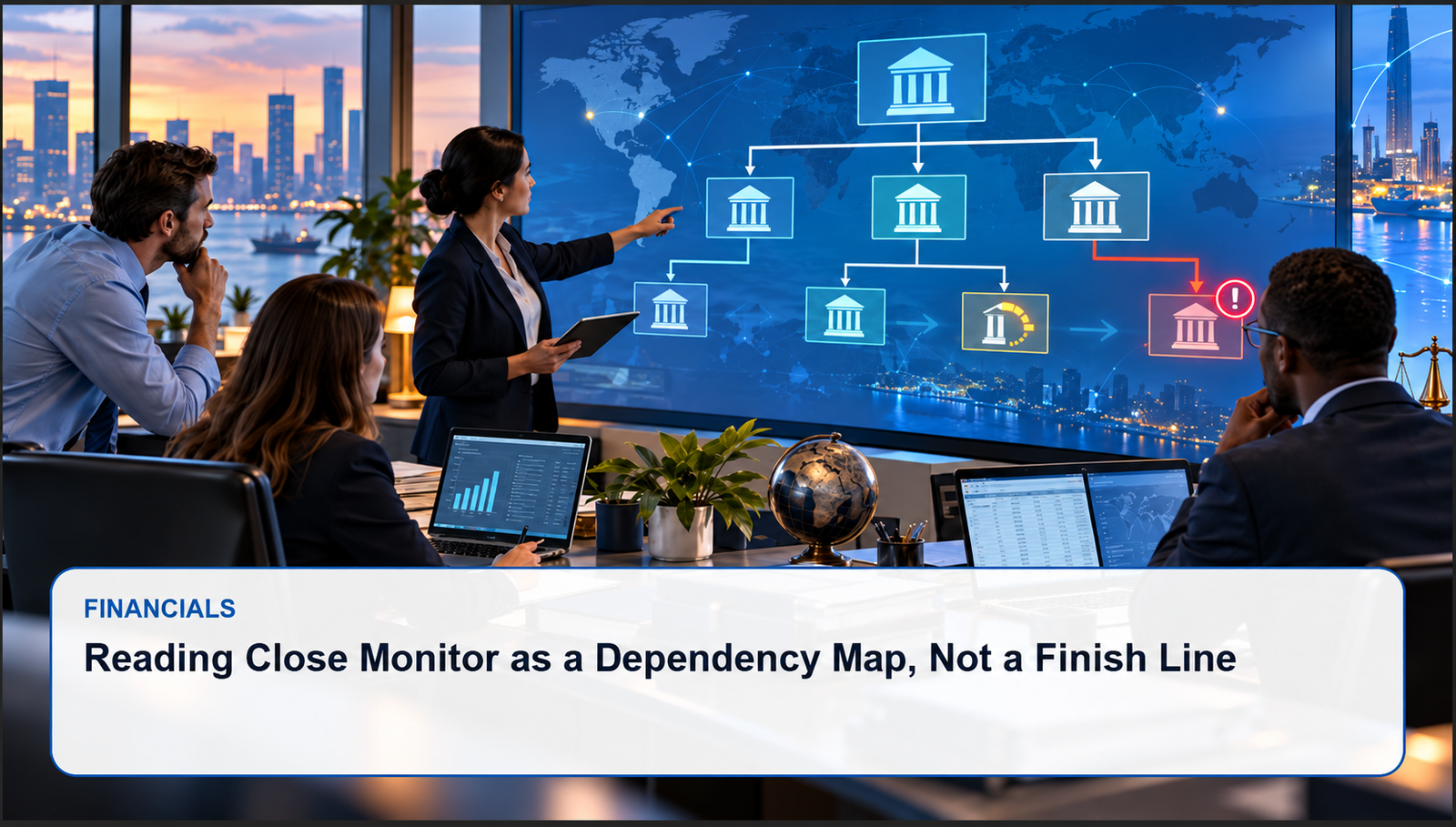
Consider a regional close where one subsidiary is still clearing intercompany differences. The consolidated view may look healthy while that single entity holds the whole period open. That is why Close Monitor works best as a dependency map, not a finish line. Our Oracle Fusion Financials Online Training walk controllers, ledger owners, and consolidation analysts through realistic scenarios, so they can read Close Monitor responsibly, test difficult cases, and leave evidence that another analyst can follow without guessing.
Why Oracle Fusion Financials Training Treats Close Monitor as a Decision Tool
Close Monitor is often introduced as a screen: a hierarchy of ledgers and entities, each with a status. Learners who stop there end up memorizing fields instead of understanding the work. Good Oracle Fusion Financials Training starts from a different question: is this close hierarchy fit for the next business action?
That question matters because the people looking at the screen each see only part of the picture. Controllers care about whether the period can be signed off. Ledger owners care about whether their own books are complete and accurate. Consolidation analysts care about whether the entities roll up cleanly. None of them can answer the question alone, because the answer depends on how the hierarchy compares with ledger status, task ownership, the ledgers each person is actually authorized to reach, and any unresolved balances.
A defensible conclusion connects all of those pieces. It also records enough context that another analyst, looking at the same facts later, would reach the same decision. That is the standard this scenario sets: not a completed close, but a close that can be explained and verified.
Frame the Decision Before Opening the Screen
The first step happens before anyone logs in. The finance group should agree on what judgment it expects Close Monitor to support and what remains a human decision. The screen can show status, but it cannot decide whether an intercompany difference is acceptable or whether a late adjustment should be allowed.
In our regional close, the team compares the Close Monitor hierarchy with four things: the status of each ledger, who owns each task, which ledgers each user can reach through the hierarchy, and which balances remain unresolved. Doing this keeps the conversation on the business assertion, such as “this entity’s intercompany position is settled,” rather than on the color of a badge. It also exposes the central risk early: green indicators being treated as proof that every dependency is complete, before that reading ever reaches a supplier, an employee, or the general ledger.
A useful walkthrough starts with the initiating event, records each handoff, and pinpoints the moment when someone’s reading of the screen becomes an operational decision. At that moment the team should capture the ledger status, task ownership, ledger reach, and open balances next to the hierarchy view. Without that record, a later investigator may find the decision perfectly reasonable on its face, yet be unable to see the facts that actually justified it.
Follow the Transaction Through Its Boundaries in an Oracle Fusion Financials Course
Setup and reach must always be read together. A correct rule applied to the wrong population still produces a misleading answer. If a ledger owner can see only part of the hierarchy, the view they rely on may be accurate and still incomplete.
A strong Oracle Fusion Financials Course makes this concrete with two examples of the same close. The first is an ordinary case in which everything flows as expected. The second is a deliberately awkward variation, such as a subsidiary whose intercompany balances are still open when its tasks have already been marked complete. Before looking at the screen, controllers, ledger owners, and consolidation analysts each predict what the hierarchy should show. Then they compare the prediction with the actual ledger status, task ownership, reach, and balances.
Any gap between expectation and screen becomes a question to test, not an invitation to adjust the data until it looks familiar. The team should write down the expected conclusion before testing so that a plausible screen cannot quietly rewrite the original business requirement. The person responsible for the check, the close steward, keeps that written expectation and the comparison available through every checkpoint, ideally twice a day during a busy close.
This discipline pays off because problems like this are usually discovered after the original operator has moved on. By then, memory is no substitute for a transaction history.
Test the Exception, Not Just the Happy Path
Anyone can pass a close that goes smoothly. The real test comes from awkward conditions: a late change, an incomplete record, a duplicate request, or a case just outside the normal date or amount threshold.
For controllers, ledger owners, and consolidation analysts, the key distinction is between completion and fitness for use. The hierarchy may be technically complete while the ledger status, task ownership, reach, and open balances show that it cannot support the next step. In our scenario, every task in the subsidiary might be ticked off while intercompany differences remain, so the entity is complete on paper but not ready for consolidation.
An authoritative reference helps the team separate supported behavior from local assumptions and convenient workarounds. For this topic, the primary source is the Oracle Help Center overview of Close Monitor. Grounding the review in documented behavior keeps the discussion from drifting toward “that’s how we’ve always done it.”
During each checkpoint, sort exceptions by consequence, age, and how often they repeat. Start with the records where a misread green indicator could affect downstream work, then inspect the supporting facts. This ordering stops a large queue of harmless items from hiding one materially important judgment.
Keep Evidence With the Operational Record in Oracle Fusion Financials Online Training
Evidence has to outlive the meeting. Identifiers, timestamps, parameters, statuses, and exceptions belong in a retrievable file, not in someone’s inbox or memory. This is a theme that Oracle Fusion Financials Online Training returns to repeatedly, because online learners practice with a concrete close file they can revisit and compare against their own work.
A controlled repair leaves the hierarchy understandable. It records who acted, which fact about ledger status, ownership, reach, or balances justified the action, and how the team confirmed the result. History should explain the repaired state without erasing proof of the original condition. If the original problem disappears from the record, no one can tell whether it was fixed or merely hidden.
Operators also need an escalation path that preserves the original data. The temptation, under time pressure, is to correct the symptom with an undocumented manual adjustment or to add a broad workaround around the hierarchy. Both are risky. A broad fix can conceal the very misreading it was meant to address while changing records that were never affected.
A narrower response is better. It relies on the specific facts at hand, limits the reach of the change to the affected records, and gives the team a clear rollback point if the diagnosis turns out to be incomplete. That is what makes a repair safe: it can be undone.
Turn Monitoring Into Accountable Action
Monitoring becomes useful when it separates volume from risk. A long list of exceptions is not necessarily dangerous, and a short list is not necessarily safe. What matters is that aging, repeated, or unexplained exceptions have a named owner who is responsible for resolving them.
The operating metrics should reflect this. Counting completed cases measures throughput, but throughput alone says nothing about quality. Pair it with a sample check: does the hierarchy agree with the ledger status, task ownership, reach, and open balances? For a close with one subsidiary still clearing differences, that paired view reveals the quality of the close far more reliably than a completion percentage or an anomaly count taken on its own.
Ownership also has to be concrete. Controllers, ledger owners, and consolidation analysts should agree in advance who investigates, who approves, and who verifies. When those three roles are clear, a problem does not stall between teams, and no one signs off on their own work.
Rehearse Recovery and Restraint Before the Real Close
The final rehearsal should prove two things. First, the team can correct a genuine defect. Second, and just as important, it can do so without disturbing valid completed work. Recovery without restraint creates new problems, because a fix that touches unaffected records can undo hours of correct processing.
The checkpoint should close only when the hierarchy and the supporting facts tell the same story. If the screen says one thing and the ledger status, ownership, reach, or balances say another, the checkpoint stays open. Otherwise the misreading simply moves into the next close cycle under a new label, and the team meets the same problem again with less context.
Conclusion: What an Oracle Fusion Financials Course Should Leave You With
A reliable close conclusion depends on interpretation as much as processing. Close Monitor shows where things stand, but a trained reader decides what that means. At Tech Leads IT, our Oracle Fusion Financials Course uses realistic scenarios to connect the hierarchy with ledger status, task ownership, reach, and unresolved balances, showing why every green indicator deserves an explicit check before anyone acts on it.
The strongest approach gives controllers, ledger owners, and consolidation analysts a shared rule for judging readiness, preserves the transaction trail, and reviews exceptions at regular checkpoints. Success is not just a completed cycle, but a reading the next person can verify and explain. Our Oracle Fusion Financials Training and Oracle Fusion Financials Online Training give you the scenarios, reference material, and review discipline in one place, so you know exactly what to check before you trust the dashboard.