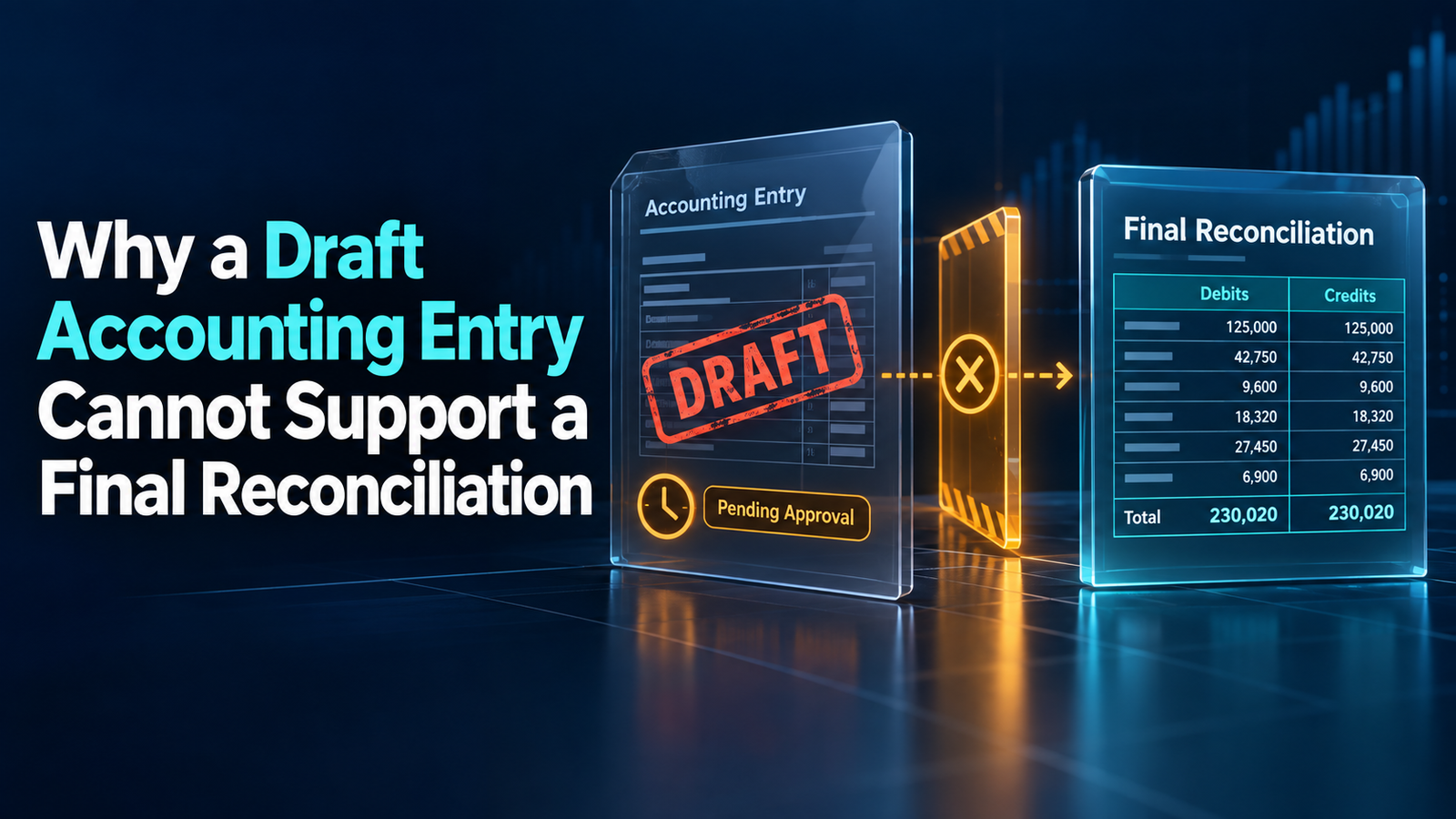
Introduction
A close analyst opens a supplier invoice, generates draft accounting, and sees the expected liability account. Tech Leads IT highlights this scenario in its Oracle Cloud Financials Online Training because the entry looks right, yet the third-party balance inquiry doesn’t show it. The confusion comes from treating a preview as a completed event.
Draft accounting lets finance inspect a proposed result, but balance-driven processes depend on finalized accounting. In Oracle Cloud Financials Training Online, analysts learn not to force a reconciliation adjustment. Instead, they confirm the accounting status, identify which balance should change, and trace the transaction through the full processing chain.
Why Oracle Cloud Financials Online Training Begins With Accounting Status
Suppose the invoice totals 48,000 and carries a supplier liability control account plus two expense distributions. The draft output shows a 48,000 credit to liability and matching expense debits. That preview is valuable because it can expose a wrong cost center, natural account, or accounting date before anything is finalized. But a correct-looking preview does not prove that any downstream balance has changed.
Good Oracle Cloud Financials Online Training teaches analysts to record the transaction identifier, event, ledger, accounting date, accounting mode, and process request instead of relying on a screenshot of journal lines.
Status language matters a great deal during close. An invoice can be validated but unaccounted, accounted in draft, accounted in final, transferred to General Ledger, or posted. Each state answers a different question. Validation checks transaction rules. Draft accounting shows a proposed subledger result. Final accounting completes the subledger entry. Transfer makes eligible entries available to General Ledger, and posting updates ledger balances. A checklist that simply says “accounted” invites confusion, so the close procedure should name the exact status each report and reconciliation requires.
Identifying the Stale Balance: An Oracle Cloud Financials Training Online Exercise
Not every balance in a finance system is maintained by the same process. A ledger account balance, a subledger transaction total, a supporting reference balance, and a third-party control account balance each serve a different purpose. Before diagnosing any difference, name the inquiry or report and the population behind it.
In this scenario the analyst is checking a supplier-level control account balance, not the journal preview. Comparing that balance to a draft line sets a maintained final figure against a provisional entry. The two can disagree without either being corrupt.
A practical Oracle Cloud Financials Training Online exercise is to build a lineage table for the 48,000 invoice:
- Source: amount and supplier.
- Accounting: event and status.
- Subledger: final lines and balance update status.
- General Ledger: transfer status, batch, and posting status, where applicable.
- Traceability: request identifiers and timestamps throughout.
The table stops a reviewer from treating an amount found in one layer as proof that every later layer contains it. It also exposes timing gaps, failed requests, and entries created for a ledger or accounting date outside the intended close population.
Using the Documented Process Boundary
Oracle’s documentation for the Update Subledger Accounting Balances process is explicit about scope. The process updates supporting reference balances and third-party control account balances. It normally runs automatically after Create Accounting, and it should be run manually if the automatic run fails. The guidance also states the decisive limit: draft entries do not update balances, and transactions must be accounted in Final to be included accurately.
That boundary explains the missing supplier amount without a manual journal, a tolerance change, or the unsupported assumption that a displayed draft line has already affected maintained balances.
It also points to two separate diagnostic paths:
- The transaction is still in draft. Finance completes the review, corrects the source data or accounting configuration through an approved route, and generates final accounting.
- Final accounting exists, but the balance still omits it. Inspect the outcome of the balance update and determine whether the automatic run failed. A manual submission may then be appropriate under the documented guidance.
Rerunning the update while the entry is still draft cannot fix a status problem. Finalizing an entry only to make a report agree defeats the purpose of draft review.
Correcting the Cause at the Right Layer
Imagine the draft reveals that the liability was derived to a general expense account instead of the supplier control account. The safest fix depends on why that happened. Bad invoice data should be corrected in the source transaction where permitted. A faulty account rule or mapping set calls for controlled configuration analysis and broader regression testing.
Editing or offsetting the difference in General Ledger would not repair supplier-level accounting lineage. It might make one total look balanced while leaving the subledger detail and the control account relationship wrong. Data, rules, and processing should be diagnosed separately before any remedy is chosen.
Final status should also be treated as a governance threshold, not a button pressed to keep the close moving. The reviewer needs evidence that the expected account, dimensions, entered and accounted amounts, currency, party, and accounting date are correct. Material exceptions need an owner and a disposition. Where re-accounting is required, preserve the link between the original event, the correction, and the final result. A team that knows only that a request succeeded may miss an entry finalized to the wrong period or ledger, even though the process itself ended normally.
Reconciling Through Controlled Checkpoints
A dependable sequence runs from transaction completeness to validation, accounting errors, draft review where required, final accounting, balance update, transfer, posting, and finally reconciliation. Not every transaction has to pass through manual review. Risk-based policies can define which populations need draft inspection. What matters is that each checkpoint has a clear completion condition.
For example, zero accounting errors is not the same as all expected transactions being accounted for. Compare counts and values against the source population so that transactions dropped before processing cannot quietly vanish from the close.
For third-party balances, reconcile by party and control account, not just by ledger total. A 48,000 shortfall for one supplier can be hidden by an unrelated 48,000 difference for another. Look into unusual negative positions, dormant parties with new activity, and final entries that lack expected party context. For supporting references, confirm the values needed for analysis are populated consistently. Aggregate agreement is useful, but it does not show that the detailed attribution used for audit, settlement, or management reporting is sound.
Making Failure Recovery Observable
Operations teams should monitor the requests that complete the accounting chain instead of waiting for a reconciler to stumble on a stale balance. Capture successful, warning, and error outcomes, assign ownership, and keep the diagnostic output for failed records.
When a manual balance update follows an automatic failure, link it to the failed request and verify the intended ledger and population. That makes recovery explainable and discourages broad reruns done without understanding their scope. Repeated failures deserve root-cause analysis, because a workaround that succeeds every month is still an unstable dependency in the close.
Conclusion: What Oracle Cloud Financials Online Training Should Leave You With
A visible accounting line and an updated balance are not the same control fact. Draft mode supports review, but supporting reference and third-party balances require final accounting and a successful update process. This is the practical takeaway of any solid Oracle Cloud Financials Online Training program. Name the balance being reconciled, trace the transaction across statuses, fix errors at their source, and monitor the requests that complete the chain. When every checkpoint has evidence and an owner, a missing amount becomes a diagnosable processing condition rather than a reason to post an unexplained adjustment.