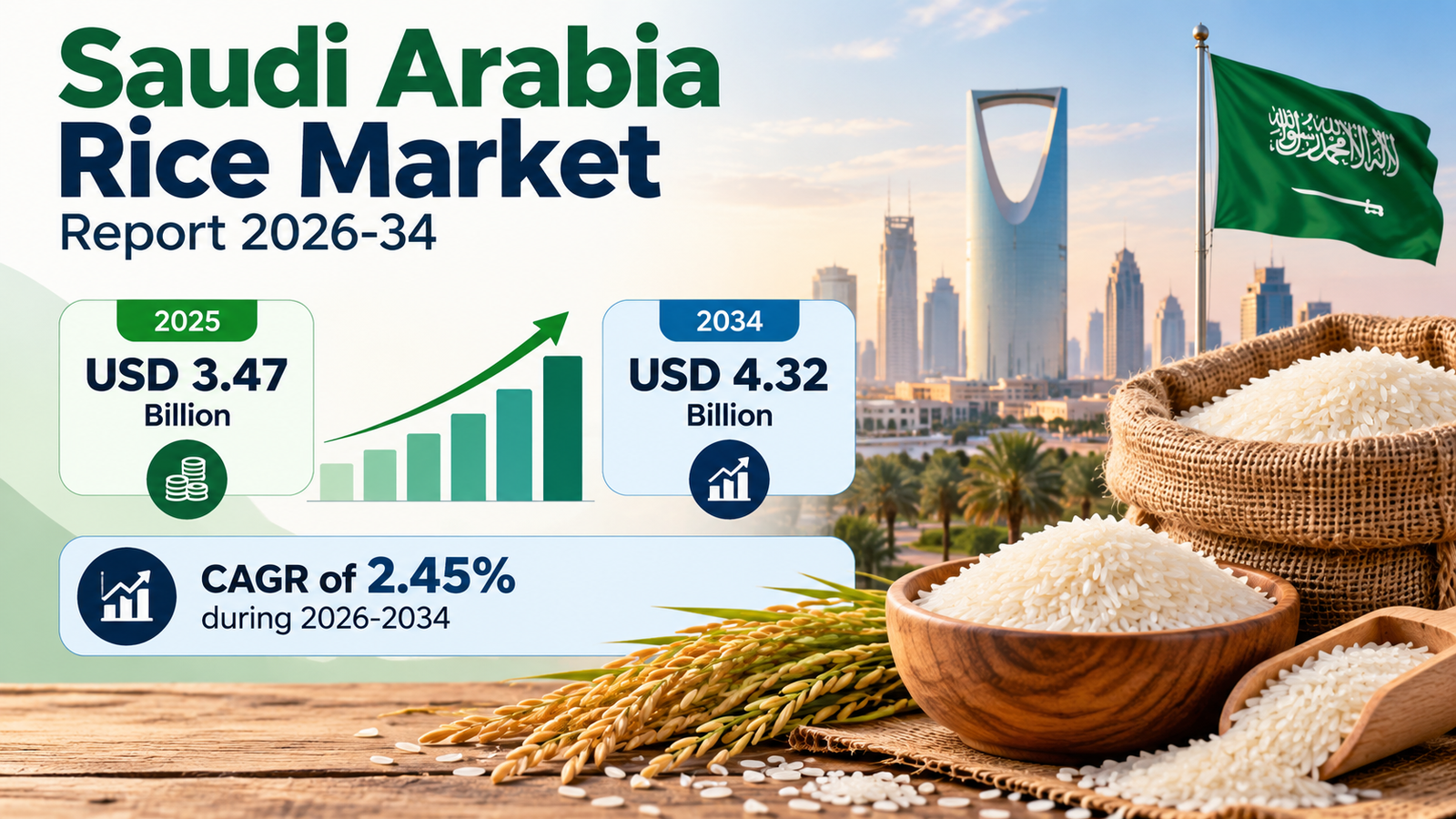
The Saudi Arabia rice market, Rice is a dietary staple across Saudi households, restaurants, and catering operations, and the Kingdom imports nearly all of its supply, with total imports of almost 1.75 million tonnes annually. Saudi Arabia rice market size reached USD 3.47 Billion in 2025. Looking forward, IMARC Group expects the market to reach USD 4.32 Billion by 2034, exhibiting a growth rate (CAGR) of 2.45% during 2026-2034. Demand for different rice types suited to varied cooking styles, rising investment in packaging solutions, and advances in processing technologies are key factors driving the market.
How AI is Reshaping the Future of Saudi Arabia Rice Market?
- AI-powered demand forecasting helps importers and distributors plan purchases around the annual Indian crop cycle. Most major importers buy the new crop by December and complete imports by June, so better forecasting reduces overstocking and supports steady supply during peak periods such as Ramadan, Hajj, and Umrah.
- Computer vision and AI-based sorting in rice milling and packaging lines detect broken grains, discoloration, and foreign matter. This supports compliance with the stringent import and food safety standards applied by Saudi regulators and improves consistency in premium basmati and parboiled grades.
- AI-driven logistics and port analytics improve container scheduling, storage, and inland distribution. This matters in a market where India supplies over 73% of volume, Pakistan nearly 12%, and the United States about 8%, so supply chains span several origins and shipping routes.
- AI-enabled e-commerce and retail analytics allow supermarkets and online grocers to personalize promotions, optimize pack sizes, and manage pricing across household, family-pack, and bulk formats, especially for premium aromatic varieties.
- Precision farming and smart irrigation tools support limited domestic cultivation and overseas agricultural investments. These tools improve water-use efficiency and yield outcomes in a water-scarce country focused on long-term food security.
Grab a sample PDF of this report: https://www.imarcgroup.com/saudi-arabia-rice-market/requestsample
Market Growth Factors
The Saudi Arabia rice market is driven by rice’s central role in the national diet. Signature dishes such as kabsa, mandi, and madfoon are built on long-grain basmati and parboiled rice. Saudi Arabia is the largest buyer of Indian basmati, taking about 1.17 million tonnes worth over USD 1.1 billion in a single marketing year. Consumption is estimated at roughly 1.75 million tonnes annually and is supported by a growing labor force, population growth, and expanding foodservice operations. Imports are expected to keep rising by around 2 to 3% a year as restaurants, hotels, and catering companies scale up.
Tourism and pilgrimage are adding a large, recurring layer of demand. The Kingdom welcomed over 122 million domestic and international visitors in the latest annual tally, with tourism spending of nearly SAR 300 billion (about USD 80 billion). Under Vision 2030, the target is 150 million annual visitors. Every additional visitor increases meal volumes across hotels, restaurants, and mass catering in Makkah, Madinah, Jeddah, and Riyadh, where rice-based dishes are the default for large gatherings and pilgrim feeding programs.
Government food security programs and quality regulation shape how the market operates. The Saudi Agricultural and Livestock Investment Company (SALIC), a Public Investment Fund company, manages investments across seven countries and five continents to diversify supply. It holds a stake of about 30% in Dawaat Foods, a leading Indian basmati producer. Its subsidiary SABIL, the National Grain Supply Company, adds storage capacity of more than 2.7 million tonnes to strengthen strategic reserves and grain logistics. Alongside this, the Saudi Food and Drug Authority enforces quality and safety standards for imported rice, which builds consumer trust and favors certified suppliers.
Evolving consumer preferences are also lifting value. Households and foodservice buyers are shifting toward premium aromatic varieties, steam and sella basmati, and convenient pre-packaged formats. Manufacturers are investing in resealable packs, better shelf-life protection, and clear nutritional labeling. Fortified and parboiled rice appeals to health-conscious buyers, while organized retail chains such as supermarkets and hypermarkets, along with online grocery platforms, widen access to branded products in multiple pack sizes.
Market Segmentation
Product Type Insights:
- Regular
- Aromatic
Aromatic rice, led by basmati and jasmine, benefits from strong cultural preference and premium positioning, while regular rice serves price-sensitive households and high-volume catering.
Type Insights:
- Red Rice
- Arborio Rice
- Black Rice
- Grain Fragrance Rice
- Brown Rice
- Rosematta Rice
- Grain Parboiled Rice
- Sushi Rice
- Others
Parboiled and sella varieties are valued for their firm texture in large-batch cooking, while brown, red, and black rice are gaining traction among health-conscious urban consumers. Arborio and sushi rice serve the growing international cuisine and dining scene in major cities.
Grain Size Insights:
- Long Grain
- Medium Grain
- Short Grain
Long grain rice dominates everyday and festive cooking because of its elongation and separate-grain finish. Medium and short grain varieties cater to specialty dishes, desserts, and international cuisines.
Distribution Channel Insights:
- Offline Stores
- Online Stores
Offline stores, including supermarkets, hypermarkets, and traditional grocers, remain the primary purchase point for bulk and family packs. Online stores are expanding through quick-commerce and subscription-based grocery delivery.
Application Insights:
- Food
- Feed
- Others
Food is the primary application, spanning household consumption, restaurants, hotels, and institutional catering. Feed and other uses represent smaller but steady demand.
Regional Insights:
- Northern and Central Region
- Western Region
- Eastern Region
- Southern Region
The Northern and Central Region, anchored by Riyadh, benefits from a large population and dense foodservice activity. The Western Region, home to Makkah, Madinah, and Jeddah, is shaped by pilgrimage and tourism-driven consumption. The Eastern Region is supported by industrial and expatriate populations, while the Southern Region is gaining relevance as domestic tourism grows.
Recent Development & News
- April 2026: The U.S. Department of Agriculture’s Foreign Agricultural Service reported that Saudi rice consumption is projected at 1.75 million tonnes, supported by labor force growth and tourism. Imports were noted to be rising by at least 2 to 3% annually, driven by foodservice expansion.
- January 2026: Saudi Arabia’s Ministry of Tourism reported more than 122 million domestic and international visitors, a 5% increase, with tourism spending of nearly SAR 300 billion. The figures reinforce demand for rice across hospitality and catering channels.
- October 2025: SALIC took part as Agricultural Investment Partner in the 42nd Saudi Agriculture Exhibition in Riyadh. Its subsidiary SABIL signed an MoU with the Arabian Agricultural Services Company (ARASCO) to improve transport efficiency across the grains and feed sector.
- August 2025: SALIC highlighted its strategic investments across seven countries and five continents, including 13 projects aimed at diversifying supply sources and strengthening national food security.
- April 2025: SALIC launched the National Grain Supply Company (SABIL), with storage capacity of more than 2.7 million tonnes, to manage strategic grain reserves and strengthen the national food supply chain.
If you require any specific information that is not covered currently within the scope of the report, we will provide the same as a part of the customization.
About Us
IMARC Group is a global management consulting firm that helps the world’s most ambitious changemakers to create a lasting impact. The company provide a comprehensive suite of market entry and expansion services. IMARC offerings include thorough market assessment, feasibility studies, company incorporation assistance, factory setup support, regulatory approvals and licensing navigation, branding, marketing and sales strategies, competitive landscape and benchmarking analyses, pricing and cost research, and procurement research.
Contact Us
IMARC Group,
134 N 4th St. Brooklyn, NY 11249, USA,
Email: sales@imarcgroup.com,
Tel No: (D) +91 120 433 0800,
United States: +1-201971-6302