
Introduction
Intercompany balances rarely go wrong because the arithmetic is hard. At Tech Leads IT, our Oracle Cloud Financials Training Online shows learners that they go wrong because two entities record different versions of one event, book it in different periods, or record only one side. A one-sided journal is one of the most telling signs, often pointing to a failed import, an unfinished approval, or a wrong trading partner.
The variance is only the symptom, and the journal trail shows the cause. That is why Oracle Cloud Financials Online Training treats reconciliation as an investigation into reciprocal activity, not a month-end exercise in forcing totals to agree.
Why Oracle Cloud Financials Training Begins with Defining the Reciprocal Pair
Before reviewing any exception, you need a precise picture of what agreement looks like. Entity A’s receivable from Entity B should mirror B’s payable to A under the company’s account mapping and currency rules. Comparison can be made by legal entity, ledger, balancing segment, intercompany organization, account, period, and currency. If these dimensions are misaligned, a grand total can hide several wrong pairings.
A strong foundation in Oracle Cloud Financials Training therefore stresses documentation up front: which accounts are reciprocal, which trading-partner values are valid, and whether the comparison uses entered, accounted, or translated amounts.
The expected relationship is not always a mirror image. Markups, taxes, withholding, freight, and allocation rules can split one document across several accounts. Settlement netting can change how open items look without changing the obligation. Identify these legitimate differences first, but never let complexity excuse unexplained balances. Every accepted exception needs a rule, an owner, and evidence that separates it from activity requiring correction.
Recognizing a Missing Side in Oracle Cloud Financials Training
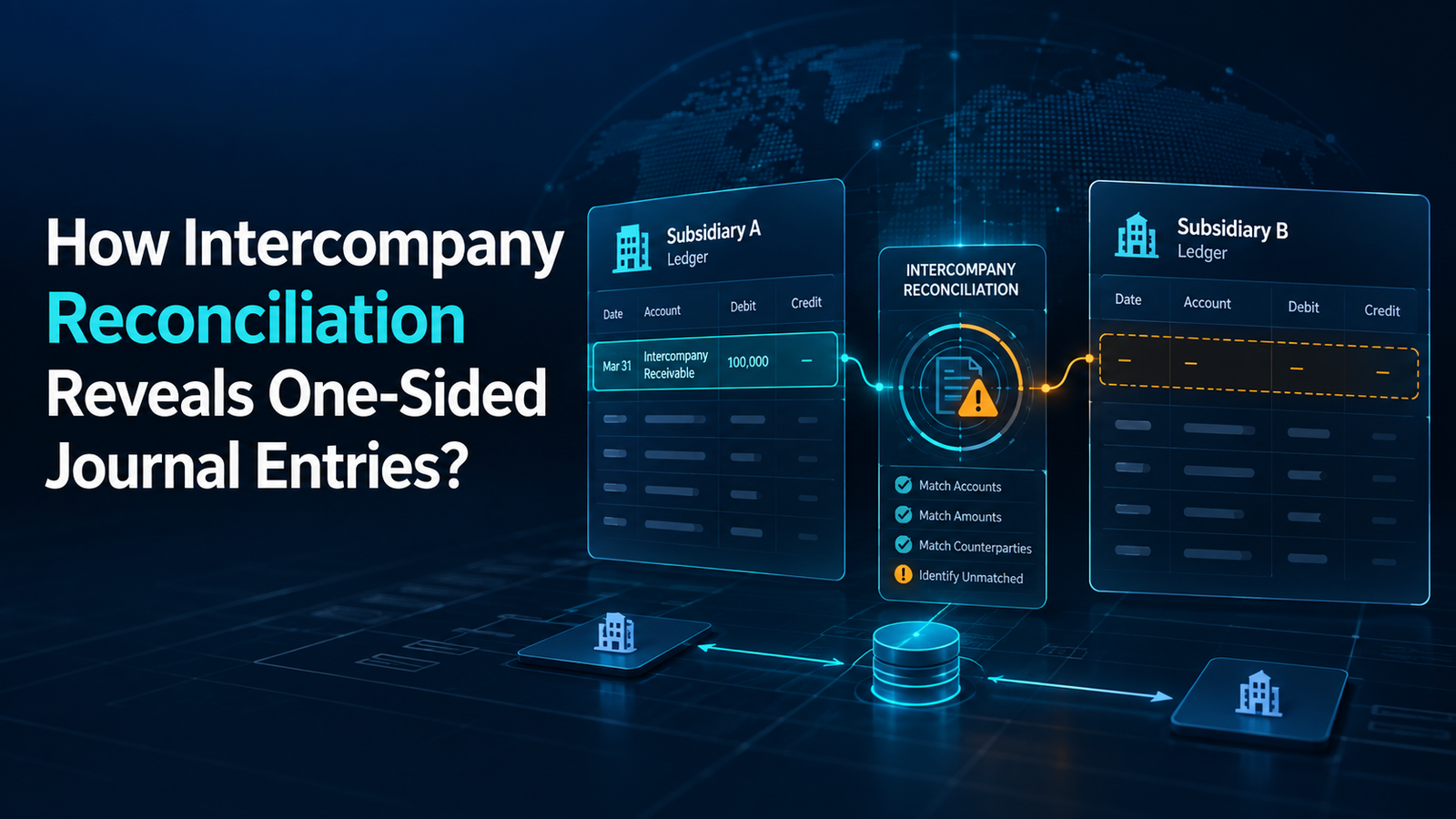
A one-sided journal typically shows up as a balance for one provider-receiver pair with no activity in the reciprocal account. Filter the report to the relevant period and pair, then compare it with journal and subledger detail. Common causes include:
- a manual journal posted on one ledger while its counterpart sits in draft
- a rejected intercompany transaction
- an interface batch that completed for only one entity
A blank opposite side is more useful than a net variance because it directs you to a process break before you get into accounting comparisons.
Still, an apparent blank is not always a true gap. The counterpart may be under the wrong trading partner, in the next period, in another reporting currency, or summarized in a different account. Check adjacent periods and likely suspense or clearing accounts before concluding nothing exists. Connect records using document numbers, references, creation times, and preparer details. Matching on amount alone is risky, because recurring management fees and standard allocations often produce identical figures.
Controlling Report Context: What Oracle Cloud Financials Training Online Should Emphasize
The Oracle Help Center procedure for generating the Intercompany Reconciliation Report begins with the Extract Intercompany Reconciliation process, launched from the IC Reconciliation infolet. You select a provider ledger, a provider accounting period, and an additional currency. According to the documentation, the ledger and period should match what the dashboard displays, and the additional currency should match the dashboard ledger currency. These settings matter because a correct report run in the wrong context produces a convincing but irrelevant exception list. Parameter discipline is a control, not a clerical preamble.
This is the kind of detail that Oracle Cloud Financials Training Online is well placed to teach through hands-on repetition. When an additional currency is chosen, the process enables a conversion rate type and a conversion date. Record both with your review evidence. Two entities may agree in transaction currency yet differ once translated, simply because they used different rates or dates. That is a valuation issue, not necessarily a missing journal, so reconcile the native obligation first and isolate translation differences afterward.
If you rerun the report, keep the earlier output or run identifier. Reviewers can then explain why an exception changed after rates, late journals, or mappings were updated.
Classifying and Tracing Exceptions to Their Source
Classify an exception before you correct it. Useful categories include:
- missing counterpart
- wrong partner
- wrong period
- account mapping difference
- currency conversion difference
- amount difference
- settlement timing
The category determines the owner and the remedy. A missing counterpart may belong to an integration team or a journal approver. A wrong partner may point to master-data validation. A period mismatch may require coordination between close calendars. Without classification, teams keep investigating the same patterns and lean on broad top-side adjustments that mask preventable failures.
Follow each material variance to the journal lines and, where relevant, to the source transaction. Check posting status, accounting date, ledger, balancing segment, partner, account, currency, and reference fields. Then review workflow history or import logs to find where symmetry broke. The goal is not to find a number that offsets the variance. It is to confirm that both entities recognized the same economic event under approved rules. That discipline stops an unrelated journal from being paired with an exception just because it happens to clear the difference.
Correcting Entries Without Erasing the Audit Trail
Corrections should preserve the original record and state why the change was made. When policy calls for it, reverse and repost an incorrect journal instead of rewriting history through an opaque net adjustment. If the counterpart is valid but late, document the timing difference and the period in which it should be clear. If an accrual is needed for close, link it to the source exception and set a reversal date. An item is not resolved simply because the current-period net reaches zero. The fix must address the specific entity pair and accounting basis.
Materiality thresholds help prioritize, but they should not bury small recurring exceptions. A low-value one-sided entry repeated over many periods can signal a systemic configuration problem and may eventually become material. Track both amount and age, and escalate anything that survives more than one close. Also separate operational resolution from accounting disposition: an item can be explained yet still open, or corrected yet awaiting confirmation in a refreshed extract. Clear status definitions keep those states from being confused.
Preventing the Next One-Sided Entry
Use exception trends to strengthen upstream controls:
- validate reciprocal trading partners
- restrict manual posting to sensitive intercompany accounts
- require references that both sides share
- monitor interface batches for asymmetric completion
- align period cut-offs between entities
- assign clear ownership of rejected transactions
Where automated intercompany processing is available, test the failure paths as carefully as the success paths. Automation produces consistent pairs, but it can also replicate a bad mapping at scale if monitoring only checks technical completion.
Governance should include a named preparer, an independent reviewer, evidence of report parameters, an exception log, and defined sign-off criteria. Metrics should go beyond the final unreconciled amount to cover aged open items, recurrence by root cause, late postings, and manual corrections. A zero total produced by offsetting exceptions is not a clean result. Pair-level visibility and aging show whether control quality is improving or whether the team is just getting faster at clearing the same defects.
Conclusion: Building Practical Skills Through Oracle Cloud Financials Training Online
Intercompany reconciliation is most valuable when it turns a difference into a specific process diagnosis. For finance professionals pursuing Oracle Cloud Financials Training Online, the real skill lies in connecting report parameters, currency context, journal detail, and workflow evidence so they can tell a missing side from a period, mapping, or valuation problem. A controlled response keeps the audit trail intact, assigns the right owner, verifies the refreshed result, and feeds the root cause back into preventive controls. Done this way, the reconciliation report becomes a lens on accounting integrity, not a worksheet for certifying a net balance.