Introduction
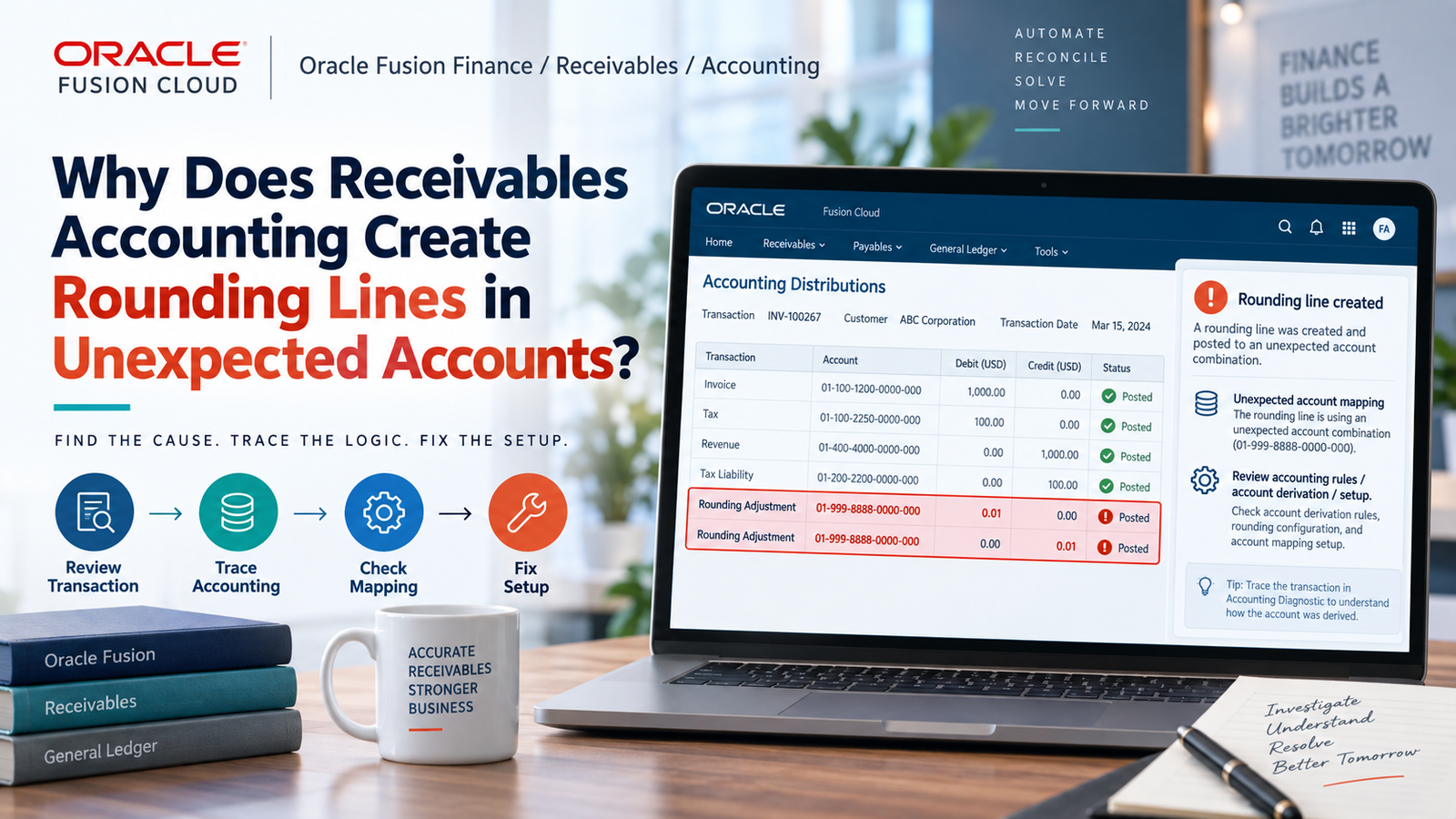
A stray rounding line sitting in an account nobody expected is almost never a random glitch. Soft Online Training helps analysts recognize it as the visible trace of a calculation, allocation, or balancing step buried inside a receivables transaction. Displayed totals get rounded for currency precision, but the accounting engine often works with more precise intermediate numbers, so rounded lines don’t always sum back to the header figure. Anyone who completes structured Oracle Fusion Financials Training in Bangalore learns not to dismiss the amount as trivial, but to reconstruct the calculation first asking where the residual originated, which stage produced it, and which configuration assigned its account.
Naming the Residual: A Foundational Skill Taught in Oracle Fusion Financials Training in Bangalore
Not every small leftover line represents the same underlying mechanism. One kind of residual shows up when a transaction amount gets spread across revenue, tax, freight, or receivable lines. A different kind appears when an entered-currency amount is translated into the ledger currency. Yet another can be introduced when subledger journal lines must be forced into balance after account derivation or gain/loss processing runs. The size of the amount tells you nothing on its own; what actually identifies the mechanism is the line’s currency, its journal line type, its accounting class, and how it relates to the lines sitting next to it.
The right starting point is the transaction and its accounting detail, not the general ledger balance in isolation. Capture the entered and accounted amounts for every related line, along with the transaction currency, ledger currency, conversion rate, accounting date, and account. Total the lines at each level of the transaction. Doing this reveals whether the residual originates in the source distribution, is introduced during currency conversion, or gets tacked on afterward simply to make the journal entry balance.
How Precision Rules Create Predictable Differences
Every currency has a defined level of precision, and any calculated value eventually has to be rounded down to that precision before it can be posted or displayed. Picture a charge allocated proportionally across several lines each individual share may carry more decimal places than the currency actually supports. Round each share on its own, and the sum of those rounded shares can end up slightly different from the rounded total. Something has to absorb that gap so the receivable and its offsetting distributions stay in balance.
The same logic applies to percentage-based calculations. Tax rates, discounts, and revenue-allocation percentages can generate repeating decimals even when the original invoice is stated in whole currency units. Quantity and unit-price precision add yet another layer, since the extended line amount, the tax calculation, and the accounting distribution can each round independently at their own defined point. A dependable reconstruction keeps full precision throughout the calculation and only rounds at the exact same boundaries the transaction and accounting processes actually use.
Foreign Currency and the Second Layer of Calculation
A foreign-currency transaction carries both entered amounts and accounted amounts. Every entered distribution is converted at the applicable rate and then rounded to ledger-currency precision. Those converted distributions can differ slightly from what you’d get by converting the transaction total separately. This is why an entered-currency journal can balance perfectly while its accounted-currency counterpart still needs a small residual adjustment and why investigators sometimes find nothing wrong with the invoice even though the accounting entry contains an extra line.
Rate precision and rate type both influence the outcome, but adjusting the rate is not a fix simply because a residual exists. Verify first that the correct rate, date, and currency pair were actually applied. Then recompute each distribution in accounted currency and compare that sum against the converted control amount. If the difference matches the generated line exactly, that line is doing its job as a balancing mechanism rather than pointing to a flawed invoice.
Allocation Order and Its Effect on Where the Line Lands
Receivables transactions frequently combine multiple revenue lines, tax lines, freight, installments, discounts, and adjustments. The sequence in which these amounts get allocated and rounded determines exactly where the final minor currency unit ends up. A residual tied to tax-inclusive pricing can follow an entirely different accounting path than one produced by prorating a receipt discount. An invoice split into installments might show discrepancies at the line level or the schedule level that simply don’t appear when you only look at the transaction total.
This is exactly why a useful comparison transaction has to match on more than customer and amount. It needs the same currency, transaction type, tax treatment, line structure, conversion conditions, and accounting date. A simpler invoice that happens not to produce a rounding line is not a valid control if it skips the allocation path that caused the residual in the first place. Build your comparison around the specific calculation branch you suspect is responsible.
Understanding Account Derivation A Recurring Theme in Oracle Fusion Financials Training in Bangalore
The account assigned to a generated line depends on the accounting event, the journal line’s classification, the account derivation rules in place, and the relevant ledger options. It might come from a configured rounding or balancing account, or it could inherit most of its dimensions from the transaction and distribution context while a single segment is supplied by a rule. This is precisely where analysts new to the topic get tripped up, and it’s a core focus of any well-designed Oracle Fusion Financials Training in Bangalore program: the account can look wrong simply because people assume every residual should default to the revenue account or the receivable account shown on the invoice.
Read the generated line as a series of individual segment decisions rather than a single account choice. Identify which segments diverge from what you expected, then trace each one back to the rule or option responsible for it. An unusual cost center, for instance, may come from a completely different source than the natural account segment. Resist the urge to replace an entire account within a rule just to fix one segment that shortcut can wipe out valid company, business-unit, or intercompany derivation logic and create much larger reconciliation headaches down the line.
Building a Reconstruction That Actually Produces Evidence
Set up a worksheet organized by transaction line and distribution. Capture the unrounded entered amount, the rounded entered amount, the conversion rate, the unrounded accounted amount, the rounded accounted amount, the accounting class, and the resulting account. Total the figures after each calculation boundary and pinpoint exactly where the residual first appears. Oracle’s own financial documentation lays out the accounting and currency concepts needed to interpret these boundaries correctly, and this worksheet-driven approach is a staple technique taught in structured Oracle Fusion Financials Training in Bangalore courses. The worksheet needs to reproduce the difference exactly. An amount that’s merely similar isn’t sufficient justification for a configuration change.
From there, examine the accounting event and rule results tied to the generated line. Compare them against a successful transaction that follows the identical calculation path but derives the expected account. Check the effective dates on transaction types, account rules, and ledger options, since the current setup may not match whatever was in place when the original event was accounted for. If accounting has been regenerated since then, be sure to separate the latest entry from any reversed or superseded ones so the investigation doesn’t accidentally blend incompatible versions together.
Conclusion
Rounding lines that turn up in unexpected accounts stop being mysterious once the investigation separates calculation from account derivation. Reconstruct the transaction at full currency precision, find the exact point where the residual first appears, identify which accounting line absorbs it, and trace every account segment back to the rule or option governing it. That kind of evidence is what separates legitimate precision handling from a genuinely incorrect source distribution or an overly broad derivation rule and it’s exactly the sequence a thorough Oracle Fusion Financials Training in Bangalore should reinforce, since it resolves the immediate issue without quietly burying a repeatable configuration problem under a manual adjustment.