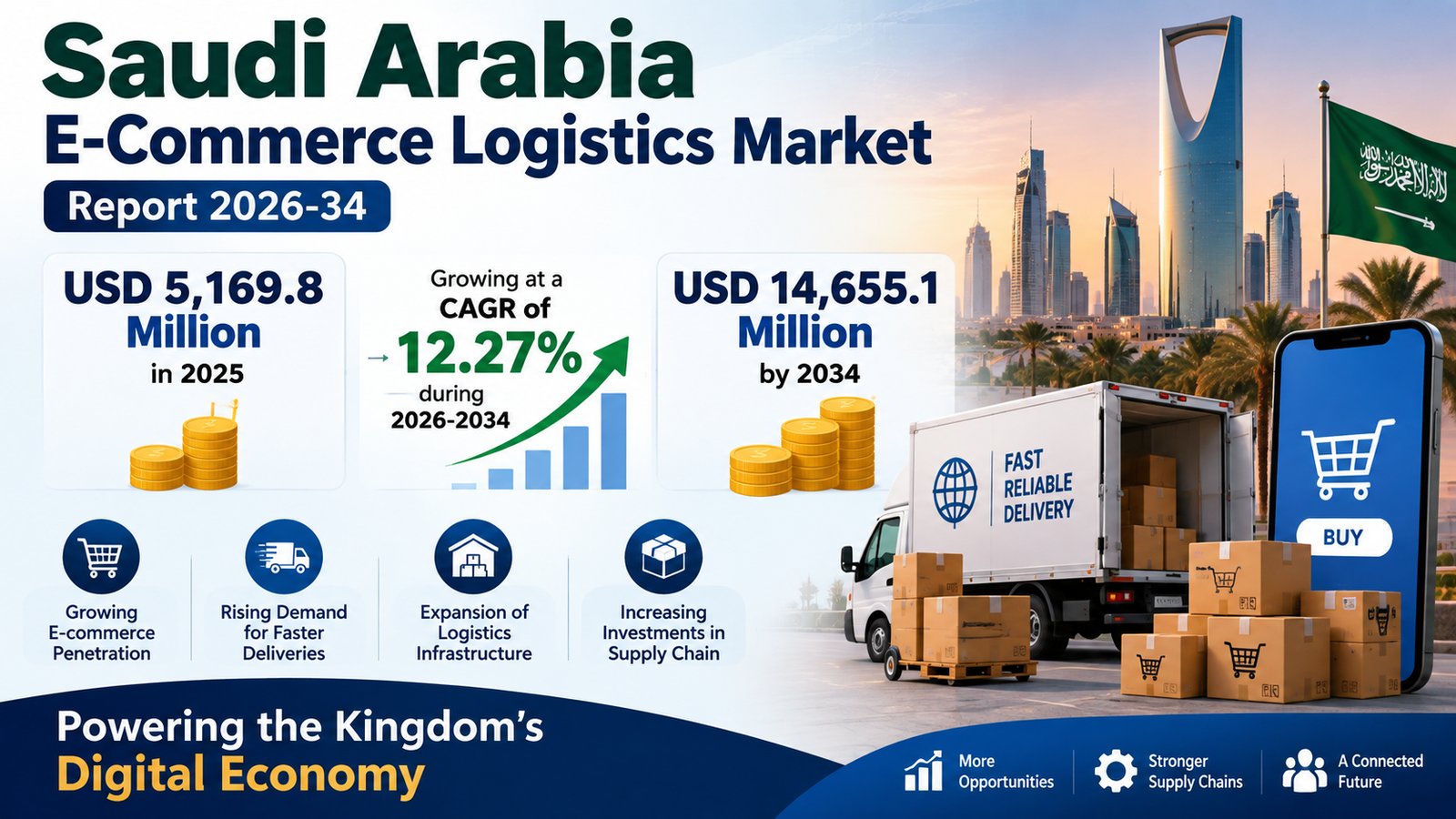
IMARC Group, a leading global market research and management consulting firm, has published its latest market intelligence report on the Saudi Arabia e-commerce logistics market size reached USD 5,169.8 Million in 2025. Looking forward, IMARC Group expects the market to reach USD 14,655.1 Million by 2034, exhibiting a growth rate (CAGR) of 12.27% during 2026-2034, driven by the growth of integrated logistics partnerships, expansion of regional fulfillment hubs, rising demand for faster deliveries, and supportive Vision 2030 infrastructure investments that continue to reshape the Kingdom’s last-mile delivery landscape.
The market is expanding rapidly as Saudi Arabia’s e-commerce ecosystem matures from a fragmented, city-centric model into a nationally connected logistics network. Large-scale strategic partnerships that blend local market knowledge with international logistics capabilities are addressing the rising complexity of supply chains driven by the country’s booming online retail sector. As e-commerce players seek faster, more reliable deliveries, integrated logistics providers offering scalable infrastructure, streamlined warehousing, real-time tracking, and efficient last-mile execution are becoming central to competitive differentiation. At the same time, logistics providers are expanding their footprint across key geographies to shorten delivery cycles, reduce congestion in central hubs, and meet the demands of both domestic consumers and international merchants entering the Saudi market.
How AI is Reshaping the Future of Saudi Arabia E-Commerce Logistics Market?
- AI-Powered Route Optimization and Last-Mile Delivery Planning: Logistics providers operating across Riyadh, Jeddah, and Dammam are deploying AI-driven route optimization engines that process real-time traffic data, delivery density, and driver availability to shorten delivery windows and reduce fuel consumption, a capability that has become essential as regional fulfillment hubs multiply and delivery volumes surge during peak retail periods.
- Predictive Demand Forecasting for Warehousing and Inventory Management: Machine learning models are helping e-commerce logistics operators forecast SKU-level demand across fashion and apparel, consumer electronics, and beauty and personal care categories, allowing warehouses to pre-position inventory closer to demand centers and reduce stockouts during high-volume shopping events such as national sales campaigns.
- AI-Driven Fraud Detection and Returns Management: As cross-border and domestic e-commerce volumes climb, AI-based fraud detection systems are being integrated into order processing workflows to flag suspicious transactions and streamline returns handling, reducing losses for logistics providers while improving trust for both B2B and B2C shippers operating in the Kingdom.
- Computer Vision in Warehouse Automation: Fulfillment centers are increasingly adopting computer vision and robotics for picking, sorting, and packing operations, cutting labor-intensive processing time and supporting the rapid throughput required by gateway facilities such as those recently launched in Jeddah to serve the Red Sea region.
Grab a sample PDF of this report: https://www.imarcgroup.com/saudi-arabia-e-commerce-logistics-market/requestsample
Saudi Arabia E-Commerce Logistics Market Trends and Drivers
Saudi Arabia’s e-commerce logistics sector is increasingly shaped by large-scale strategic partnerships that combine local operational strength with international logistics expertise. These alliances are helping overcome operational bottlenecks by enabling access to scalable infrastructure, streamlined warehousing, real-time tracking, and efficient last-mile execution under a single ecosystem. For instance, CEVA Logistics formed a joint venture with Almajdouie Logistics, one of the leading Saudi providers, bringing together CEVA’s global expertise and Almajdouie’s regional strength to create a workforce of 2,000 and a local fleet of over 2,000 assets, an initiative designed to serve multiple sectors including e-commerce while directly supporting the Kingdom’s Vision 2030 logistics goals. As more global logistics firms seek entry into Saudi Arabia, such joint ventures are expected to multiply, reinforcing a market landscape built on synergy, efficiency, and strategic geographic coverage.
The Saudi e-commerce logistics landscape is also evolving around a strong focus on regional infrastructure, particularly fulfillment hubs and gateway facilities. As customer expectations around delivery timelines tighten, logistics providers are expanding their footprint across key geographies to support faster, more reliable service. Shipa Delivery, for example, launched a new e-commerce gateway in Jeddah to complement its existing hubs in Riyadh and Dammam, a western hub that reduced delivery times by up to 24 hours and expanded capacity by 15%, particularly benefiting shipments to the Red Sea region. This shift toward region-specific fulfillment solutions is optimizing delivery logistics during peak periods and improving end-user satisfaction, with companies operating multiple gateways and localized hubs now better positioned to absorb volume spikes and provide consistent service levels across the Kingdom.
The Kingdom’s broader logistics infrastructure continues to underpin e-commerce fulfillment growth. Vision 2030 infrastructure investments, e-commerce expansion, and Saudi Arabia’s strategic positioning as a trade corridor connecting Asia, Europe, and Africa remain primary forces driving overall logistics market growth, with third-party logistics models dominating the sector’s model type mix and roadways leading the transportation segment given the Kingdom’s extensive highway network linking major population centers. Government-backed digital commerce initiatives are also reinforcing demand, as national e-commerce revenues continue climbing on the back of rising internet penetration, expanding smartphone usage, and improved digital payment systems, creating sustained downstream pressure on transportation, warehousing, and value-added logistics services such as labeling and packaging.
Saudi Arabia E-Commerce Logistics Industry Segmentation
The report has segmented the market into the following categories:
Breakup By Service:
- Transportation
- Warehousing and Inventory Management
- Value-added Services (Labeling, Packaging)
Transportation accounts for a significant share of the service segment, reflecting the scale of investment logistics providers are directing toward regional fulfillment hubs, fleet expansion, and route optimization technologies needed to serve a rapidly growing base of online shoppers across urban and increasingly rural areas of the Kingdom.
Breakup By Business:
- B2B
- B2C
B2C transactions represent a substantial portion of e-commerce logistics volume, driven by the explosive growth of online marketplaces and direct-to-consumer retail across fashion, electronics, and beauty categories, which require frequent, smaller-batch deliveries compared to the bulk shipment patterns typical of B2B logistics.
Breakup By Destination:
- Domestic
- International/Cross Border
Domestic shipments dominate the destination segment, supported by the rapid expansion of local online retail platforms and marketplaces that primarily serve Saudi consumers, though cross-border logistics is gaining momentum as international merchants seek entry into the Kingdom’s expanding digital retail market.
Breakup By Product:
- Fashion and Apparel
- Consumer Electronics
- Home Appliances
- Furniture
- Beauty and Personal Care Products
- Others
Fashion and apparel leads the product segment, reflecting strong consumer preference for online clothing and accessory purchases, a category that benefits from frequent promotional campaigns, influencer-driven marketing, and the convenience of doorstep delivery that has become a standard expectation among Saudi digital shoppers.
Breakup By Region:
- Northern and Central Region
- Western Region
- Eastern Region
- Southern Region
The Northern and Central Region, anchored by Riyadh, commands a leading regional share, supported by the capital’s dense population base, concentration of fulfillment infrastructure, and role as the primary hub for both domestic distribution networks and the headquarters operations of major logistics and e-commerce companies.
Competitive Landscape
The report provides a comprehensive analysis of the competitive landscape in the Saudi Arabia e-commerce logistics market, covering market structure, key player positioning, top winning strategies, competitive dashboard, and company evaluation quadrant, along with detailed profiles of all major companies operating across transportation, warehousing, and last-mile delivery segments of the industry.
What Does The Full Report Cover?
If you are tracking the Saudi Arabia e-commerce logistics market for investment decisions, market entry planning, competitive benchmarking, or strategic advisory, IMARC Group’s report gives you everything in one place:
- Complete market sizing with revenue forecasts covering the full projection period
- Quantified growth driver analysis with impact scoring across service, business, destination, product, and regional markets
- Sub-segment breakdowns for transportation, warehousing and inventory management, value-added services, B2B, B2C, domestic, cross border, fashion and apparel, consumer electronics, home appliances, furniture, and beauty and personal care products
- Regional data for the Northern and Central, Western, Eastern, and Southern regions of Saudi Arabia
- Competitive profiles of leading companies with strategic landscape assessment
- Porter’s Five Forces, value chain analysis, and pricing intelligence
- Latest developments covering integrated logistics partnerships, regional fulfillment hub expansion, and last-mile delivery innovation shaping market competition across the Kingdom
Recent News and Developments in Saudi Arabia E-Commerce Logistics Market
- April 2025: Quiqup expanded its core e-commerce logistics operations to Saudi Arabia with support from the Mohammed bin Rashid Innovation Fund, enhancing cross-border fulfillment capabilities, improving service access for SMEs, and strengthening the Kingdom’s last-mile logistics infrastructure across the growing e-commerce ecosystem.
- February 2025: DHL eCommerce acquired a minority stake in Saudi logistics firm AJEX, backed by Ajlan & Bros Holding, expanding DHL’s reach into the Kingdom’s fast-growing e-commerce logistics sector and integrating global delivery expertise into the local market.
- January 2025: Nice One, a Saudi e-commerce company, completed its public listing on the Tadawul stock exchange, with its market capitalization rising significantly on its initial trading day, a development reflecting growing investor confidence in the Kingdom’s digital retail and logistics ecosystem.
- October 2024: Shipa Delivery launched a new e-commerce gateway in Jeddah to complement its existing hubs in Riyadh and Dammam, a western hub that reduced delivery times by up to 24 hours and expanded capacity by 15%, particularly benefiting shipments to the Red Sea region.
- July 2024: CEVA Logistics formed a joint venture with Almajdouie Logistics to expand its footprint in the Kingdom, combining global expertise with regional strength to create a workforce of 2,000 employees and a local fleet of over 2,000 assets serving multiple sectors including e-commerce.
Note: If you require specific details, data, or insights that are not currently included in the scope of this report, we are happy to accommodate your request. As part of our customization service, we will gather and provide the additional information you need, tailored to your specific requirements. Please let us know your exact needs, and we will ensure the report is updated accordingly to meet your expectations.
Key Questions This Report Answers
- What is the current Saudi Arabia e-commerce logistics market size and what is its projected value?
- Which service segment holds the largest share in the Saudi Arabia e-commerce logistics market?
- What are the key drivers of Saudi Arabia e-commerce logistics market growth?
- Which region dominates the Saudi Arabia e-commerce logistics market and why?
- How are regional fulfillment hub expansion, integrated logistics partnerships, and digital infrastructure investment reshaping competitive strategies in the e-commerce logistics industry?
- Who are the top companies in the Saudi Arabia e-commerce logistics market and what are their competitive strategies?
- What are the investment and market entry opportunities across transportation, warehousing, B2C, and cross-border logistics segments?
About Us
IMARC Group is a global management consulting firm that helps the world’s most ambitious changemakers to create a lasting impact. The company provides a comprehensive suite of market entry and expansion services. IMARC offerings include thorough market assessment, feasibility studies, company incorporation assistance, factory setup support, regulatory approvals and licensing navigation, branding, marketing and sales strategies, competitive landscape and benchmarking analyses, pricing and cost research, and procurement research.
Contact Us
IMARC Group
134 N 4th St. Brooklyn, NY 11249, USA
Email: sales@imarcgroup.com
Tel No: (D) +91 120 433 0800
United States: +1-201-971-6302