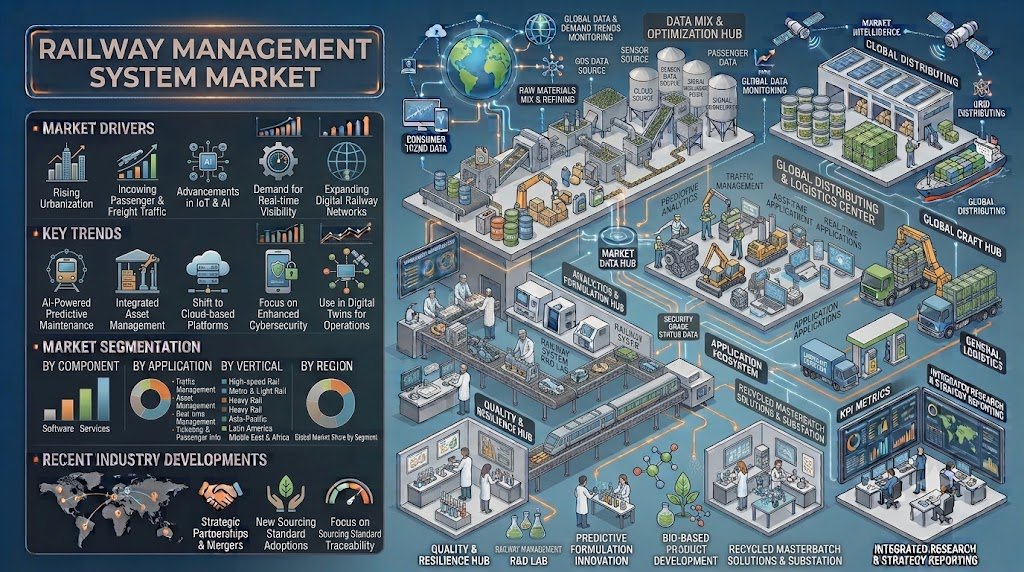
Market Overview:
According to IMARC Group’s latest research publication, “Railway Management System Market: Global Industry Trends, Share, Size, Growth, Opportunity and Forecast 2026-2034”, The global railway management system market size was valued at USD 66.6 Billion in 2025. Looking forward, IMARC Group estimates the market to reach USD 141.7 Billion by 2034, exhibiting a CAGR of 8.75% from 2026-2034.
This detailed analysis primarily encompasses industry size, business trends, market share, key growth factors, and regional forecasts. The report offers a comprehensive overview and integrates research findings, market assessments, and data from different sources. It also includes pivotal market dynamics like drivers and challenges, while also highlighting growth opportunities, financial insights, technological improvements, emerging trends, and innovations. Besides this, the report provides regional market evaluation, along with a competitive landscape analysis.
How AI and Digital Innovation Are Reshaping the Railway Management System Market
- Europe leads the global market with a 32.7% share in 2025, supported by the EU’s Trans-European Transport Network (TEN-T) and European Green Deal investments targeting a 90% carbon reduction by 2050 through rail modernization.
- On-premises deployment dominates with 66.7% market share in 2025, preferred for its ability to offer greater data security, real-time system control, and regulatory compliance without reliance on external cloud servers.
- The United States holds 75.8% of the North America market, supported by a USD 66 billion allocation under the Infrastructure Investment and Jobs Act for rail modernization, including predictive maintenance, smart signaling, and real-time monitoring.
- India’s railways handle over 7 billion passenger journeys annually, creating significant demand for advanced railway management solutions to manage scheduling, traffic, safety, and operational efficiency at scale.
- China allocated USD 120 billion to expand its rail network, with a specific focus on real-time monitoring systems and smart scheduling technologies, reinforcing its position as a key driver in the Asia Pacific railway management system market.
Download a sample PDF of this report:https://www.imarcgroup.com/railway-management-system-market/requestsample
Key Trends in the Railway Management System Market
- Rapid Urbanization Increasing Public Transport Demand: The United Nations reports that 55% of the global population lived in urban areas in 2025, a figure projected to rise to 68% by 2050. As cities expand, rail networks face growing pressure to handle higher passenger volumes with greater efficiency. In the EU, 8 billion passengers used railways for national journeys, reflecting a 67.9% increase compared to 2020, highlighting the urgent need for scalable railway management solutions across metropolitan and intercity corridors.
- Integration of IoT and AI in Rail Operations: The IoT in transportation market reached USD 143.0 billion and is growing at 17.1% annually. Railway operators are deploying IoT sensors, artificial intelligence, and big data analytics to enable real-time train monitoring, predictive maintenance, and automated fault detection. These technologies reduce unplanned downtime and improve passenger punctuality. Additionally, around 75% of state governments in India are operating more than half of their workloads on hyperscale cloud platforms, including railway-related digital services.
- Government Investments Accelerating Rail Modernization: The World Rail Market Study recorded a 2.7% annual growth in the global rail supply market driven by rising government commitment to sustainable transport. Brazil’s National Railway Plan targets doubling rail’s modal share from 17.7% to 34.6%, supported by approximately USD 30 billion in transformative investments. Similarly, the U.S. Infrastructure Investment and Jobs Act allocates USD 66 billion specifically for rail infrastructure, fueling demand for advanced management systems, automated signaling, and passenger information platforms.
- Smart Ticketing Transforming Passenger Experiences: Smart ticketing adoption is reshaping how passengers interact with rail networks, with the smart ticketing market in the United States expected to grow at 11.08% annually. Amtrak reported a 15% improvement in passenger utilization after modernizing its network infrastructure. Mobile-based ticketing applications, integrated journey planning, and contactless payment systems are becoming standard across rail systems in North America, Europe, and Asia Pacific, directly increasing demand for comprehensive passenger management software.
- Sustainability Goals Driving Energy-Efficient Rail Systems: The EU rail network spans 201,000 kilometers, with 57% electrified and 11,500 kilometers designated as high-speed lines, marking a 14.5% growth since 2015. Infrastructure spending across Europe rose to approximately USD 49 billion, with 28% directed toward upgrades that enhance energy efficiency and reduce emissions. These investments are translating directly into procurement of next-generation railway management systems capable of supporting green transport targets.
The railway management system market report provides a comprehensive overview of the industry. This analysis is essential for stakeholders aiming to navigate the complexities of the biochar market and capitalize on emerging opportunities.
Growth Factors in the Railway Management System Market
- Surging Urban Population Driving Rail Network Expansion: According to the World Bank, India’s urban areas are projected to house 600 million people, or 40% of the population, by 2036, contributing 70% of GDP. This scale of urbanization demands highly efficient railway management infrastructure to support commuter mobility, freight logistics, and intercity connectivity. Similar growth patterns across China, Indonesia, and Brazil are amplifying the need for scalable, technology-driven rail management solutions.
- High-Speed Rail Projects Boosting Management System Demand: High-speed rail networks require advanced operational management platforms that can handle complex scheduling, real-time signal coordination, and passenger information delivery simultaneously. Europe’s commitment to expanding high-speed infrastructure, combined with China’s USD 120 billion rail allocation, is generating substantial contracts for railway management system providers across both the solutions and services segments.
- Digital Transformation of Freight Logistics: Rail freight operators across North America and Latin America are increasingly leveraging IoT and AI-based technologies to optimize logistics, reduce operational costs, and improve delivery accuracy. Brazil’s National Railway Plan aims to double the freight rail modal share, directly increasing demand for freight-specific railway management modules including asset tracking, scheduling automation, and maintenance management systems.
- Growing Public-Private Partnerships Supporting SME Adoption: Small and medium-sized railway operators are overcoming financial barriers through government-backed public-private partnerships (PPPs) that fund the adoption of modular and cloud-based railway management platforms. SaaS-based solutions allow smaller operators to deploy scalable systems without large upfront capital investments, expanding the addressable market for railway management system vendors beyond large national rail authorities.
- Real Estate and Economic Growth Around Railway Hubs in MEA: Dubai’s real estate market experienced a 40% growth in Q3 with transactions worth approximately USD 26.6 billion, while Abu Dhabi recorded a 56% annual rise to USD 18.5 billion. This economic expansion around transportation hubs is directly supporting investments in advanced railway management infrastructure to improve urban connectivity, freight logistics, and tourism-linked passenger services across the Middle East and Africa.
Leading Companies Operating in the Global Railway Management System Industry:
- ABB Ltd.
- Alstom SA
- Capgemini SE
- Cisco Systems, Inc.
- Hitachi, Ltd.
- Huawei Technologies Co., Ltd.
- Indra Sistemas S.A.
- Nokia Corporation
- Siemens Mobility
- Thales Group
Railway Management System Market Report Segmentation:
Breakup By Component:
- Solutions
- Rail Asset Management System
- Rail Traffic Management System
- Rail Operation Management System
- Rail Control System
- Rail Maintenance Management System
- Passenger Information System
- Rail Security
- Services
- Training and Consulting
- System Integration and Deployment
- Support and Maintenance
- Managed Service
- Professional Service
Services account for the largest market share as it encompasses critical offerings such as system integration, consulting, support, and maintenance, which are essential for seamless operations of railway management systems globally.
Breakup By Deployment Mode:
- On-premises
- Cloud-based
On-premises leads the market with 66.7% market share due to the need for greater control, security, and reliability in managing sensitive rail operations data, along with compliance with stringent safety regulations and data privacy laws.
Breakup By Organization Size:
- Small and Medium-sized Enterprises
- Large Enterprises
Large enterprises occupy a substantial market share due to their ability to invest heavily in advanced infrastructure, automation, and technology-driven railway management solutions across complex, multi-network rail systems.
Breakup By Region:
- North America (United States, Canada)
- Asia Pacific (China, Japan, India, South Korea, Australia, Indonesia, Others)
- Europe (Germany, France, United Kingdom, Italy, Spain, Russia, Others)
- Latin America (Brazil, Mexico, Others)
- Middle East and Africa
Europe holds the leading position with a 32.7% market share, driven by the region’s advanced rail infrastructure, strong government investments in digitalization through EU-led initiatives, and a firm commitment to sustainable transportation across member nations.
Recent News and Developments in the Railway Management System Market
- March 2025: Siemens Mobility announced an expanded digital rail signaling contract with Network Rail in the United Kingdom, covering the deployment of European Train Control System (ETCS) Level 2 technology across key regional corridors, with the aim of improving network capacity and reducing signal-related delays by up to 30%.
- January 2025: Alstom secured a new contract with SNCF Voyageurs in France to deliver an integrated railway traffic management platform covering real-time train regulation, automated conflict resolution, and passenger information updates, reinforcing France’s commitment to modernizing its national rail operations ahead of expanding high-speed rail services.
- February 2026: Hitachi Rail signed a multi-year agreement with the Indian Railways Ministry to deploy an AI-powered predictive maintenance and asset management system across a network of over 5,000 locomotives, targeting a reduction in unplanned maintenance-related delays by approximately 25% and supporting India’s broader rail modernization initiative under the National Rail Plan.
Note: If you require specific details, data, or insights that are not currently included in the scope of this report, we are happy to accommodate your request. As part of our customization service, we will gather and provide the additional information you need, tailored to your specific requirements. Please let us know your exact needs, and we will ensure the report is updated accordingly to meet your expectations.
About Us:
IMARC Group is a global management consulting firm that helps the world’s most ambitious changemakers to create a lasting impact. The company provides a comprehensive suite of market entry and expansion services. IMARC offerings include thorough market assessment, feasibility studies, company incorporation assistance, factory setup support, regulatory approvals and licensing navigation, branding, marketing and sales strategies, competitive landscape and benchmarking analyses, pricing and cost research, and procurement research.
Contact Us:
IMARC Group
134 N 4th St. Brooklyn, NY 11249, USA
Email: sales@imarcgroup.com
Tel No: (D) +91 120 433 0800
United States: +1-201-971-6302