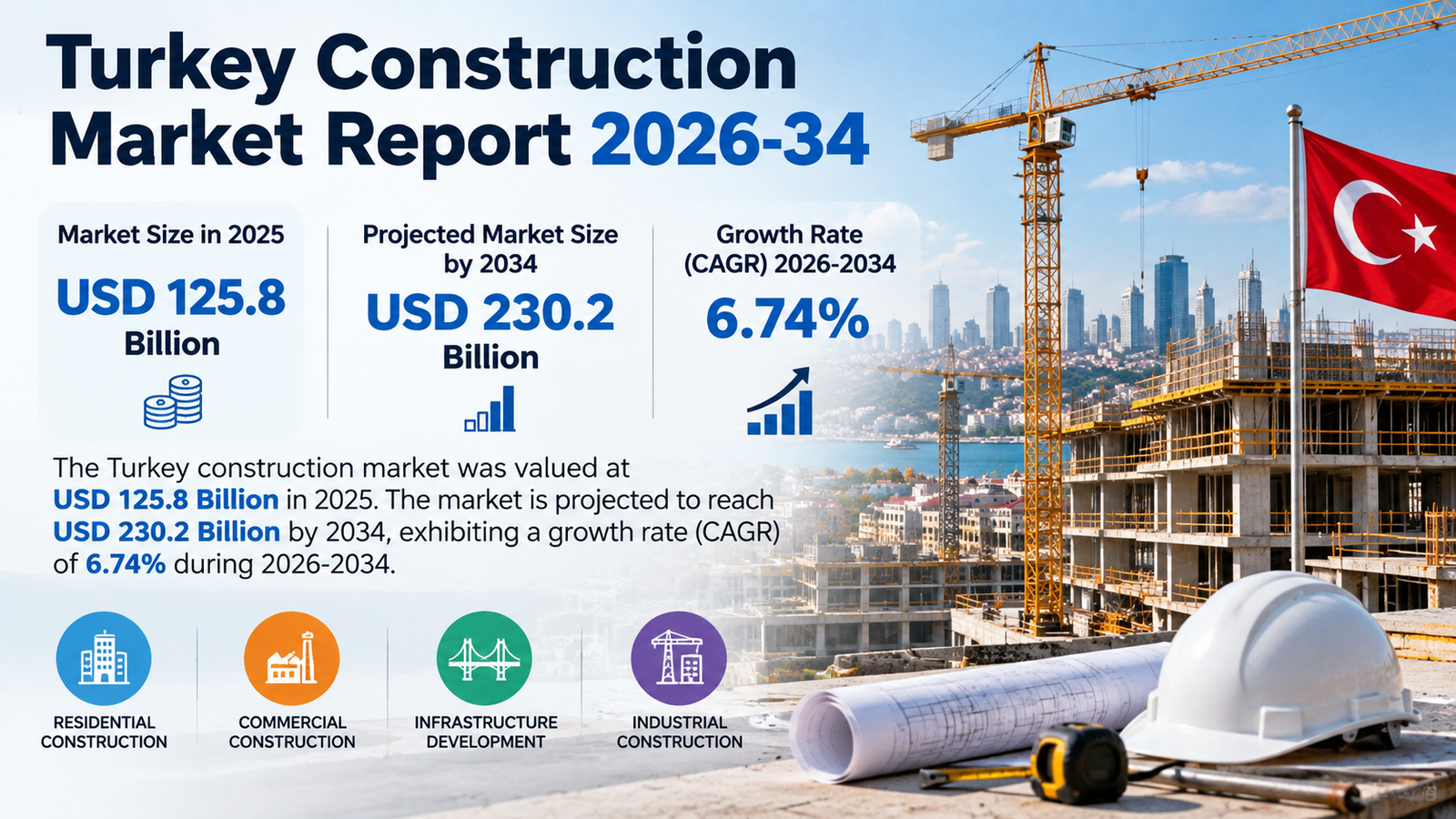
IMARC Group, a leading global market research and management consulting firm, has published its latest market intelligence report on the Turkey construction market size reached USD 125.8 Billion in 2025. The market is projected to reach USD 230.2 Billion by 2034, exhibiting a growth rate (CAGR) of 6.74% during 2026-2034, driven by massive post-earthquake reconstruction efforts across southern provinces, government mandates for urban transformation and seismic retrofitting, large-scale infrastructure mega-projects including the Istanbul Canal, rising urbanization, population growth, and increasing investment in energy infrastructure.
The market is experiencing strong momentum as Turkey channels significant public and private capital into rebuilding earthquake-affected regions while simultaneously pushing forward some of the largest infrastructure and urban renewal programs in its history. The February 2023 Kahramanmaraş earthquakes triggered an unprecedented reconstruction drive that continues to shape construction demand, with the government pledging to deliver hundreds of thousands of housing units in affected provinces. Alongside this, sweeping urban transformation initiatives are targeting earthquake-vulnerable building stock in major cities, while transportation and energy mega-projects are reinforcing Turkey’s position as a strategic construction hub connecting Europe and Asia.
How AI is Reshaping the Future of the Turkey Construction Market?
- AI-Powered Structural Risk Assessment and Seismic Retrofitting Prioritization: Machine learning platforms are helping Turkish municipalities and engineering firms analyze building age, soil composition, and structural data to prioritize which buildings require urgent seismic retrofitting, enabling more efficient allocation of retrofitting permits and zero-interest loan programs across dense urban districts such as Istanbul’s Küçükçekmece and Zeytinburnu.
- AI-Driven Project Scheduling and Cost Control Across Mega-Projects: Large infrastructure developments such as the Istanbul Canal and new high-speed rail corridors are using AI-based scheduling tools to manage complex multi-contractor timelines, predict material cost fluctuations, and reduce delays, a critical capability given that opportunistic pricing and rising material costs have significantly inflated construction expenses in earthquake-affected regions.
- Computer Vision for Construction Site Safety and Quality Monitoring: AI-enabled camera systems and drone-based inspection tools are being deployed across large residential reconstruction sites to monitor worker safety compliance, track progress against build-back-better resilience standards, and verify adherence to Turkey’s updated seismic and energy-efficient building codes before final handover.
Grab a sample PDF of this report: https://www.imarcgroup.com/turkey-construction-market/requestsample
Turkey Construction Market Trends and Drivers
Post-earthquake reconstruction remains the single largest structural driver of the Turkey construction market. In March 2025, the World Bank extended an additional EUR 200 Million, equivalent to roughly USD 207.5 Million, to Turkey for the construction of 2,800 resilient rural homes in earthquake-affected areas, matching funds contributed by the French development agency AFD and bringing combined financing to EUR 400 Million. This funding sits within the broader USD 1 Billion Turkey Earthquake Recovery and Reconstruction Project, which aims to provide permanent housing for 16,000 people while expanding coverage to seven additional provinces. All reconstruction work is required to follow a build-back-better approach, incorporating Turkey’s latest seismic and climate-resilient building codes along with energy efficiency and universal access provisions, and post-earthquake legal reforms have expedited land consolidation by allowing property owners holding a simple majority of shares to approve plot division, reconstruction, and public land transactions.
Government-mandated urban transformation is reinforcing this momentum well beyond the earthquake zone. Regulatory reforms enacted in 2024 simplified the retrofitting approval process for high-risk buildings, lowering the ownership consent threshold from a two-thirds majority to an absolute majority, which has removed a major bottleneck in multi-owner apartment blocks. Financial incentives including zero-interest loans and expanded relocation subsidies are easing the burden on property owners, while major redevelopment zones in Istanbul such as Fikirtepe, Bağcılar, Tuzla, and Kartal are replacing aging housing stock with earthquake-resistant, energy-efficient structures.
Large-scale infrastructure investment is the third major pillar supporting the market. In September 2025, Turkey launched construction of the 224 kilometer Kars-Iğdır-Aralık-Dilucu railway line, extending the national rail network to Azerbaijan’s Naxçıvan exclave. The EUR 2.4 Billion project, awarded to Kalyon İnşaat, includes five stations, five tunnels, 19 cut-and-cover sections, and 10 bridges, and is designed to handle up to 15 Million Tonnes of freight annually, backed by a USD 2.8 Billion financing package led by Mitsubishi UFJ Financial Group. The Istanbul Canal project also regained momentum, alongside continued double-track and high-speed rail development, while the energy sector is seeing sustained construction activity tied to Turkey’s renewable energy targets and efforts to reduce reliance on imported energy.
Turkey Construction Industry Segmentation
The report has segmented the market into the following categories:
Breakup By Sector:
- Residential
- Commercial
- Industrial
- Infrastructure (Transportation)
- Energy and Utilities
Residential construction commands significant market share, propelled directly by the earthquake reconstruction mandate and urban transformation programs replacing vulnerable housing stock with resilient, code-compliant buildings across affected and high-risk regions. Infrastructure and transportation construction is gaining accelerated momentum through mega-projects such as the Istanbul Canal and cross-border rail corridors, while energy and utilities construction is expanding in line with Turkey’s push to diversify its power generation mix and reduce energy import dependence.
Breakup By Region:
- Marmara
- Central Anatolia
- Mediterranean
- Aegean
- Southeastern Anatolia
- Black Sea
- Eastern Anatolia
Marmara, anchored by Istanbul, remains the dominant regional market given its concentration of urban transformation zones, mega-infrastructure projects, and commercial construction activity, while Southeastern Anatolia and the Mediterranean region are experiencing outsized residential construction growth tied directly to earthquake reconstruction efforts in the provinces most affected by the 2023 disaster.
Competitive Landscape
The report provides a comprehensive analysis of the competitive landscape in the Turkey construction market, covering market structure, key player positioning, top winning strategies, competitive dashboard, and company evaluation quadrant, along with detailed profiles of major domestic contractors, international engineering firms, and construction material suppliers active in reconstruction and infrastructure projects across the country.
Recent News and Developments in Turkey Construction Market
- September 2025: Turkey launched construction of the 224 kilometer Kars-Iğdır-Aralık-Dilucu railway line extending the national rail network to Azerbaijan’s Naxçıvan exclave, with the EUR 2.4 Billion project awarded to Kalyon İnşaat backed by a USD 2.8 Billion financing package led by Mitsubishi UFJ Financial Group.
- March 2025: The World Bank extended an additional EUR 200 Million to Turkey for the construction of 2,800 resilient rural homes in earthquake-affected areas, matching funds from the French development agency AFD and bringing total financing under the initiative to EUR 400 Million, targeting permanent housing for 16,000 people across seven provinces.
- 2025: The Istanbul Canal project received renewed momentum alongside continued development of double-track alignments and civil works for high-speed rail lines, reflecting sustained government investment in transportation infrastructure connecting the Marmara region to broader national and cross-border networks.
- 2024: Regulatory reforms simplified the seismic retrofitting approval process for high-risk buildings, lowering the required ownership consent threshold from a two-thirds majority to an absolute majority, easing a major bottleneck for urban transformation projects in multi-owner apartment structures across Istanbul and other high-density cities.
Note: If you require specific details, data, or insights that are not currently included in the scope of this report, we are happy to accommodate your request. As part of our customization service, we will gather and provide the additional information you need, tailored to your specific requirements. Please let us know your exact needs, and we will ensure the report is updated accordingly to meet your expectations.
About Us
IMARC Group is a global management consulting firm that helps the world’s most ambitious changemakers to create a lasting impact. The company provides a comprehensive suite of market entry and expansion services. IMARC offerings include thorough market assessment, feasibility studies, company incorporation assistance, factory setup support, regulatory approvals and licensing navigation, branding, marketing and sales strategies, competitive landscape and benchmarking analyses, pricing and cost research, and procurement research.
Media and Sales Contact
IMARC Group
Email: sales@imarcgroup.com
United States: +1-201-971-6302
India: +91-120-433-0800
United Kingdom: +44-753-714-6104