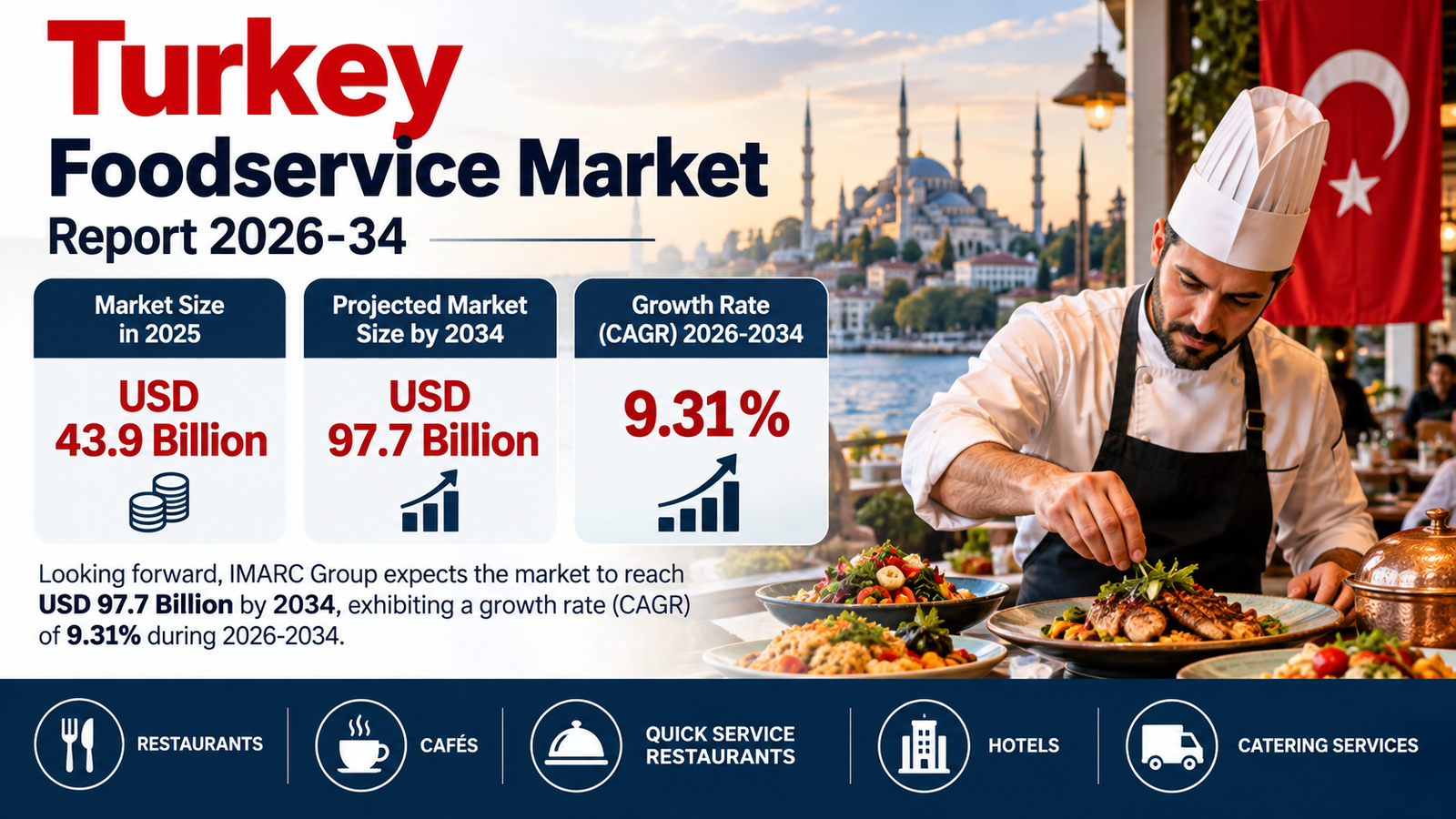
IMARC Group, a leading global market research and management consulting firm, has published its latest market intelligence report on the Turkey foodservice market size reached USD 43.9 Billion in 2025. Looking forward, IMARC Group expects the market to reach USD 97.7 Billion by 2034, exhibiting a growth rate (CAGR) of 9.31% during 2026-2034, driven by changing consumer lifestyles, rapid urbanization, an expanding middle class, increasing tourism influxes, technological advancements, evolving dietary trends, rising disposable incomes, sustainability concerns, and demographic shifts.
The market is experiencing strong momentum as Turkey’s fast paced urban lifestyle continues to push consumers toward quick dining and convenience driven eating occasions. Consumers, primarily in cities such as Istanbul, Ankara, and Izmir, increasingly prefer quickly prepared meals on the go or dining out to save time and effort, and the popularity of fast food outlets, cafes, and casual dining formats has not come at the expense of flavor or quality. At the same time, diners are seeking more memorable experiences, including themed restaurants, interactive dining concepts, and live cooking formats that go beyond a simple meal, reshaping how foodservice operators design their offerings across chained and independent outlets.
How AI is Reshaping the Future of the Turkey Foodservice Market?
- AI-Powered Delivery Logistics and Demand Prediction: Online food ordering platforms operating in Turkey are using machine learning to forecast peak order windows, optimize rider allocation, and reduce delivery times across dense urban markets, helping quick service restaurants and cloud kitchens manage surges in demand during major cities’ lunch and dinner rushes without overstaffing kitchens during slower hours.
- Personalized Menu Recommendations and Loyalty Engagement: Restaurant chains and food delivery apps are deploying AI-driven recommendation engines that analyze past orders, dietary preferences, and spending patterns to surface personalized menu suggestions and targeted loyalty offers, increasing repeat visits and average order value across both dine-in and delivery channels.
- AI-Enabled Kitchen Operations and Inventory Management: Cloud kitchens and full service restaurant groups are adopting AI-based inventory forecasting tools to reduce food waste, manage perishable stock more precisely, and coordinate procurement across multiple outlet locations, an important efficiency lever given persistent input cost pressures facing Turkish foodservice operators.
Grab a sample PDF of this report: https://www.imarcgroup.com/turkey-foodservice-market/requestsample
Turkey Foodservice Market Trends and Drivers
Urbanization and the expansion of Turkey’s middle class continue to reshape the foodservice landscape. Major cities including Istanbul, Ankara, and Izmir have seen a steady rise in the number of dining establishments to match the tastes of a rapidly growing urban population, and rising disposable incomes are giving more households the means to dine out more frequently and experiment with new formats. People living in large metropolitan areas tend to socialize more and eat outside the home more often, which continues to expand the range of available dining options. Government backed sustainability financing is also reinforcing this shift, with Turkey securing a partnership worth close to USD 966 Million with the World Bank for green transformation, part of a broader USD 35 Billion pledge from the World Bank to support the country over a three year period, an initiative that is encouraging foodservice operators to adopt more energy efficient kitchen equipment and sustainable sourcing practices.
Tourism remains one of the most powerful growth engines for the market. Turkey welcomed a record 64 million international visitors in a recent year, generating over USD 65 Billion in tourism revenue, with food and beverage spending accounting for more than a fifth of total tourist expenditure. Istanbul alone accounts for roughly a third of total arrivals, and destinations such as Antalya and Cappadocia continue to draw visitors seeking authentic Turkish cuisine, from street food stalls to fine dining establishments. This steady visitor inflow is prompting foodservice operators to diversify menus to serve both traditional Turkish dishes and international cuisines, while also supporting ancillary offerings such as food tours, cooking classes, and culinary events that extend the tourist food experience beyond the restaurant table.
Digitalization and online ordering have become deeply embedded in how Turkish consumers access food. Yemeksepeti, the country’s pioneering food delivery brand, completed a full year of its Pick-up service, which was piloted across 4,000 restaurants and achieved 80 percent restaurant penetration, offering diners a convenient alternative to traditional delivery. International chains are also recognizing Turkey’s growth potential: Chuck E Cheese announced plans to open three venues in Istanbul by the end of a coming year, with an eventual target of 20 locations nationwide, citing Turkey’s youthful demographic and family centered culture as key factors behind the expansion, while established quick service brands continue to relaunch and expand their franchise networks to capture rising demand across chained and independent formats alike.
Turkey Foodservice Industry Segmentation
The report has segmented the market into the following categories:
Breakup By Type:
- Cafes and Bars (Bars and Pubs, Cafes, Juice/Smoothie/Desserts Bars, Specialist Coffee and Tea Shops)
- Cloud Kitchen
- Full Service Restaurants (Asian, European, Latin American, Middle Eastern, North American, Others)
- Quick Service Restaurants (Bakeries, Burger, Ice Cream, Meat-based Cuisines, Pizza, Others)
Quick service restaurants continue to hold strong appeal among Turkish consumers seeking speed and affordability, while full service restaurants, particularly Middle Eastern and international cuisine concepts, are benefiting from both a growing domestic appetite for dining experiences and continued tourist footfall. Cloud kitchens are emerging as a capital efficient format for operators looking to scale delivery-first concepts without the overhead of a traditional storefront.
Breakup By Outlet:
- Chained Outlets
- Independent Outlets
Independent outlets continue to hold the larger share of the Turkish foodservice landscape, reflecting the country’s deeply rooted culture of family run cafes, bakeries, and neighborhood restaurants, while chained outlets are expanding steadily as both domestic groups and international franchise brands pursue multi-city rollouts.
Breakup By Location:
- Leisure
- Lodging
- Retail
- Standalone
- Travel
Standalone locations remain central to everyday dining, while leisure and travel-linked foodservice outlets are gaining share as tourism volumes climb and visitors seek dining options integrated with cultural, entertainment, and hospitality venues.
Breakup By Region:
- Marmara
- Central Anatolia
- Mediterranean
- Aegean
- Southeastern Anatolia
- Black Sea
- Eastern Anatolia
Marmara, anchored by Istanbul, leads the regional market given its status as Turkey’s largest urban center, key tourism gateway, and hub for both domestic restaurant groups and international foodservice brands entering the country.
Competitive Landscape
The report provides a comprehensive analysis of the competitive landscape in the Turkey foodservice market, covering market structure, key player positioning, top winning strategies, competitive dashboard, and company evaluation quadrant, along with detailed profiles of major domestic restaurant groups, international quick service and full service franchise operators, and food delivery platforms active across the country.
Recent News and Developments in Turkey Foodservice Market
- February 2026: Turkey’s Ministry of Culture and Tourism confirmed a record 64 million international visitors and over USD 65 Billion in tourism revenue for the prior year, while announcing a target of USD 68 Billion in tourism revenue for the current year, a milestone expected to further boost restaurant, cafe, and hospitality-linked foodservice spending across major tourist hubs.
- November 2025: Turkey’s Minister of Culture and Tourism reported that the country welcomed 50 million international visitors in the first nine months of the year, generating over USD 50 Billion in tourism revenue, with average visitor spending rising 7 percent from the prior year, reinforcing the direct link between tourism inflows and foodservice sector growth.
- October 2025: US restaurant and entertainment chain Chuck E Cheese announced plans to enter the Turkish market in partnership with local franchisees PNB Restoran and Unique Hospitality Company, with three venues planned for Istanbul and a longer-term goal of 20 locations nationwide.
- March 2025: Industry data highlighted that Yemeksepeti’s Pick-up service, piloted across select cities before a nationwide rollout, reached 80 percent restaurant penetration after being tested with 4,000 restaurants, marking a shift in how Turkish consumers access quick service dining beyond traditional delivery.
Note: If you require specific details, data, or insights that are not currently included in the scope of this report, we are happy to accommodate your request. As part of our customization service, we will gather and provide the additional information you need, tailored to your specific requirements. Please let us know your exact needs, and we will ensure the report is updated accordingly to meet your expectations.
About Us
IMARC Group is a global management consulting firm that helps the world’s most ambitious changemakers to create a lasting impact. The company provides a comprehensive suite of market entry and expansion services. IMARC offerings include thorough market assessment, feasibility studies, company incorporation assistance, factory setup support, regulatory approvals and licensing navigation, branding, marketing and sales strategies, competitive landscape and benchmarking analyses, pricing and cost research, and procurement research.
Media and Sales Contact
IMARC Group
Email: sales@imarcgroup.com
United States: +1-201-971-6302
India: +91-120-433-0800
United Kingdom: +44-753-714-6104