
Introduction
If you’ve spent any time around Oracle Fusion Cloud, you already know reporting isn’t an afterthought here it’s baked into everything. Soft Online Training has had a lot of learners walk in confused about why there are so many “reporting tools” instead of just one, and honestly, that confusion is fair. Oracle didn’t build one tool because one tool can’t do everything a finance team, an HR head, and a technical consultant all need at the same time. So instead, you get a handful of tools, each doing its own job well. Getting comfortable with all of them is basically non-negotiable if you’re going through any proper Oracle Fusion Technical Training in Bangalore program.
Why Oracle Fusion Cloud Even Needs Multiple Reporting Tools
Here’s the thing: Oracle could have shipped a single reporting engine and called it a day. But real business users don’t work that way. Some want quick, live numbers they can slice on the fly. Others need a formatted, audit-ready document that looks exactly the same every time it’s printed. And some technical folks just want raw access to build whatever the business asks for next week. That’s why Oracle Fusion Cloud spreads reporting across several purpose-built tools, and knowing which one fits which situation is a skill that any decent Oracle Fusion Technical Training in Bangalore course should be drilling into you from day one.
OTBI The Tool Everyone Reaches for First
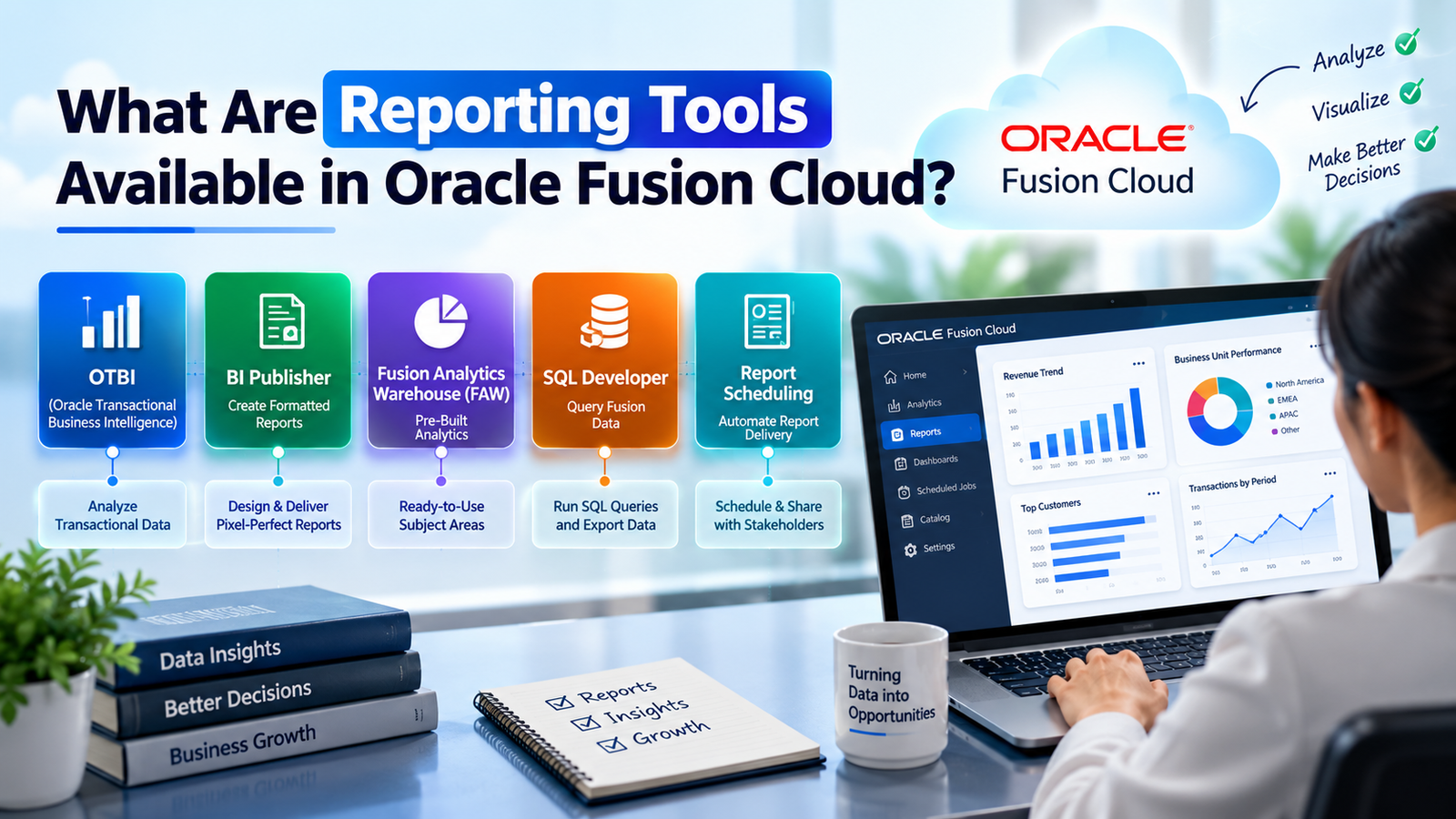
Oracle Transactional Business Intelligence, or OTBI, is usually the first reporting tool people get introduced to, and there’s a good reason for that. It pulls data straight from the live transactional tables, so what you see is what’s actually happening right now, not waiting on a nightly batch job. You build reports by dragging fields from subject areas, no SQL required, which is why functional consultants love it.
That said, the “easy” version of OTBI only gets you so far. The moment you need custom subject areas, tricky calculated measures, or joins that Oracle didn’t anticipate, you need to actually understand the data model underneath. That’s the gap where a lot of self-taught folks get stuck, and it’s exactly the kind of thing hands-on Oracle Fusion Technical Training in Bangalore is meant to close.
BI Publisher When the Output Has to Look Right
OTBI is great for exploring data, but it’s not built for documents that need to look a certain way every single time think invoices, payslips, purchase orders, tax filings. That’s BI Publisher‘s job. You define a data model (often SQL-based or pulling from web services), then design a template RTF, Excel, whatever fits and BIP stitches the two together into a clean PDF, Word doc, or spreadsheet.
This is one of those tools where the demand for skilled people never seems to slow down. Every company running Fusion needs someone who can build and maintain these formatted outputs, which is probably why BI Publisher gets so much airtime in Oracle Fusion Technical Training in Bangalore batches. It’s not glamorous work, but it’s the stuff businesses genuinely can’t run without.
Financial Reporting Studio Built for Finance, Period
If you’re on the finance side, Financial Reporting Studio (FRS) is where you’ll spend a lot of your time. It’s purpose-built for balance sheets, P&L statements, cash flow reports, the formal stuff that needs to tie back cleanly to the General Ledger, follow accounting standards, and support drill-downs when someone asks “wait, where did this number come from?”
Building good FRS reports takes more than just knowing the tool you need to actually understand the chart of accounts and basic accounting logic too. It’s a mix of functional and technical thinking, and that combination is exactly what practical Oracle Fusion Technical Training in Bangalore tries to build in people, rather than just teaching button clicks.
Smart View For the Excel Diehards
Let’s be honest, a lot of finance people never really leave Excel, no matter how many fancy cloud dashboards get rolled out. Smart View respects that. It’s an Excel add-in that connects live to Oracle Fusion Cloud, letting users pull real data into spreadsheets, build their own analyses, and in some planning scenarios, even push updates back into the system.
It’s especially handy during budgeting cycles or month-end close, when people just want their numbers in a familiar grid instead of clicking through five different screens to find what they need.
Oracle Analytics Cloud Reporting’s Bigger, Smarter Cousin
Once organizations outgrow standard reporting and start wanting real dashboards, trend predictions, or mashups of Fusion data with outside sources, that’s where Oracle Analytics Cloud (OAC) steps in. Technically it’s a separate product, not a core Fusion reporting tool, but it’s getting bundled into enterprise reporting strategies often enough that it’s worth knowing. More advanced Oracle Fusion Technical Training in Bangalore programs are starting to touch on it too, especially for anyone eyeing analytics-heavy roles down the line.
The Reports and Analytics Work Area
There’s also a simpler, more everyday piece worth mentioning the Reports and Analytics work area, sitting inside each Fusion module like Financials, HCM, or Procurement. It’s basically a central spot where users can find pre-built reports, run their own OTBI queries, or pull up BIP outputs without hopping between different corners of the application. Nothing fancy, but it saves a lot of hassle for people who aren’t technical and just want their numbers without a scavenger hunt.
So Which Tool Should You Actually Use?
Honestly, this is where a lot of beginners trip up. They assume one tool should do it all. It won’t, and that’s fine. OTBI for quick, live digging around. BI Publisher when the output format really matters. FRS when finance needs proper statements. Smart View when Excel is just easier. OAC when things get analytical. Knowing when to reach for which one is less about memorizing features and more about experience and that judgment call is really what solid Oracle Fusion Technical Training in Bangalore is trying to hand you, beyond just the tool basics.
Wrapping Up
At the end of the day, these reporting tools are what make Oracle Fusion Cloud actually useful to the people running a business, not just the people maintaining the system. Soft Online Training has seen firsthand how much of a difference it makes when someone learns these tools properly, with real scenarios, instead of just watching a few tutorial videos and hoping for the best. If you’re serious about building a career here, putting in the time with structured Oracle Fusion Technical Training in Bangalore is probably one of the better decisions you’ll make for where this field is headed.