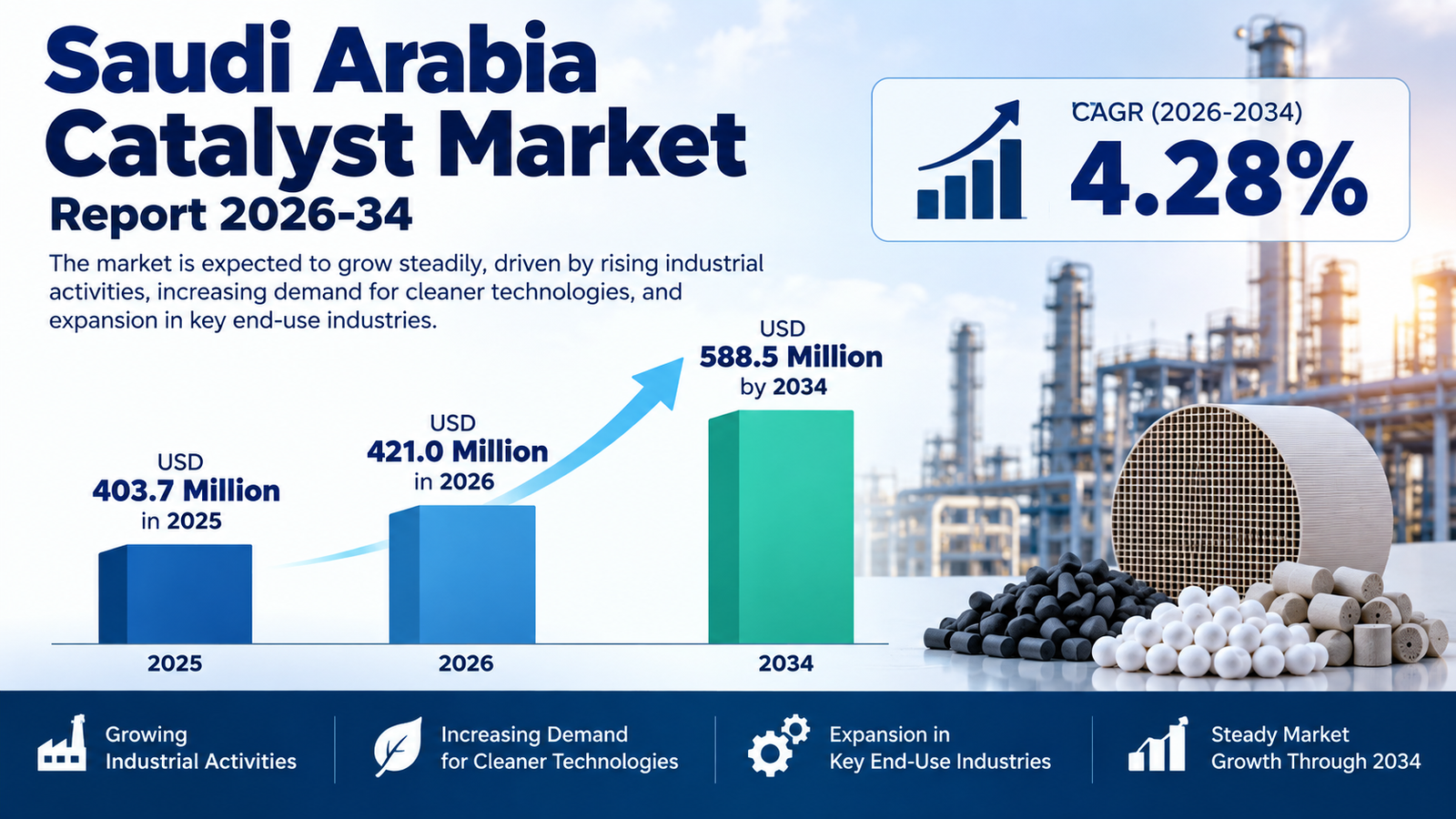
IMARC Group, a leading global market research and management consulting firm, has published its latest market intelligence report on the Saudi Arabia catalyst market size grew from USD 403.7 Million in 2025 to USD 421.0 Million in 2026. Looking forward, IMARC Group expects the market to reach USD 588.5 Million by 2034, exhibiting a growth rate (CAGR) of 4.28% during 2026-2034, driven by the Kingdom’s push toward sustainability and green technologies, which is increasing demand for catalysts used in renewable energy processes such as hydrogen production and biomass conversion.
A catalyst is a substance that accelerates a chemical reaction without undergoing a permanent change itself, working by providing an alternative reaction pathway with lower activation energy so reactants transform into products more efficiently. Catalysts play a crucial role across petrochemicals, petroleum refining, pharmaceuticals, and environmental protection, and Saudi Arabia’s position as a global crude oil leader with more than 17% of the world’s proven petroleum reserves places catalyst demand at the core of its downstream industrial strategy.
How AI is Reshaping the Future of Saudi Arabia Catalyst Market?
- AI-powered process simulation and reaction modeling are helping refiners and petrochemical producers optimize catalyst selection and loading configurations before physical deployment, reducing trial-and-error cycles in hydroprocessing, hydrocracking, and fluid catalytic cracking units.
- Machine learning-based predictive maintenance systems are being applied to monitor catalyst deactivation and fouling in real time across refinery and petrochemical complexes, allowing operators to schedule regeneration or replacement precisely rather than on fixed intervals, minimizing unplanned downtime at large-scale facilities such as those in Jubail and Yanbu.
- AI-driven materials discovery platforms are accelerating the development of next-generation catalysts for hydrogen production, ammonia cracking, and sulfur recovery, shortening development timelines for domestic catalyst manufacturers working to localize technologies once imported entirely from abroad.
- Digital twin technology integrated with AI analytics is enabling petrochemical plants to simulate catalytic reactor performance under varying feedstock conditions, supporting higher yield efficiency and lower energy consumption across polymer and chemical manufacturing lines.
- AI-enhanced quality control systems are being deployed at domestic catalyst manufacturing sites to verify particle size, surface area, and activity consistency during production, supporting compliance with the stringent specifications required by regional oil and gas customers.
Grab a sample PDF of this report: https://www.imarcgroup.com/saudi-arabia-catalyst-market/requestsample
Market Growth Factors
The Saudi Arabia catalyst market is being propelled by the Kingdom’s strategic drive to localize an industry it has historically relied on imports to serve. Despite its global leadership in energy and petrochemicals, Saudi Arabia has depended heavily on catalyst imports, a dynamic that increases operational risk whenever international supply chains face disruption. In response, SABIC has launched a strategic project to manufacture catalysts domestically as part of the Shareek program, a public-private partnership initiative designed to increase private sector investment through government-approved incentives. The catalyst project follows a two-stage approach: first acquiring core technology through the full buyout of Scientific Design, a licensor of high-performance catalyst processes used in glycol manufacturing, and second, building new plants dedicated to catalysts used in polymer and chemical production. This localization effort is explicitly aligned with Vision 2030 goals to raise the level of local content, strengthen the competitiveness of the energy sector, and support the broader national industrial strategy.
Refinery modernization and downstream capacity expansion are reinforcing steady catalyst demand. Saudi Arabia’s refineries require advanced catalyst technologies to maximize yield, meet increasingly stringent environmental specifications on sulfur content, and improve overall processing efficiency, particularly as the country continues to invest in refinery upgrades and integrated petrochemical complexes across Jubail and Yanbu. International catalyst technology providers are responding directly to this demand: Axens completed the expansion of its Axens Catalyst Arabia Limited site in Dammam, adding capacity to manufacture Tail Gas Treatment Catalysts locally, a milestone that made it the first and only company producing this catalyst type in Saudi Arabia and the wider Middle East, with sulfur recovery efficiency reaching up to 99.9% and a direct role in minimizing sulfur oxide emissions across the oil and gas sector.
The Kingdom’s clean energy transition is opening a distinct new demand channel for catalysts tied to hydrogen and ammonia production. Saudi Arabia’s first green hydrogen plant is on track to begin operations, while state oil company Saudi Aramco has moved to co-own a blue hydrogen venture in the Kingdom as part of its New Energies strategy, developments that require specialized catalysts for electrolysis, ammonia synthesis, and ammonia cracking processes. This shift toward blue and green hydrogen production directly supports catalyst consumption in environmental and renewable energy applications, a segment IMARC Group identifies as a key growth driver alongside traditional petroleum refining and petrochemical uses. Complementing this, Honeywell has invested in a new catalytic process for paraxylene production in Dammam under a memorandum of understanding with Saudi Aramco tied to the In-Kingdom Total Value Add program, which targets 70% localization of production and employment in line with Vision 2030 objectives.
Environmental regulation and sustainability compliance continue to shape catalyst selection across Saudi industry. Refiners and petrochemical producers are increasingly adopting catalysts engineered to reduce sulfur, chlorine, arsenic, and mercury content in fuel streams, supporting compliance with both domestic environmental standards and international emissions requirements for exported refined products. This regulatory push, combined with the Kingdom’s ambition to become a regional manufacturing hub for specialty materials, is expected to sustain multi-year investment in both heterogeneous and homogeneous catalyst production capacity.
Market Segmentation
Type Insights:
- Heterogeneous Catalyst
- Homogeneous Catalyst
Process Insights:
- Recycling
- Regeneration
- Rejuvenation
Raw Material Insights:
- Chemical Compounds
- Metals
- Zeolites
- Others
Application Insights:
- Chemical Synthesis
- Petroleum Refining
- Polymers and Petrochemicals
- Environmental
Regional Insights:
- Eastern Province
- Riyadh
- Makkah
- Others
Heterogeneous catalysts hold the leading share of the market given their widespread use in large-scale refining and petrochemical operations, where solid-phase catalysts allow for easier separation from reaction products and continuous processing in fixed-bed and fluidized-bed reactors. The Eastern Province, home to Jubail and Dammam, two of the country’s most significant petrochemical and catalyst manufacturing hubs, represents the largest regional segment given its concentration of refining capacity and specialty chemical infrastructure.
Recent Development & News
- April 2025: Axens completed the expansion of its Axens Catalyst Arabia Limited site in Dammam, adding local capacity to manufacture Tail Gas Treatment Catalysts, becoming the first company to produce this catalyst category in Saudi Arabia and the broader Middle East to serve the oil and gas sector.
- 2025: SAMA Healthy Water and related industrial manufacturers across Saudi Arabia’s Eastern Province continued signing equipment supply agreements with international technology partners, reflecting the wider trend of localized specialty manufacturing investment that parallels the catalyst sector’s Shareek-driven expansion.
- February 2026: Saudi Arabia’s first green hydrogen plant was reported on track to begin operations by the end of the year, while Saudi Aramco confirmed it will co-own a blue hydrogen company in the Kingdom as part of its New Energies business, a development expected to expand demand for electrolysis and ammonia synthesis catalysts.
- 2024: SABIC continued progressing its Shareek-aligned catalyst manufacturing project, advancing plans for new plants dedicated to catalysts used in polymer and chemical manufacturing as part of its broader strategy to reduce the Kingdom’s reliance on imported catalyst technology.
If you require any specific information that is not covered currently within the scope of the report, we will provide the same as a part of the customization.
About Us
IMARC Group is a global management consulting firm that helps the world’s most ambitious changemakers to create a lasting impact. The company provides a comprehensive suite of market entry and expansion services. IMARC offerings include thorough market assessment, feasibility studies, company incorporation assistance, factory setup support, regulatory approvals and licensing navigation, branding, marketing and sales strategies, competitive landscape and benchmarking analyses, pricing and cost research, and procurement research.
Contact Us
IMARC Group,
134 N 4th St. Brooklyn, NY 11249, USA,
Email: sales@imarcgroup.com,
Tel No: (D) +91 120 433 0800,
United States: +1-201-971-6302