Introduction
Anyone who has spent even a few weeks working inside Oracle Fusion has probably run into this question at some point: OTBI or BI Publisher, which one do I actually use here? Soft Online Training gets this question a lot from students, and honestly, it’s a fair one because the two tools overlap just enough to be confusing. They both live under the Oracle Fusion reporting umbrella, they both pull from the same underlying data, and yet they’re built for completely different jobs. If you’re studying Oracle Fusion Technical Training in Hyderabad or just trying to make sense of a project requirement that landed on your desk, sorting out this difference early will save you a lot of back-and-forth later.
So let’s actually get into what each tool does, how they’re different under the hood, and which one you’d reach for depending on what you’re trying to build.
What OTBI Actually Does
OTBI (Oracle Transactional Business Intelligence) is the tool Fusion gives you when you just need an answer, fast, without filing a ticket to IT. It’s built right into the application, and it works off pre-built “subject areas” , basically ready-made data models that sit on top of the real transactional tables. You drag a field, drop it into a column, add a filter, and you’ve got a working report in a few minutes. No SQL required.
This is exactly why functional consultants and business analysts gravitate toward it. Say a finance manager wants to know which invoices are still open past 60 days they don’t need a developer for that. They open OTBI, pick the right subject area, and build it themselves. It’s meant for exploration, for quick dashboards, for the kind of reporting where speed matters more than polish.
Where BI Publisher Comes In
BI Publisher (people usually just call it BIP) is a different animal entirely. This is the tool you use when the output has to look exactly right: an invoice that goes to a customer, a payslip an employee opens, a statutory report that gets submitted to a government body. None of that can look like a rough spreadsheet dump. It needs a proper layout, a logo, consistent fonts, and the works.
BIP achieves this by keeping the data and the layout completely separate. You build a data model first this could be a SQL query, or it could even pull from an OTBI analysis and then you design a template on top of it, usually in Word (RTF), Excel, or PDF format. Once that template is built, you can run the exact same report a thousand times and it’ll look identical every time.
This is also where things get more technical. Writing efficient SQL, structuring a data model properly, building templates that don’t break when the data changes this takes real practice. It’s a big part of why people specifically look for Oracle Fusion Technical Training in Hyderabad rather than trying to piece it together from scattered tutorials online. Getting comfortable with BIP genuinely takes hands-on repetition.
So What’s Actually Different Between the Two?
Let’s go through the practical differences one at a time, because on paper they can sound similar but in day-to-day use they really aren’t.
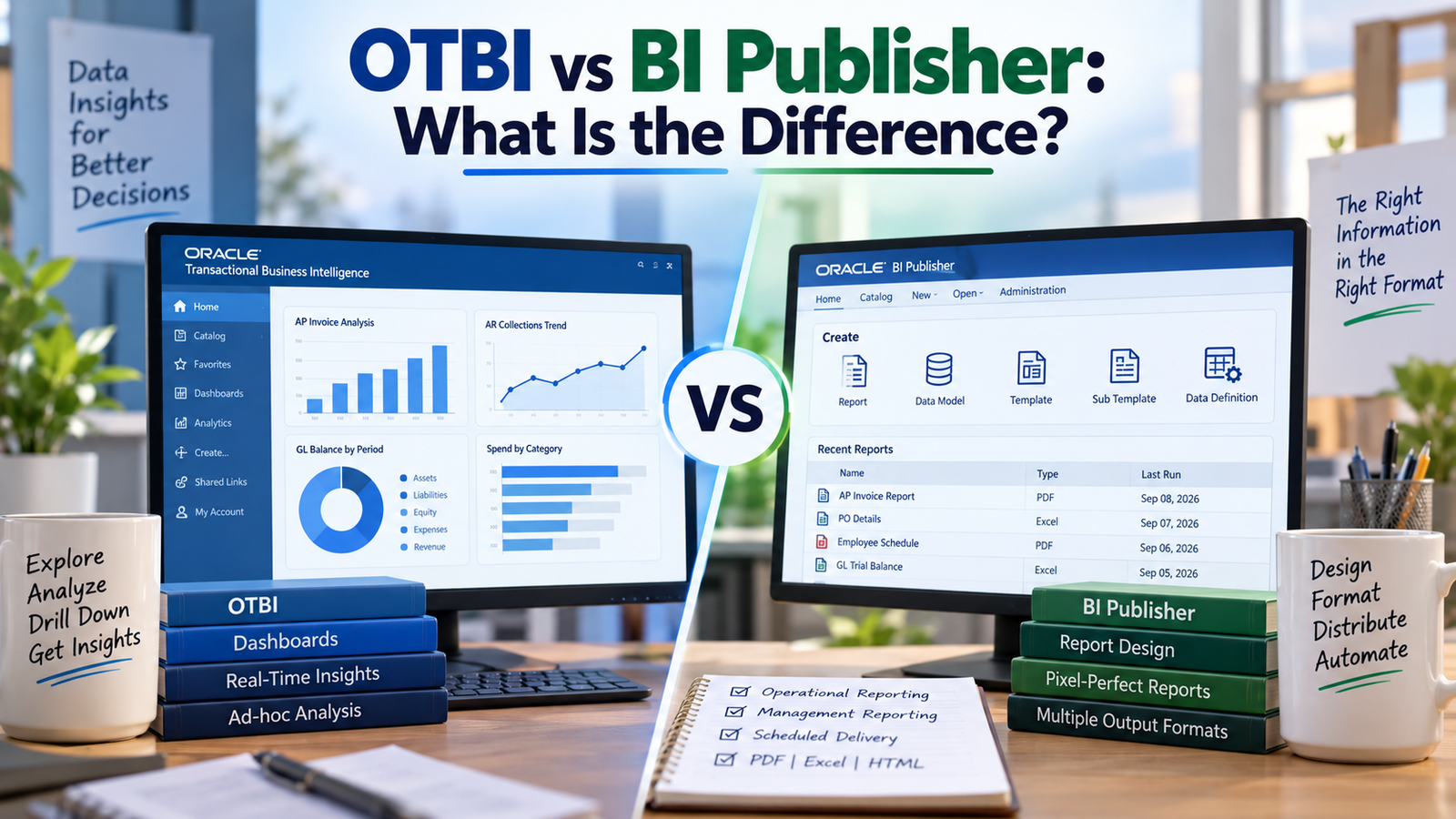
What they’re built for. OTBI is for quick, self-serve insight. You want an answer today, not a finished document. BI Publisher is for formal, repeatable output, the kind of report that has to look the same every single time it’s generated.
How much technical skill you need. With OTBI, if you can use a spreadsheet, you can probably figure out the interface within an hour. BI Publisher expects you to know SQL, understand how to structure a data model, and be comfortable building template skills that most people pick up through structured Oracle Fusion Technical Training in Hyderabad rather than trial and error.
Where the data comes from. OTBI is limited to the subject areas that are already built and available in Fusion. BI Publisher isn’t limited that way at all; it can pull from SQL queries, web services, OTBI analyses, or even outside databases, which gives it a lot more room to handle complicated reporting needs.
What the output looks like. OTBI reports live mostly inside the application itself, dashboards, pivot tables, that sort of thing. BI Publisher can export to PDF, Excel, Word, HTML, and even eText format, which matters a lot if you’re dealing with banking or EFT files.
How much control you have over layout. This is really the crux of it. OTBI doesn’t care much about how things look, it’s about getting to the data. BI Publisher gives you full control over fonts, headers, footers, branding, page breaks, all of it.
How they handle bigger jobs. OTBI is fine for smaller, real-time lookups, but push it too hard with a massive query and it can start to lag. BI Publisher, especially when the SQL behind it is written well, handles larger datasets and batch jobs much more comfortably.
Scheduling. BI Publisher can be set up to run automatically and email itself out on a schedule say, every Monday morning. OTBI really isn’t built for that; it’s meant to be used live, in the moment.
When You’d Actually Reach for Each One
If someone just needs to poke around the data, build a quick pivot table, or put together a dashboard for a Monday meeting, OTBI is the obvious pick. It’s fast, it doesn’t require a developer, and it gets the job done without any fuss.
But if the requirement involves an invoice, a payslip, a compliance filing, or anything that has to go out looking polished and consistent, that’s BI Publisher territory. Anything that needs scheduling, branding, or a specific format also belongs here.
They’re Not Always Separate Tools, Either
Here’s something that surprises a lot of people new to Fusion: OTBI and BI Publisher often work together on the same report. A functional consultant might build the underlying data using OTBI because it’s quick and doesn’t need SQL, and then a technical developer takes that same analysis and wraps a proper BI Publisher template around it. The result is a report that was easy to build and looks professional at the end. This kind of handoff between functional and technical work comes up constantly on real Fusion projects, and it’s exactly the sort of practical scenario covered in Oracle Fusion Technical Training in Hyderabad not just the theory, but how these tools actually get used together on the ground.
Wrapping Up
At the end of the day, OTBI and BI Publisher aren’t competing tools, they’re solving two different problems. OTBI gets you quick answers without needing a developer involved. BI Publisher gets you polished, repeatable, properly formatted output for the reports that matter to people outside your team. Soft Online Training covers both of these in a way that connects the dots between them, rather than teaching them as two unrelated topics. If you’re aiming to actually work with Fusion reporting day-to-day, rather than just knowing the theory, going through Oracle Fusion Technical Training in Hyderabad is a solid way to get real practice with both tools before you need them on a live project.