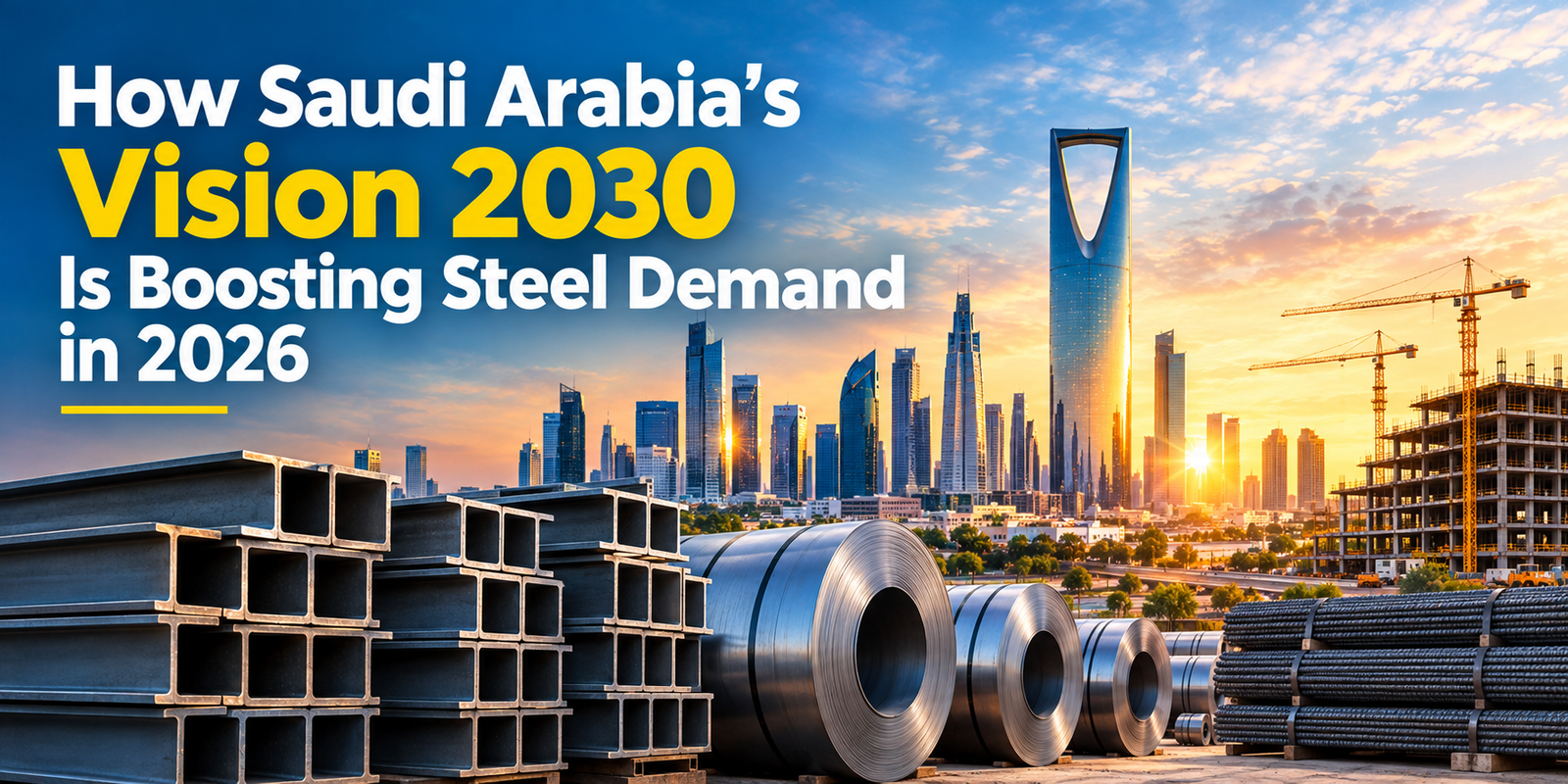
Saudi Arabia is entering an important stage of its Vision 2030 transformation in 2026. The Kingdom is investing heavily in infrastructure, housing, tourism, logistics, manufacturing, renewable energy, and large-scale development projects. These investments are creating strong demand for construction materials, particularly steel.
Steel is essential for buildings, bridges, industrial facilities, warehouses, transport infrastructure, energy projects, and large commercial developments. As more Vision 2030 projects move from planning to construction and delivery, the demand for locally produced and imported steel products is expected to remain strong.
According to the World Steel Association, Saudi Arabia produced 10.8 million tonnes of crude steel in 2025, up from 9.6 million tonnes in 2024. This placed Saudi Arabia 18th among the world’s steel-producing countries in 2025.
Vision 2030 Enters a Critical Phase
Saudi Vision 2030 was created to diversify the Kingdom’s economy, reduce dependence on oil, and build a more competitive private sector. In 2026, the program entered its third and final phase, covering the remaining five years toward 2030. The focus is increasingly on achieving long-term objectives while adapting investments and priorities to changing economic conditions.
This final phase is important for the steel industry because many major developments require large volumes of steel throughout their construction and operational stages.
The official Vision 2030 platform currently highlights major projects including NEOM, Qiddiya, The Red Sea, ROSHN, Diriyah, The Line, Trojena, and other large infrastructure developments.
Mega Projects Are Creating New Steel Demand
Large-scale developments are one of the biggest factors supporting steel consumption in Saudi Arabia.
Projects involving residential communities, hotels, entertainment facilities, airports, transportation networks, commercial buildings, industrial zones, and utilities all require steel at different stages of development.
The Public Investment Fund’s giga-project strategy was specifically designed to create new economic ecosystems and support sectors beyond traditional real estate and infrastructure.
For steel manufacturers, this creates opportunities across a wide range of products, including:
- Structural steel
- Reinforcing bars and rebar
- Steel sections
- Plates and coils
- Pipes and tubes
- Industrial fabrication products
- Steel components for infrastructure and energy projects
As project specifications become more advanced, demand is also growing for products that meet higher requirements for strength, durability, efficiency, and sustainability.
Construction Remains a Major Driver
Construction is one of the most steel-intensive areas of the economy. High-rise buildings, commercial developments, industrial facilities, transport infrastructure, and large public projects all require substantial quantities of steel.
Worldsteel research notes that infrastructure and non-residential construction tend to have relatively high steel intensity. This means strong infrastructure investment can translate directly into higher steel demand.
Saudi Arabia’s expanding construction pipeline therefore creates opportunities not only for steel producers but also for rolling mills, fabricators, machinery suppliers, contractors, and other companies involved in the steel value chain.
Growth of Local Steel Manufacturing
Vision 2030 is not focused only on consuming more steel. It also aims to strengthen domestic manufacturing and local supply chains.
Saudi Arabia’s National Industrial Strategy seeks to build an agile, competitive, and sustainable industrial economy. Its priorities include industrial infrastructure, advanced manufacturing, localization, supply-chain development, and stronger global competitiveness.
This approach can help Saudi steel manufacturers respond more effectively to domestic project requirements while reducing dependence on long-distance supply chains.
The industrial sector is already expanding. According to the National Industrial Development and Logistics Program’s 2025 results, Saudi Arabia had 12,946 industrial facilities in 2025, while cumulative non-government investment in economic and industrial cities and special zones reached SAR 1.466 trillion.
These developments create a broader industrial ecosystem in which steel production, processing, fabrication, machinery, logistics, and construction can grow together.
Saudi Arabia’s Steel Production Is Growing
Saudi Arabia’s recent production figures demonstrate the increasing importance of its steel industry.
Worldsteel reported that Saudi Arabia produced:
- 9.9 million tonnes of crude steel in 2023
- 9.6 million tonnes in 2024
- 10.8 million tonnes in 2025
The increase from 2024 to 2025 was approximately 12.5%, showing a significant improvement in national steel production.
Saudi Arabia also ranked 18th globally in crude steel production in 2025, moving up from 20th in 2024.
These figures indicate that the Kingdom is becoming an increasingly important steel-producing market in the Middle East.
Regional Steel Demand Is Also Rising
The broader regional outlook supports Saudi Arabia’s growth.
Worldsteel’s October 2025 Short Range Outlook forecast finished steel demand in the Middle East at 62.5 million tonnes in 2026, compared with 60.1 million tonnes in 2025. That represents projected growth of 4.0%. The outlook specifically identified Saudi Arabia among the developing economies expected to contribute to steel-demand growth in 2026.
This regional momentum provides additional opportunities for Saudi steel producers and suppliers serving construction, infrastructure, manufacturing, and energy markets.
Infrastructure and Logistics Projects Add Further Demand
Steel demand is not limited to buildings. Saudi Arabia is also developing ports, logistics facilities, transportation networks, industrial zones, and other infrastructure to strengthen its position as a regional trade and manufacturing hub.
The 2025 Vision 2030 Annual Report highlighted major investment in ports and logistics infrastructure, including more than SAR 8.5 billion in private-sector investment by 2025 and 29 logistics centers representing more than $2.9 billion in investment.
Such projects require steel for warehouses, terminals, bridges, storage facilities, industrial buildings, equipment structures, and supporting infrastructure.
Energy and Renewable Projects Create New Opportunities
Saudi Arabia’s economic transformation also includes investments in energy diversification and renewable energy.
Solar and wind projects require steel structures for equipment support, transmission infrastructure, substations, industrial facilities, and associated construction. The Vision 2030 project portfolio includes developments such as the Sakaka Solar Power Plant and Dumat Al Jandal Wind Farm.
As Saudi Arabia develops a broader energy mix, steel suppliers can benefit from demand across both conventional and renewable energy infrastructure.
Localization Is Becoming More Important
Another important trend is the localization of industrial supply chains.
Large Saudi projects increasingly create opportunities for local manufacturers to supply products and services instead of relying entirely on overseas sources. Aramco, for example, has highlighted the development of local manufacturing capabilities, including casting, forging, rig manufacturing, and steel-related manufacturing. It reported that 350 local manufacturing facilities worth more than $9 billion had been established since 2015 through the wider localization drive.
For the steel sector, localization can support investment in production capacity, processing facilities, fabrication capabilities, technical skills, and modern steelmaking technologies.
Sustainability Will Shape the Future of Steel
Higher steel demand also brings greater attention to sustainability.
Saudi Arabia’s industrial transformation increasingly emphasizes efficiency, advanced manufacturing, and sustainable production. The National Industrial Strategy specifically aims to build a sustainable and competitive industrial economy.
Steel producers are therefore likely to face growing demand for efficient production processes, improved energy performance, recycling, lower-emission technologies, and products designed for modern construction requirements.
This is particularly relevant as global customers and major infrastructure developers place greater emphasis on environmental performance.
What This Means for Steel Manufacturers in Saudi Arabia
The combination of Vision 2030 investment, mega-project development, infrastructure expansion, industrial localization, and energy diversification is creating a favorable environment for the Saudi steel sector.
Steel manufacturers and steel mills in Saudi Arabia can benefit from opportunities across:
- Large-scale construction
- Infrastructure development
- Industrial facilities
- Housing and urban development
- Tourism and hospitality
- Renewable energy
- Logistics and ports
- Manufacturing facilities
- Transportation projects
- Oil and gas infrastructure
However, companies will need to compete on more than production volume. Quality, delivery reliability, technical capability, cost efficiency, sustainability, and the ability to meet project specifications will increasingly influence purchasing decisions.
What to Expect From the Saudi Steel Market in 2026
The outlook for 2026 remains positive, although market conditions can vary depending on project schedules, investment priorities, commodity prices, financing conditions, and global trade developments.
The broader Middle East steel market is forecast to grow by 4.0% in 2026, while Saudi Arabia’s 2025 production reached 10.8 million tonnes. Together, these figures point to a market with strong underlying momentum.
The key opportunity is that Saudi Arabia is developing not just individual construction projects, but an interconnected industrial economy. Buildings, transportation, energy, logistics, manufacturing, and urban development all create demand for steel at different stages.
Conclusion
Saudi Arabia’s Vision 2030 is reshaping the country’s economy, and steel is an important part of that transformation. Mega projects, infrastructure investment, industrial expansion, renewable energy development, and localization are creating multiple sources of steel demand in 2026.
With Saudi Arabia producing 10.8 million tonnes of crude steel in 2025 and regional steel demand forecast to grow in 2026, the Kingdom is strengthening its position as a major steel market in the Middle East.
For steel manufacturers, steel mills, and steel plants in Saudi Arabia, the next few years could bring significant opportunities. Companies that combine reliable production, high-quality products, modern technology, and sustainable practices will be well positioned to support Saudi Arabia’s ambitious Vision 2030 development goals.