
Introduction
If you’ve worked with Oracle Fusion Applications, you’ve likely seen a report so polished it seemed impossible to come from a plain database query. Soft Online Training often gets this exact question: how does Fusion turn raw backend data into a clean invoice or financial statement fit for a client or auditor? The answer, almost always, is BI Publisher. It quietly powers reporting across nearly every Fusion module, and understanding it is a core part of any solid Oracle Fusion Technical Training in Chennai program once you get how it works, the “magic” stops feeling like magic.
So, What Exactly Is BI Publisher?
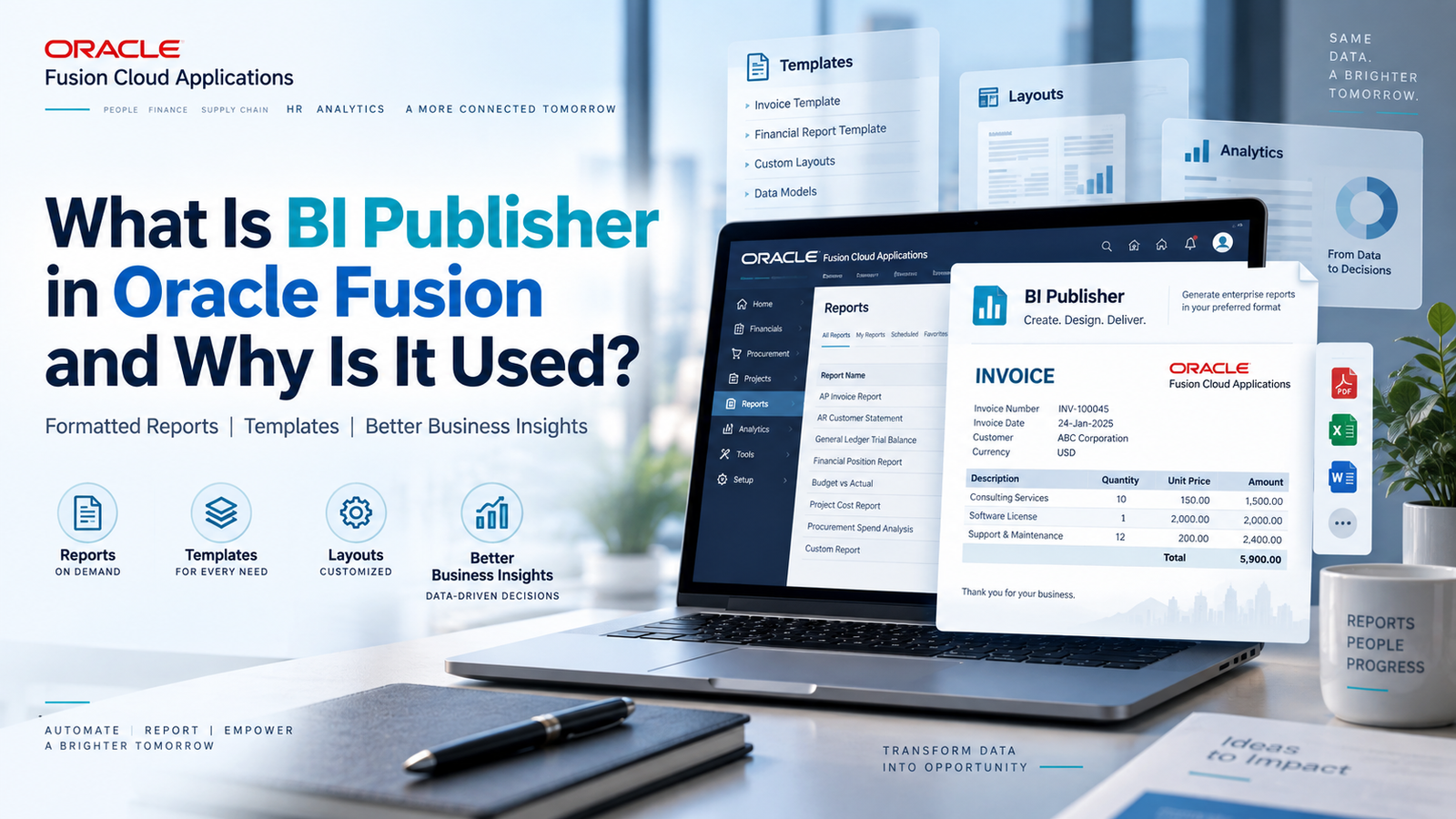
BI Publisher most people just call it BIP is Oracle’s built-in reporting engine, and it’s baked right into the Fusion Applications stack. What makes it different from a lot of older reporting tools is that it doesn’t tie the data to how that data looks on screen or paper. Instead, it splits things into two pieces: a data model that pulls the numbers, and a layout template that decides how those numbers are displayed. Change the template, and the report looks completely different. Change the data query, and the layout doesn’t care, it just adapts.
This might sound like a small technical detail, but it changes everything about how reports get maintained. A finance team that wants their invoice template redesigned doesn’t need someone to rewrite the underlying SQL. Someone just tweaks the RTF or Word template, and the data keeps flowing exactly as before. It’s a genuinely practical way to build reports, and it’s a big part of why BIP has stuck around for so long.
Why Do Companies Bother With BI Publishers At All?
Here’s the thing: every company running Fusion needs reports, but not the same kind of reports. Payroll needs payslips. Finance needs statutory filings that have to match a very specific government format, down to the pixel sometimes. Procurement needs purchase orders that carry the company logo and match a vendor’s expected layout. None of these are “nice to have” ; they’re the paperwork that keeps a business legally and operationally functioning.
What’s useful about BI Publisher is that it doesn’t care whether you’re doing a strict, formal, legally-mandated document or a loose analytical summary for a Monday morning meeting. It handles both without forcing you into a different tool. And because a single report can be output as a PDF, an Excel file, an HTML page, or a Word document without rebuilding anything, teams stop wasting time maintaining five versions of the “same” report for five different audiences.
The Features That Actually Matter Day-to-Day
A couple of features tend to come up again and again once people start actually working with BIP. Scheduling is one report that can run automatically at set times and land in someone’s inbox without a human having to remember to trigger them. Bursting is the other, and it’s honestly one of the more clever ideas in the tool: you generate one big report, and BIP splits it up and sends each department, region, or manager only their relevant slice, automatically.
Template design is where a lot of people get pleasantly surprised. You’re not stuck writing code to build a layout; you can design templates in Microsoft Word or Excel using Oracle’s plugin. That means someone from finance who knows their way around Word formatting can actually contribute to how a report looks, without needing a developer standing over their shoulder. For the more demanding cases government forms, EDI files, anything that needs pixel-level precision there’s still room to build PDF or e-Text templates that handle it properly.
Where Oracle Fusion Technical Training in Chennai Fits Into This
If you’re trying to actually build a career around this stuff rather than just understand it in theory, this is usually where Oracle Fusion Technical Training in Chennai comes into the picture. Chennai has quietly become one of the stronger cities in India for Oracle skill-building, partly because there’s a decent concentration of trainers and companies who work with Fusion day to day, and partly because the demand from local IT firms keeps the training programs relevant and current rather than stuck on outdated syllabuses.
A decent Oracle Fusion Technical Training in Chennai program doesn’t just throw BI Publisher at you on day one. It usually starts by walking through how Fusion is structured architecturally, then moves into the technical tools BIP, OTBI, FBDI, Fast Formulas one at a time, with enough hands-on practice that you’re not just watching slides. By the time someone finishes a proper Oracle Fusion Technical Training in Chennai course, they should be able to sit down, write the SQL for a data model, build a template, and get a working report out the other end without needing hand-holding.
What This Actually Does for Your Career
There’s a reasonably practical career argument here too. As more organizations shift off Oracle EBS and onto Fusion Cloud, the people who know how to build and maintain Fusion reports aren’t exactly sitting around unemployed. Titles like Oracle Fusion Technical Consultant, Reports Developer, or Techno-Functional Consultant show up constantly in job listings, and BI Publisher experience is almost always somewhere in the requirements list.
It also tends to pair naturally with other tools in the Fusion technical toolkit. OTBI handles the more ad-hoc, drag-and-drop style analytical reporting, while FBDI is what you reach for when you need to move large volumes of data into Fusion in bulk. Knowing BIP alongside these doesn’t just make your resume longer it means you can actually handle a reporting or data migration project start to finish instead of just one piece of it.
How BI Publisher Sits Inside the Bigger Fusion Picture
BI Publisher isn’t some separate add-on bolted onto Fusion; it’s woven into nearly every module. Payroll, General Ledger, Procurement, HCM all of them ship with a set of pre-built BIP reports out of the box. Most of the time, those standard reports get you most of the way there. But real businesses rarely fit neatly into “standard,” which is exactly when a technical consultant steps in to rebuild the data model or redesign the layout to match what the business actually needs.
This is also why any serious Oracle Fusion Technical Training in Chennai course treats BI Publisher as a core subject rather than a footnote. It’s not an optional extra skill you pick up later, it’s something you’re expected to already know cold if you’re calling yourself a Fusion technical consultant.
Wrapping It Up
At the end of the day, BI Publisher isn’t just a formatting tool sitting on top of Oracle Fusion, it’s the thing standing between raw, unreadable database output and a document someone can actually use, sign, or send to a regulator. The flexibility of its templates, the way it handles bursting and scheduling, and how deeply it’s tied into every Fusion module make it one of those skills you genuinely can’t skip if you’re working in this space. Soft Online Training is a good starting point if you want to actually see these concepts applied to real scenarios instead of just reading about them. And if you’re serious about turning this into a career rather than a passing interest, putting in the time with Oracle Fusion Technical Training in Chennai is probably one of the more sensible investments you can make. The job market for it isn’t slowing down anytime soon.