
Introduction
If you’ve spent any time working around Oracle Fusion integrations, you’ve probably run into this question: at some point should this be built as a REST call or a SOAP service? Soft Online Training gets this question a lot from learners who are just starting to work with Fusion integrations, and honestly, it’s one of those things that sounds simple until you’re actually staring at a WSDL file at 11 PM trying to figure out why your integration is throwing a fault. Anyone planning to get serious about Oracle Fusion Technical Training in Pune will run into this exact fork in the road pretty early on, so it’s worth actually understanding rather than just memorizing.
So let’s talk through what these two really are, how they show up inside Fusion, and more practically when you’d actually pick one over the other on a real project.
Why APIs Even Matter in Oracle Fusion
Fusion doesn’t live on an island. Almost every implementation I’ve come across eventually needs to talk to something outside itself: a third-party payroll vendor, a tax calculation engine, an old on-prem system nobody wants to retire, a CRM, you name it. That’s where APIs come in. They’re the plumbing that lets data move between Fusion and whatever else the business is running.
Oracle built in support for both REST and SOAP services, and that’s not an accident. Different situations call for different tools. This is actually one of the first things that gets hammered home in a decent Oracle Fusion Technical Training in Pune session, because almost every real project ends up touching one or both of these at some point.
SOAP in Oracle Fusion the older, sturdier option
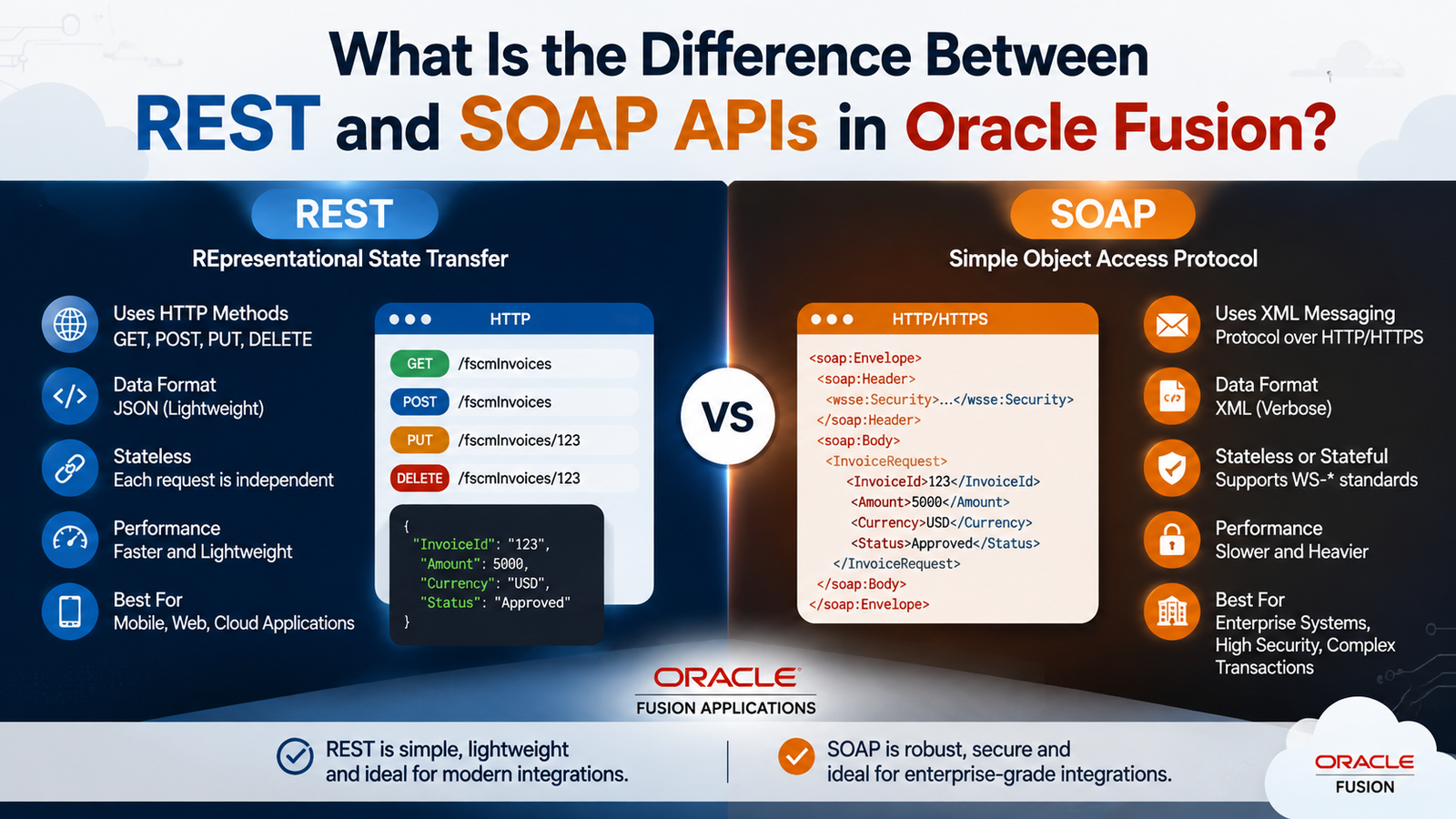
SOAP has been around since the early 2000s, and yes, it shows. It’s XML-based, it’s verbose, and it comes with a fair amount of ceremony. But there’s a reason a lot of enterprise systems still lean on it: it’s predictable, and predictability matters a lot when you’re pushing a payroll batch or triggering a multi-step approval chain.
A few things worth knowing about SOAP in Fusion:
The structure is rigid. Every message follows a contract laid out in a WSDL file, so both sides know exactly what to expect, no surprises, no guessing.
Error handling is built in. SOAP has its own fault-reporting standard, which honestly makes tracking down what went wrong a little less painful than it sounds.
Security is enterprise-grade. WS-Security is baked in, which matters if you’re dealing with a client that has strict compliance rules (and most large enterprises do).
The trade-off is weight. Because everything’s wrapped in an XML envelope, SOAP messages are chunkier and slower than their REST counterparts.
You’ll still find SOAP holding down a lot of legacy integrations, especially ones that were originally built for on-prem EBS and later carried over. Working comfortably with WSDLs and XML schemas is still a real skill, and it’s covered properly in most Oracle Fusion Technical Training in Pune programs for exactly that reason.
REST in Oracle Fusion the newer, lighter option
REST is where most new Fusion work is happening now, and it’s not hard to see why. It rides on plain HTTP methods GET, POST, PUT, PATCH, DELETE and usually moves data around as JSON, which is a lot friendlier to read and debug than a wall of XML.
A quick rundown of what makes REST different:
It’s fast and light. JSON payloads are smaller, so things move quicker and use less bandwidth.
It’s organized around resources. An endpoint usually maps to something concrete: an employee, an invoice, a purchase order which makes it intuitive once you get the hang of it.
It plays well with the rest of the world. Most modern apps, mobile platforms, and cloud tools are REST-first these days, so integrating with them is usually smoother.
Authentication is simpler. OAuth or basic auth gets you most of the way there, without the heavier security scaffolding SOAP needs.
Oracle keeps adding more REST endpoints across Fusion modules every release, so getting real hands-on practice with them has become non-negotiable in any current Oracle Fusion Technical Training in Pune curriculum.
So which one should you actually use?
There’s no universal answer here, and anyone who tells you otherwise probably hasn’t worked on enough projects. That said, a rough guideline:
Lean toward SOAP when you’re dealing with something transactional and multi-step, think payroll runs or approval workflows where you need a strict, guaranteed contract and enterprise-level security.
Lean toward REST when you just need to move data quickly pulling employee records, updating a field, hooking into some modern SaaS tool.
In practice, most consultants end up doing both on the same project, sometimes in the same week. That’s exactly why a solid Oracle Fusion Technical Training in Pune program won’t let you specialize in just one. You need to be comfortable switching between them depending on what the client’s environment demands.
Why it’s worth learning both, even if REST feels like “the future”
It’s tempting to write SOAP off as legacy and move on, especially with Oracle clearly investing more in REST. But that’s not really how enterprise IT works. Plenty of organizations are running hybrid setups where old SOAP-based integrations are still quietly doing their job alongside shiny new REST services, and someone has to maintain both.
If you’re trying to build a career here, it helps to be the person who can:
Build and test REST APIs comfortably using something like Postman
Read a WSDL without panicking and work through XML schemas when needed
Actually debug what’s going wrong, regardless of which protocol is involved
Understand the security model each one relies on
Bring both into the picture when working with Oracle Integration Cloud (OIC)
That combination not just REST, not just SOAP, but genuine comfort with both is what a good Oracle Fusion Technical Training in Pune program is really trying to build in you, through actual project work rather than slides.
Wrapping up
REST and SOAP both still have a place in Oracle Fusion, and which one you reach for really comes down to what the project needs: speed and simplicity, or strict structure and heavyweight security. Soft Online Training tends to walk learners through both using real integration scenarios rather than just theory, because that’s really the only way it sticks. If you’re planning to build a real career around Fusion integrations, putting in the time with a proper Oracle Fusion Technical Training in Pune program is probably the fastest way to get comfortable handling both REST and SOAP in situations that actually matter.
At the end of the day, this isn’t really about picking a side. It’s about knowing enough to make the right call when a client hands you a requirement and that kind of judgment only comes from actually working through both, not just reading about them.