
Introduction
If you’ve spent any time around an Oracle Fusion project, you’ve probably noticed people using “implementation” and “support” as if they mean the same thing. They don’t, and mixing them up tends to cause real problems: budgets get set wrong, teams get staffed wrong, and expectations after go-live end up way off base. The team at Tech Leads IT runs into this confusion constantly, and honestly, it’s one of the most common questions we get from finance teams and IT leaders trying to plan an Oracle Fusion rollout usually right around the same time they start looking into Oracle Fusion Financials Training to get their own people up to speed.
So let’s untangle it. This isn’t just a vocabulary lesson knowing where implementation ends and support begins actually changes how you plan your project, who you hire, and how you train your people going forward. It also shapes which kind of learning path makes sense for your team: some roles are better suited to a hands-on Oracle Fusion Financials Course built around configuration and go-live scenarios, while others line up more with the troubleshooting-heavy skills you’d pick up through Oracle Fusion Financials Online Training designed for people already working in a live support environment.
A Quick Refresher on Oracle Fusion Financials
Oracle Fusion Financials is the finance backbone inside Oracle’s larger Fusion Cloud suite. It handles General Ledger, Accounts Payable, Receivables, Cash Management, Fixed Assets, and financial reporting, among other things. Companies move to it because their old finance systems can’t keep up anymore too much manual work, too little visibility, too many spreadsheets patching the gaps.
It’s a big, flexible platform, though, and that flexibility comes at a cost: you can’t really wing it. That’s a big reason Oracle Fusion Financials Training has picked up so much interest lately. People would rather learn the system properly than figure it out by making mistakes in a live client environment (which, trust me, is not where you want to be learning).
What Implementation Actually Looks Like
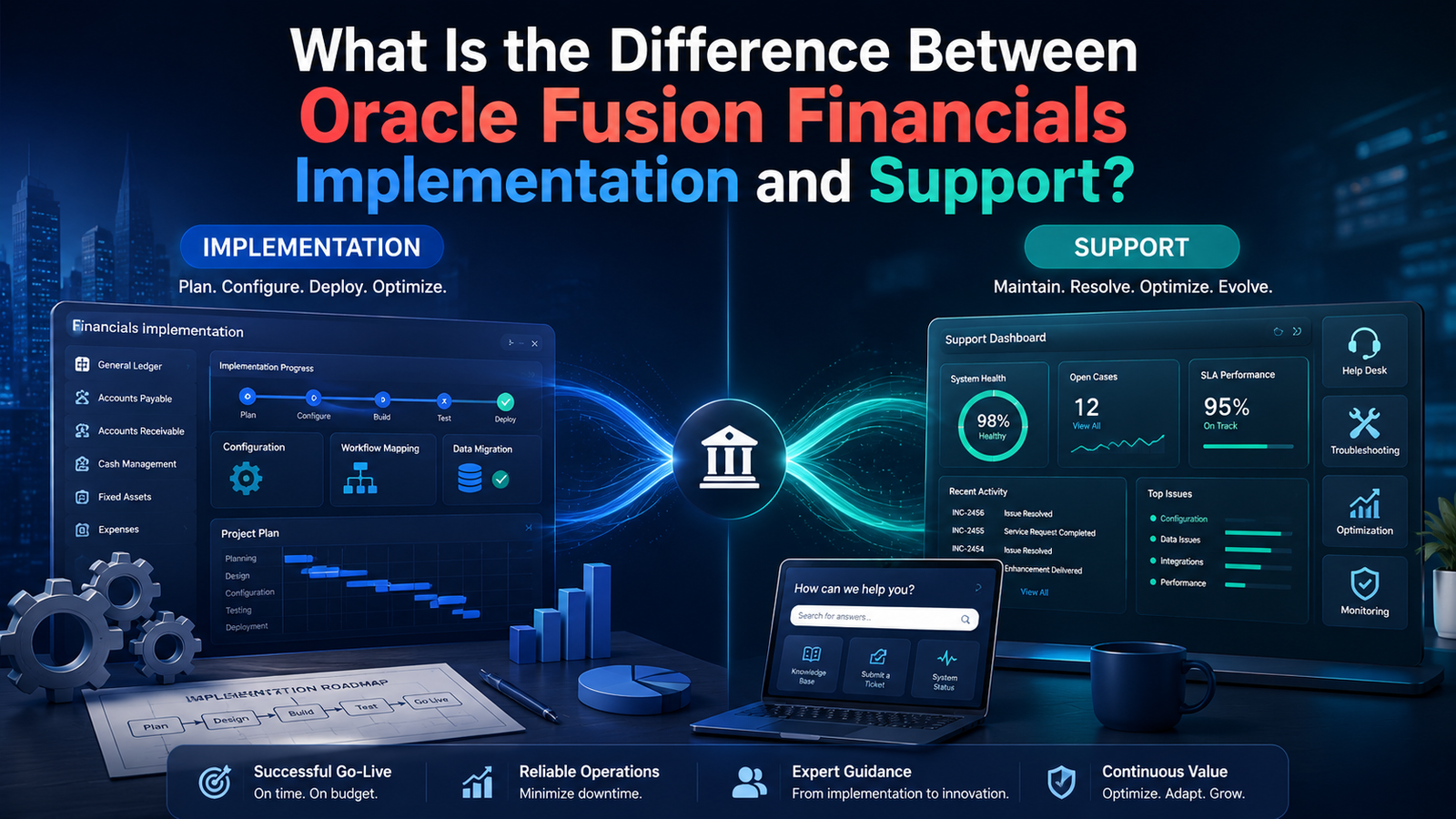
Implementation is the build phase. It’s what happens before a company has a working Oracle Fusion system or before an old, clunky one gets replaced. It’s a project with a start date, an end date, and a lot of moving parts in between.
Here’s roughly how it plays out:
First, there’s a requirement gathering, where consultants sit down with finance teams to figure out how things currently work, what’s broken, and what compliance rules need to be baked in. Then comes solution design mapping all of that onto Oracle Fusion’s modules and features. After that, the real configuration work starts: chart of accounts, ledgers, business units, tax setups, approval workflows, integrations with other systems. None of this is quick.
Data migration usually happens in parallel cleaning up old records, transferring open transactions, making sure vendor and customer data doesn’t come over corrupted (it often does, at least a little). Then testing, testing, and more testing. Unit tests, integration tests, and finally user acceptance testing, where the actual finance team pokes at the system to see if it holds up.
Somewhere in there, end users need training before go-live, because nothing kills confidence in a new system faster than confused employees on day one. And once the system finally goes live, there’s usually a stretch of “hypercare” , a few intense weeks where the project team hovers nearby, ready to fix anything that breaks.
It takes a mix of skills to do this well: solid accounting knowledge, technical configuration chops, and enough project discipline to keep dozens of moving pieces from falling apart. Most consultants who do this for a living built that foundation through something structured like an Oracle Fusion Financials Course that actually walks through configuration exercises and realistic client scenarios, rather than just slides.
And What About Support?
Once the system lives, the whole rhythm changes. Support isn’t a project with an end date it just keeps going, for as long as the company uses the platform. There’s no big finish line, just an ongoing stream of smaller things that need attention.
A support team spends its time on things like:
- Fixing the day-to-day stuff a failed batch job, a posting error, an approval workflow that’s stuck for no obvious reason
- Diagnosing bugs or config quirks that only show up once real people start using the system in ways nobody quite predicted
- Handling enhancement requests, which range from “add one more field to this report” to genuinely reworking a process
- Managing Oracle’s quarterly updates, which means reading release notes, testing new features somewhere safe, and rolling changes out without breaking anything
- Keeping an eye on performance and making sure integrations with other systems aren’t quietly falling apart
- Just helping people. Access issues, “why doesn’t this button do what I expect,” that sort of thing
Support work asks for a different temperament than implementation. You’re reacting more than building. You need patience for repetitive tickets and sharp instincts for the ones that turn out to be bigger than they first look. A lot of professionals build these specific skills through Oracle Fusion Financials Online Training, mostly because it lets them study troubleshooting, patch analysis, and ticket handling around a job they already have, instead of stepping away from work to attend a classroom.
Why the Skills Don’t Just Transfer Automatically
Here’s something people get wrong a lot: they assume that learning implementation automatically prepares you for support, or the other way around. It doesn’t, not really. They overlap on the platform, sure, but the day-to-day thinking is genuinely different.
This is really where good Oracle Fusion Financials Training earns its keep. A decent program doesn’t just teach you which screen to click, it teaches you why a certain tax setup choice can, three modules later, cause an AP invoice to post incorrectly. That kind of connect-the-dots understanding is what separates someone following a checklist from someone who can actually walk into a mess and figure out what went wrong.
For people already working full-time, Oracle Fusion Financials Online Training tends to be the more realistic option. Live sessions, recorded lectures, lab access, an instructor you can actually message, lets someone build genuine competence on evenings and weekends, without putting their current job on hold. A lot of accountants who want to move into a hybrid functional-technical role go this route specifically.
And a well-built Oracle Fusion Financials Course usually covers both sides anyway: configuration workshops that mirror implementation work, plus troubleshooting and patch-management exercises that mirror support work. That dual exposure matters more than people expect, especially at mid-sized companies where the same small team ends up doing a bit of both.
Two Very Different Careers, Same Platform
If you’re trying to decide which direction fits you better, it helps to picture what the actual week-to-week looks like.
Implementation consultants tend to travel more, or at least work in short, intense bursts tied to project phases. They spend a lot of time with senior finance people during requirement-gathering, build configurations from a blank slate, and get that particular satisfaction of watching a go-live actually work after months of prep. Then the project ends, and they move on to the next one.
Support analysts live a steadier life. They get to know one client’s system deeply sometimes for years and build actual relationships with the people who use it every day. Their work mixes urgent fires with planned, slower improvements. Quite a few eventually move into implementation roles later, using everything they learned about what actually breaks in production.
Neither path is objectively better. It depends on whether you like variety and adrenaline (implementation) or depth and stability (support). Plenty of people end up doing both at different points in their careers, which is honestly another good reason to get trained on both sides early rather than picking one lane too soon.
A Few Myths Worth Clearing Up
People assume support is the “easier” job because it doesn’t come with implementation’s big deadlines. In practice, a production issue during month-end close can be just as stressful as any go-live milestone arguably more, because the business is already relying on the system.
There’s also a common belief that once a system is implemented, it needs barely any support afterward. That’s rarely true. Tax law changes, companies restructure, mergers happen, and Oracle pushes quarterly updates whether you’re ready or not all of which mean ongoing configuration work.
Another one: people think you can’t move between implementation and support once you’ve picked a side. That’s not really the case. Plenty of professionals move back and forth, especially those who built a broad foundation early through something like an Oracle Fusion Financials Course that exposed them to both sides from the start.
And last, there’s still a lingering idea that online learning can’t really prepare someone for real project work. That might have been fairer a decade ago, but modern Oracle Fusion Financials Online Training programs include live labs, real case studies, and actual mentorship which closes that gap a lot more than people give it credit for.
Planning for Both Phases (Not Just Go-Live)
Companies rolling out Oracle Fusion Financials often plan hard for implementation and then treat support as an afterthought. That’s a mistake. A realistic plan should account for a hypercare period right after go-live, usually four to eight weeks of close monitoring and then a decision about what steady-state support looks like: in-house team, an outside managed services partner, or some mix of both.
It also helps to keep investing in training so internal staff stay current with Oracle’s quarterly releases, and to make sure implementation consultants actually document their configuration decisions before they leave, so the support team isn’t left guessing. And there should be a clear path for escalating issues that turn out to be bigger than routine troubleshooting.
Companies that put real effort into upskilling their own people through solid Oracle Fusion Financials Training tend to have a much smoother handoff from implementation to support, mostly because the same people (or people with equivalent grounding) carry context across both phases instead of starting from zero.
So Which Training Path Fits You?
If large, milestone-driven projects with variety sound appealing, lean toward learning configuration, data migration, and end-to-end process design the backbone of most implementation-focused Oracle Fusion Financials Course programs.
If you’d rather have stability and deep specialization, focus on troubleshooting, patch management, and getting comfortable with ticketing systems, the stuff that support-oriented training tends to emphasize.
If you’re juggling a full-time job already, Oracle Fusion Financials Online Training is probably your best bet, since it fits around your schedule instead of the other way around.
And if you genuinely don’t know which one suits you yet, that’s fine. Look for a program that covers both sides so you can try each on for size before committing to a lane.
Wrapping Up
Implementation and support really are two halves of the same job. One builds the thing, the other keeps it alive and adjusts it as the business changes around it. Knowing the difference helps professionals pick a learning path that actually fits, and it helps companies plan realistic timelines and budgets instead of assuming the work stops at go-live. As Tech Leads IT sees it again and again, the people who do well in either area are the ones who built strong fundamentals early and kept learning as Oracle’s platform kept evolving.
Whether you’re aiming to lead big implementation projects or become the person everyone trusts to keep a live system running smoothly, the training you choose matters. From solid Oracle Fusion Financials Training to flexible Oracle Fusion Financials Online Training, to a well-rounded Oracle Fusion Financials Course that covers both implementation and support, the right starting point can shape a genuinely long-term career in the Oracle Fusion world.