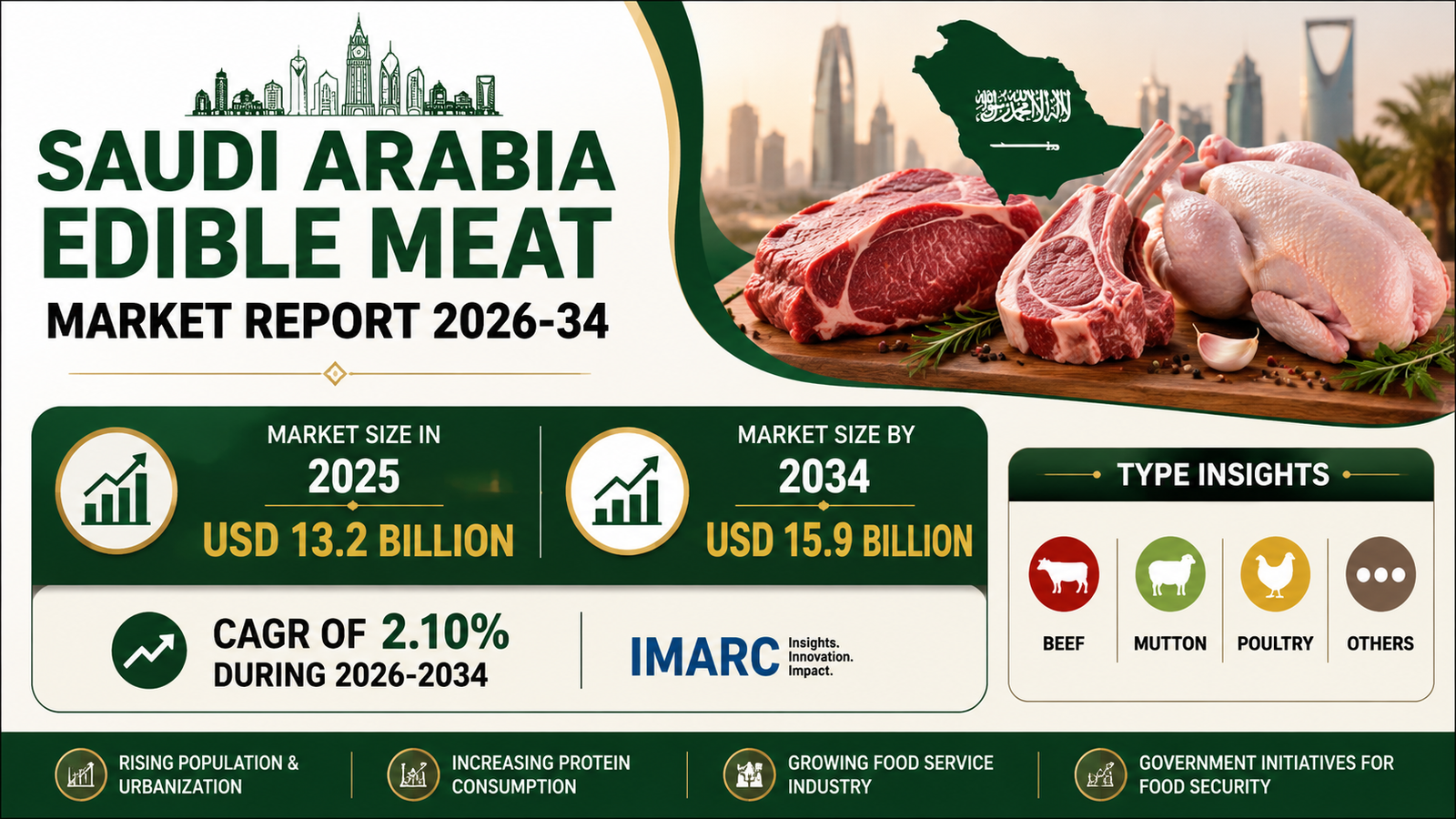
As per IMARC Group, a leading global market research and management consulting firm, has published its latest market intelligence report on the Saudi Arabia edible meat market size reached USD 13.2 Billion in 2025. Looking forward, IMARC Group expects the market to reach USD 15.9 Billion by 2034, exhibiting a growth rate (CAGR) of 2.10% during 2026-2034, driven by changing dietary patterns, escalating demand for premium and halal certified meat products, rising disposable incomes, and continuous investment in domestic poultry and livestock production capacity across the Kingdom.
The market is experiencing steady momentum driven by the deep cultural and culinary centrality of meat, particularly lamb, mutton, and poultry, in Saudi households and communal dining traditions. As disposable incomes rise and the hospitality sector expands to accommodate growing tourism and religious pilgrimage traffic, demand for premium, grass fed, and internationally sourced cuts is climbing alongside everyday consumption. At the same time, the government’s food security agenda is reshaping the supply side of the market, channeling significant capital into local processing, hatchery, and feed mill infrastructure so that a larger share of the meat consumed in the Kingdom is produced domestically rather than imported.
How AI is Reshaping the Future of the Saudi Arabia Edible Meat Market?
- AI Enabled Precision Livestock and Poultry Farming: Automated farms operated by leading domestic producers are using AI powered monitoring systems to track feed intake, growth rates, and flock health in real time, helping operators raise output per bird while reducing mortality rates and supporting the Kingdom’s push toward higher self sufficiency in poultry and red meat production.
- AI Driven Demand Forecasting for Retail and Foodservice: Supermarket chains, butchers, and foodservice operators are deploying machine learning tools to analyze seasonal consumption patterns, including spikes tied to religious occasions and pilgrimage seasons, allowing better inventory planning, reduced spoilage, and more consistent product availability for fresh and frozen cuts across urban centers.
- AI Supported Halal Compliance and Traceability: Computer vision and blockchain integrated tracking systems are being adopted across processing facilities to verify halal certification, monitor packaging integrity, and maintain end to end traceability from farm to shelf, addressing regulatory expectations and reinforcing consumer trust in both domestic and imported meat products.
Grab a sample PDF of this report: https://www.imarcgroup.com/saudi-arabia-edible-meat-market/requestsample
Saudi Arabia Edible Meat Market Trends and Drivers
The Saudi Arabia edible meat market is witnessing dynamic shifts shaped by evolving consumer preferences, government backed food security policy, and a maturing domestic processing industry. Halal certified and organically raised meat continues to gain preference among consumers seeking ethically and religiously compliant products, while a growing segment of health focused shoppers is turning toward grass fed and free range options free of synthetic hormones and additives. Globalization and a sizable expatriate population are also broadening the palate of Saudi consumers, driving demand for diverse cuts and international meat varieties alongside traditional lamb and chicken dishes that remain central to the national diet.
Government policy is playing a defining role in reshaping the supply chain behind this market. Saudi Arabia’s Ministry of Environment, Water and Agriculture has directed substantial funding through the Agricultural Development Fund, which finances up to 70% of qualifying poultry and livestock project costs when advanced technology is used, encouraging domestic producers to scale up hatchery, feed mill, and processing capacity. According to the Saudi Press Agency, the Kingdom recorded poultry meat production of 558,000 metric tons in the first half of a recent year, a 9% year on year increase, reflecting the tangible impact of this investment push. The Saudi Good Agricultural Practices certification programme, now covering around 90% of the poultry industry according to official estimates, is further reinforcing food safety standards and product quality across the sector, supported by the ministry’s “Your Local Guarantee” awareness campaign promoting compliance among farmers and processors.
Private sector investment is accelerating in parallel with these public initiatives. Tanmiah Food Company partnered with China’s Chengdu Design and Research Institute to build 100 advanced poultry broiler houses across the Kingdom, while Alwadi Poultry Farms commissioned a high capacity feed mill in Riyadh Province designed to produce 90 tons of feed per hour. Vertically integrated domestic players are also investing heavily in automation, with fully automated processing plants raising output per bird and trimming mortality rates, helping the Kingdom move closer to its long term self sufficiency targets in both poultry and red meat categories while reducing reliance on imported frozen product from major suppliers.
Saudi Arabia Edible Meat Industry Segmentation
The report has segmented the market into the following categories:
Breakup By Type:
- Beef
- Mutton
- Poultry
- Others
Poultry accounts for a leading position within the type segment, supported by its status as the most widely consumed and most affordably priced meat category in the Kingdom, alongside sustained government investment in broiler production capacity, while mutton retains strong cultural significance tied to traditional dishes and religious occasions.
Breakup By Form:
- Fresh / Chilled
- Frozen / Canned
- Processed
Fresh and chilled meat commands a substantial share of the form segment given strong consumer preference for freshly slaughtered and halal verified products purchased close to the point of consumption, while frozen and canned formats remain essential for import dependent categories and large scale foodservice operations requiring extended shelf life and consistent supply.
Breakup By Distribution Channel:
- Off-Trade
- Convenience Stores
- Online Channel
- Supermarkets and Hypermarkets
- Others
- On-Trade
Supermarkets and hypermarkets lead the off trade distribution channel, reflecting their extensive reach and cold chain infrastructure across Saudi Arabia’s major cities, while the online channel is expanding rapidly as digital grocery platforms make fresh and frozen meat products increasingly accessible to time constrained urban shoppers.
Breakup By Region:
- Northern and Central Region
- Western Region
- Eastern Region
- Southern Region
The Central Region, anchored by Riyadh, and the Western Region, home to Jeddah and the holy cities of Makkah and Madinah, together account for a significant share of consumption, driven by high population density, strong retail infrastructure, and elevated demand tied to religious pilgrimage traffic throughout the year.
Competitive Landscape
The report provides a comprehensive analysis of the competitive landscape in the Saudi Arabia edible meat market with detailed profiles of major companies, including:
- Almarai
- Al-Watania Poultry
- Halwani Bros
- Tanmiah Food Company
(Please note that this is only a partial list of the key players, and the complete list is provided in the report.)
Recent News and Developments in Saudi Arabia Edible Meat Market
- January 2025: Tanmiah Food Company’s subsidiary, Agricultural Development Company, partnered with China’s Chengdu Design and Research Institute to construct 100 advanced poultry broiler houses across Saudi Arabia, aimed at boosting food security and supporting Vision 2030.
- February 2025: Tanmiah Food Company’s “Taste Secrets” range of marinated fresh chicken was shortlisted for the Gulfood Innovation Awards in the Best Meat and Poultry Product category, highlighting growing innovation in convenient, flavored fresh meat formats.
- April 2025: Alwadi Poultry Farms commissioned ANDRITZ to build a high capacity feed mill in Riyadh Province, designed to produce 90 tons per hour of poultry and ruminant feed using advanced machinery.
- August 2025: McDonald’s Saudi Arabia partnered with a domestic poultry producer to facilitate large scale broiler production, reinforcing the trend of foodservice operators supporting localized meat supply chains.
About Us
IMARC Group is a global management consulting firm that helps the world’s most ambitious changemakers to create a lasting impact. The company provides a comprehensive suite of market entry and expansion services. IMARC offerings include thorough market assessment, feasibility studies, company incorporation assistance, factory setup support, regulatory approvals and licensing navigation, branding, marketing and sales strategies, competitive landscape and benchmarking analyses, pricing and cost research, and procurement research.
Media and Sales Contact
IMARC Group
Email: sales@imarcgroup.com
United States: +1-201-971-6302
India: +91-120-433-0800
United Kingdom: +44-753-714-6104