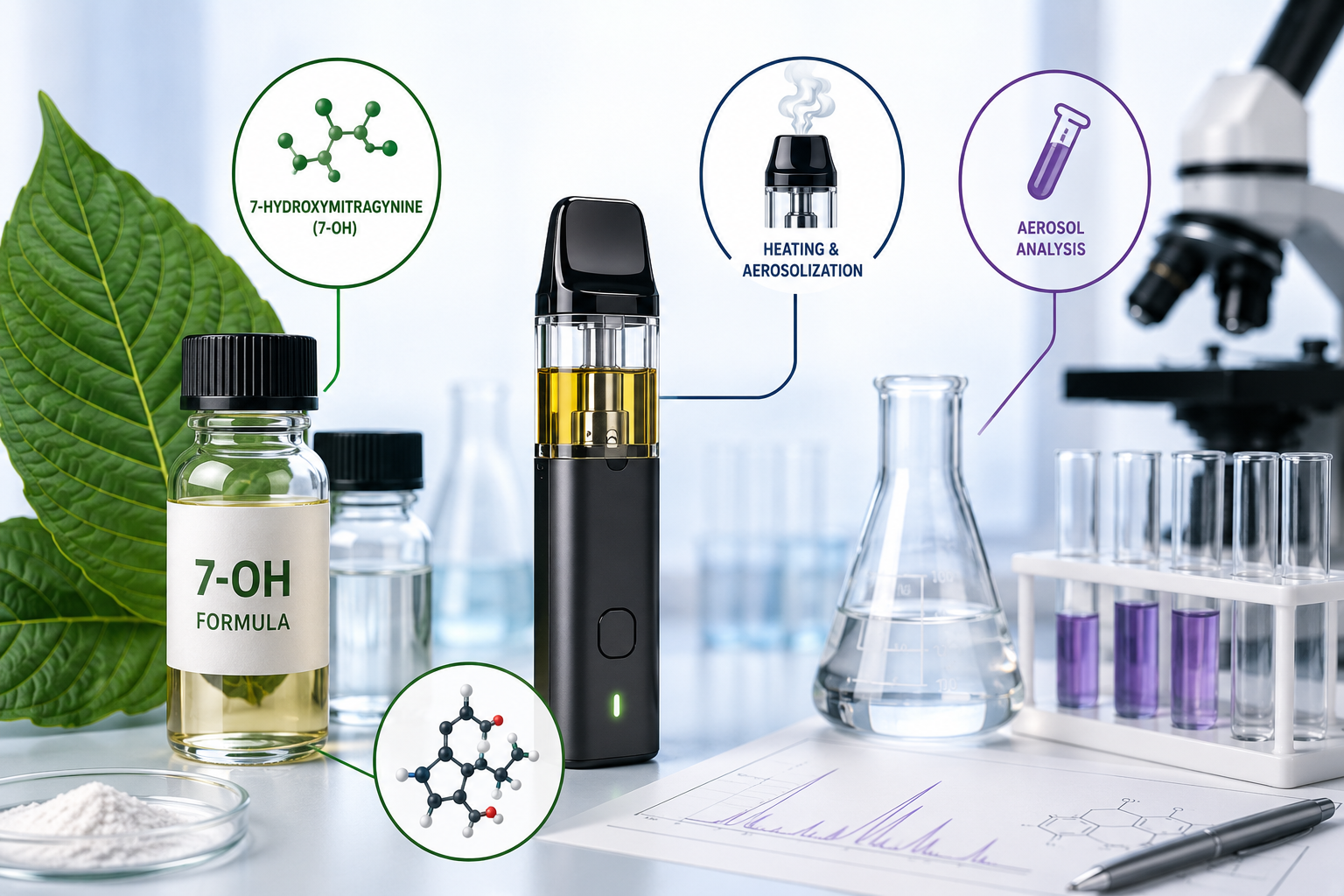
7-hydroxymitragynine, commonly known as 7-OH, is a naturally occurring alkaloid associated with Mitragyna speciosa, or kratom. Although 7-OH is normally present only in relatively small amounts in natural kratom, concentrated 7-OH products have become an increasingly important subject of scientific and regulatory research.
Vape formulations add another layer of complexity because the chemical composition of a formulation can potentially change when it is exposed to heat and converted into an aerosol. Understanding these products therefore requires looking at both formulation chemistry and chemical stability.
What Is 7-OH?
7-OH is one of several alkaloids found in kratom. Mitragynine is generally the predominant alkaloid in natural leaf, while 7-OH occurs at much lower concentrations.
Research has attracted attention to 7-OH because of its activity at the mu-opioid receptor. However, the pharmacological evidence is largely based on laboratory and preclinical research, and findings from isolated 7-OH should not automatically be applied to every kratom preparation.
What Makes a Vape Formulation Different?
Traditional kratom products may contain dried leaf, powder, tea, capsules, or extracts. A vape formulation is fundamentally different because it is designed to produce an aerosol through heating.
A 7-OH vape can therefore be considered in two stages:
Formulation → Heating → Aerosol
The chemical composition of the starting formulation does not necessarily tell researchers everything about the material present in the resulting aerosol.
Factors such as the formulation itself, device characteristics, temperature exposure, and duration of heating can potentially influence chemical stability.
Formulation Is More Than the Active Alkaloid
A product described as a 7-OH vape is not necessarily composed exclusively of 7-OH.
Depending on the product, researchers may encounter other kratom-related alkaloids, carrier materials, flavoring components, or additional substances. Recent research into commercial kratom-derived vaping products has found considerable variation in their chemical composition.
This variation is important because different formulations may behave differently during storage and heating.
For scientific analysis, identifying the complete formulation is therefore more useful than focusing only on the headline ingredient.
What Does Stability Mean?
In chemistry, stability refers to how well a compound retains its original structure under particular conditions.
Temperature, pH, solvent environment, oxygen exposure, light, and storage time can all influence chemical stability.
Research specifically examining kratom alkaloids has found that stability can vary considerably depending on temperature and pH. In one study, 7-OH was the least stable of the alkaloids examined, with significant losses observed under certain elevated-temperature conditions.
These findings are relevant to research on vaping, but they do not establish exactly what happens inside every commercial vape device.
Why Heat Matters
Vaping involves substantially greater thermal exposure than simply storing or consuming powdered botanical material.
When an alkaloid-containing formulation is heated, researchers may need to determine whether the original compound remains intact or whether degradation products appear.
This is particularly relevant for 7-OH because laboratory research has demonstrated that its stability depends on environmental conditions. A 2026 study also found that 7-OH stability was dependent on solvent and pH and identified several oxidation-related compounds in commercial products.
Importantly, these studies do not establish that every 7-OH vape produces the same degradation products. Actual aerosol chemistry requires product- and device-specific investigation.
Storage Stability and Thermal Stability Are Different
An important distinction is the difference between shelf stability and stability during vaping.
A formulation may remain relatively stable during storage but behave differently when exposed to the temperatures involved in aerosol generation.
Conversely, a compound may be stable under particular laboratory heating conditions but behave differently in a commercial device.
Researchers therefore need to study both situations separately rather than assuming that storage data predict aerosol composition.
How Researchers Analyze Stability
Modern analytical chemistry allows researchers to monitor changes in alkaloid concentrations over time.
Techniques such as liquid chromatography and mass spectrometry can be used to measure the amount of 7-OH remaining and identify potential degradation products.
The 2026 study of commercial 7-OH products used UHPLC-PDA-MS profiling and found discrepancies between some labeled and measured concentrations, along with additional oxidized compounds. More than 98% of the analyzed 7-OH-labeled products showed evidence consistent with a semisynthetic origin.
These findings highlight why laboratory analysis is important when evaluating concentrated products.
Why Aerosol Testing Matters
Testing the original formulation alone may not provide a complete picture of an inhaled product.
For vape research, scientists can compare the composition of the material before heating with the composition of the resulting aerosol. This can help determine whether compounds are being lost, transformed, or newly generated during the heating process.
Potential research questions include:
- Does the concentration of 7-OH change after heating?
- Are degradation products detectable?
- Does the aerosol contain the same compounds as the original formulation?
- Does device temperature affect chemical composition?
- Are different formulations chemically different after aerosol generation?
These questions remain important because research specifically characterizing 7-OH vape aerosols is still limited.
What Current Research Can—and Cannot—Tell Us
Existing research provides useful information about the chemistry and stability of kratom alkaloids, but there are significant limitations.
Laboratory stability experiments do not necessarily reproduce the conditions of a commercial vaping device. Similarly, research involving oral formulations cannot automatically establish what happens following inhalation.
A 2026 review of kratom research continues to identify substantial gaps in knowledge surrounding pharmacology, toxicology, and the effects of different preparations.
This makes careful interpretation especially important when discussing newer 7-OH product formats.
Final Thoughts
The science behind 7-OH vapes involves considerably more than identifying 7-hydroxymitragynine as an ingredient.
Researchers need to consider the complete formulation, chemical stability, storage conditions, thermal exposure, aerosol composition, and potential degradation products.
Current studies demonstrate that 7-OH can be sensitive to environmental conditions and that commercial 7-OH products can vary considerably in their measured chemical composition.
At the same time, there is still limited product-specific research on the chemistry of 7-OH aerosols. More controlled analytical studies will be needed to determine how formulation and heating affect the final chemical profile.
For now, the most scientifically responsible approach is to distinguish established findings about 7-OH chemistry from unanswered questions surrounding its use in vaping formulations.