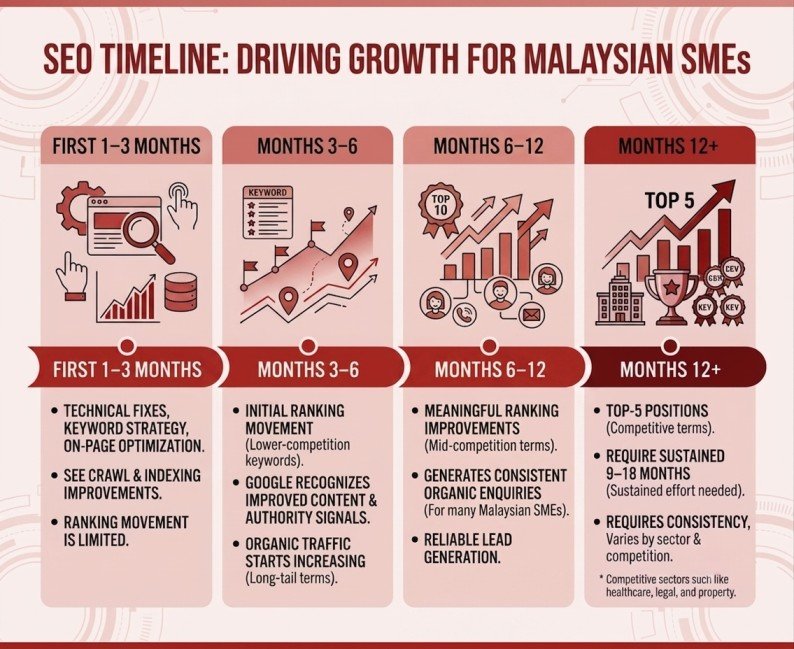
Getting a brand-new website to rank on Google is one of the most frustrating challenges in digital marketing. You publish content, wait, and… nothing. Weeks pass. The needle barely moves. Meanwhile, competitors who started years before you continue to dominate the first page. If this sounds familiar, you’re not alone — and there’s a structured way out of it.
Working with an experienced SEO agency gives you a significant head start. Rather than experimenting with tactics and hoping something sticks, a structured sprint compresses months of guesswork into a focused, results-driven programme. This post breaks down the exact 90-day framework we run for every new client — phase by phase, with clear objectives at each stage — so you know exactly what to expect and why it works.
Phase 1: Foundation & Strategy (Days 1–30)
Why the first 30 days are about listening, not launching
Most businesses want to jump straight into publishing content. We understand the urgency — but skipping the foundation phase is like building a house on sand. The first month is where we do the unglamorous work that everything else depends on.
Comprehensive site audit and competitive analysis
We start by diagnosing the current state of your website. Technical issues like broken links, slow page speed, duplicate content, and crawl errors can quietly suppress your rankings without you ever knowing. Once we have a clear picture of what’s holding the site back, we turn our attention to competitors — analysing which keywords they rank for, what content performs best, and where gaps exist that you can exploit.
Keyword research and target audience identification
Effective SEO isn’t about ranking for every keyword. It’s about ranking for the right ones. We identify high-intent search terms that your target customers are actually using, then map those keywords to specific pages and content pieces. This becomes the blueprint for everything that follows.
On-page optimisation and technical SEO fixes
With a keyword strategy in place, we systematically update title tags, meta descriptions, header structures, and internal linking. Technical fixes are prioritised by impact — the issues most likely to unlock ranking improvements get addressed first.
Phase 2: Content Creation & Implementation (Days 31–60)
How we turn strategy into search-ready content
Strategy means nothing without execution. The second phase is where the framework shifts from planning to publishing — and this is where momentum begins to build.
High-quality, keyword-optimised content
We produce blog posts, landing pages, and supporting content that targets the keywords identified in Phase 1. Each piece is written to answer genuine user questions, satisfy search intent, and demonstrate expertise in your industry. Thin, generic content rarely ranks — depth and relevance are what Google rewards.
Internal linking and structured data
As new content goes live, we build a deliberate internal linking structure that distributes authority across the site and helps search engines understand how your pages relate to one another. We also implement schema markup — structured data that enhances how your pages appear in search results and can improve click-through rates.
Initial content distribution
Publishing content is only half the job. We begin distributing it across relevant channels — whether that’s social media, email newsletters, or industry communities — to generate early traffic signals and build awareness before organic rankings fully mature.
Phase 3: Authority Building & Refinement (Days 61–90)
Turning early traction into lasting rankings
By day 60, the site has cleaner foundations, a growing content library, and early signs of movement in the rankings. The final phase focuses on accelerating that momentum and locking in sustainable growth.
Link building and outreach campaigns
Backlinks remain one of Google’s most important ranking signals. We run targeted outreach campaigns to earn links from authoritative, relevant websites — a process that requires time, persistence, and genuine relationship-building. There are no shortcuts worth taking here.
Performance monitoring and data-driven refinements
We review ranking data, traffic patterns, and user behaviour metrics to identify what’s working and what needs adjustment. Pages that are gaining traction get additional support; underperforming content gets updated or restructured. This continuous feedback loop is what separates a sprint from a static campaign.
Conversion optimisation
Higher rankings mean more visitors — but visitors need a reason to convert. In the final phase, we assess user experience, page layout, and calls to action to ensure the traffic we’re generating actually turns into leads or sales.
What Results Can You Realistically Expect After 90 Days?
SEO is not an overnight channel, and any agency that promises #1 rankings within weeks is not being straight with you. That said, a well-executed 90-day sprint delivers meaningful, measurable results:
- Increased organic traffic from target keywords, particularly long-tail terms with lower competition
- Improved rankings for priority pages, often moving from beyond page 5 to page 1 or 2
- Better engagement metrics, including longer time on site and lower bounce rates
- A scalable foundation — content, technical infrastructure, and link equity that compound over time
The clients who see the strongest results are those who commit to the process and resist the urge to pivot strategy every two weeks.
Why a 90-Day Framework Outperforms Ad-Hoc SEO
There’s a reason we structure every engagement this way. Ninety days is long enough to implement meaningful changes and see Google respond to them, but short enough to maintain urgency and accountability. Each phase builds directly on the last, creating a logical progression rather than a scattergun approach.
Data gathered in Phase 1 informs the content created in Phase 2. Performance data from Phase 2 shapes the refinements made in Phase 3. By the end of the sprint, you have a clear picture of what’s working, a growing asset in your content library, and a roadmap for continued growth.
Critically, this framework creates momentum — something that’s hard to quantify but easy to feel. When stakeholders see rankings move and traffic grow, it builds confidence and buy-in for long-term investment in SEO.
The 90-Day Sprint Is Just the Beginning
Think of the 90-day sprint as the launchpad, not the destination. The businesses that win in organic search are those that treat SEO as an ongoing discipline — consistently publishing content, earning links, and refining their approach based on data.
The sprint proves what’s possible and establishes the practices that will carry your growth forward. But sustaining and scaling that growth requires continued execution, not a one-time effort.
If your business is ready to stop guessing and start ranking, the right time to begin is now. Every month without a structured SEO strategy is a month your competitors are pulling further ahead.