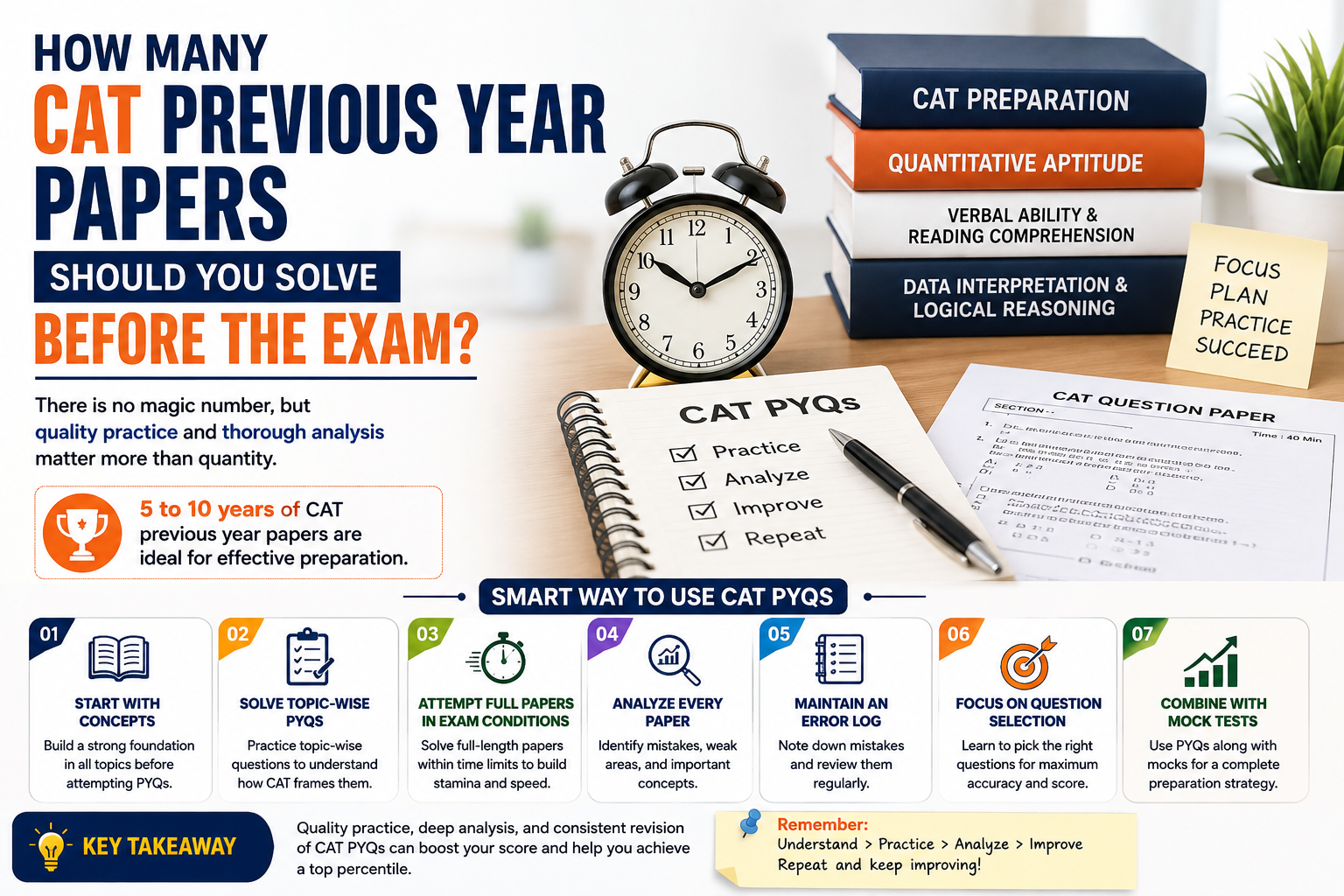
Preparing for CAT 2026 requires a combination of conceptual understanding, regular practice, and effective exam strategy. One of the most useful resources for CAT preparation is the CAT PYQ 2026 practice material, which helps aspirants understand how questions have been asked in previous CAT examinations.
Solving CAT Previous Year Question Papers can help you become familiar with question types, difficulty levels, time pressure, and the kind of thinking required to solve CAT-level problems. However, PYQs are most effective when you don’t just solve them—you also analyse your mistakes and use them to improve your preparation.
What Is CAT PYQ?
CAT PYQ refers to CAT Previous Year Questions or previous year question papers. These questions give aspirants an opportunity to practise questions that were asked in earlier CAT examinations.
CAT preparation generally covers three major sections:
- VARC – Verbal Ability & Reading Comprehension
- DILR – Data Interpretation & Logical Reasoning
- QA – Quantitative Ability
The exact CAT 2026 exam pattern, number of questions, duration, and marking scheme should be checked against the official notification when released.
Why Should You Solve CAT Previous Year Papers?
1. Understand the CAT Question Pattern
Reading about the CAT syllabus is useful, but solving actual previous-year questions gives you a much better idea of how concepts are tested.
By practising PYQs, you can understand:
- Types of questions asked
- Difficulty variations
- Question formats
- Section-wise trends
- Common concepts
- Level of reasoning required
This helps you prepare according to the actual nature of the examination rather than relying only on theoretical preparation.
2. Identify Important Topics
CAT PYQs can help you identify areas that deserve more attention.
For example, in Quantitative Ability, you can practise questions from:
- Arithmetic
- Algebra
- Geometry
- Number System
- Modern Mathematics
For VARC, focus on:
- Reading Comprehension
- Para Jumbles
- Para Summary
- Odd Sentence
For DILR, practise different types of:
- Tables
- Charts
- Arrangements
- Games and tournaments
- Caselets
- Logical sets
Don’t assume that a topic will definitely appear simply because it appeared frequently in previous years. Instead, use PYQs to understand the level and style of questions.
3. Improve Your Question-Solving Skills
CAT questions often require more than remembering formulas.
A question may have multiple possible approaches, but your goal should be to identify the most efficient method.
While solving PYQs, ask:
Can I solve this using a shorter approach?
Can I eliminate options?
Is there a way to estimate the answer?
Should I attempt this question under exam conditions?
This mindset can improve both speed and decision-making.
4. Improve Time Management
Time management is an important part of CAT preparation.
Initially, you can solve PYQs without strict time limits to understand the concepts. Once you become comfortable, start solving them under timed conditions.
For example:
Learn → Practise → Time Yourself → Analyse
This helps you understand how much time you need for different question types.
Also Read: CAT Mock Test 2026
5. Learn Question Selection
CAT is not simply about attempting as many questions as possible.
You need to decide:
- Which question should I attempt first?
- Which question should I skip?
- Which question requires too much time?
- Which question can be solved quickly?
- When should I move to another question?
Previous year questions can help you develop this decision-making ability.
CAT PYQ Preparation Strategy
A structured approach can make your PYQ practice more effective.
Step 1: Complete the Basic Concepts
Before solving a large number of PYQs, understand the fundamentals of the relevant topics.
Step 2: Start Topic-Wise
Begin with individual topics.
For example:
QA → Arithmetic → CAT PYQs
Then move to Algebra, Geometry and other areas.
Step 3: Move to Section-Wise Practice
Once you have covered multiple topics, solve PYQs from a complete section.
Step 4: Practise Under Time Pressure
Start using a timer to improve your speed and accuracy.
Step 5: Analyse Every Question
Don’t stop after checking your score.
Review:
- Correct answers
- Incorrect answers
- Unattempted questions
- Time-consuming questions
- Questions solved using shortcuts
- Questions you should have skipped
How to Analyse CAT PYQs
Your analysis should focus on why you got a question right or wrong.
Conceptual Error
You didn’t know the required concept.
Action: Revise the concept and solve similar questions.
Calculation Error
Your approach was correct but the calculation was wrong.
Action: Practise calculations and carefully review intermediate steps.
Question Selection Error
You spent too much time on a difficult question.
Action: Improve your ability to identify easier questions.
Reading Error
You misunderstood the question or passage.
Action: Work on reading accuracy and comprehension.
Time-Management Error
You knew the solution but couldn’t complete it quickly enough.
Action: Practise similar questions with a time limit.