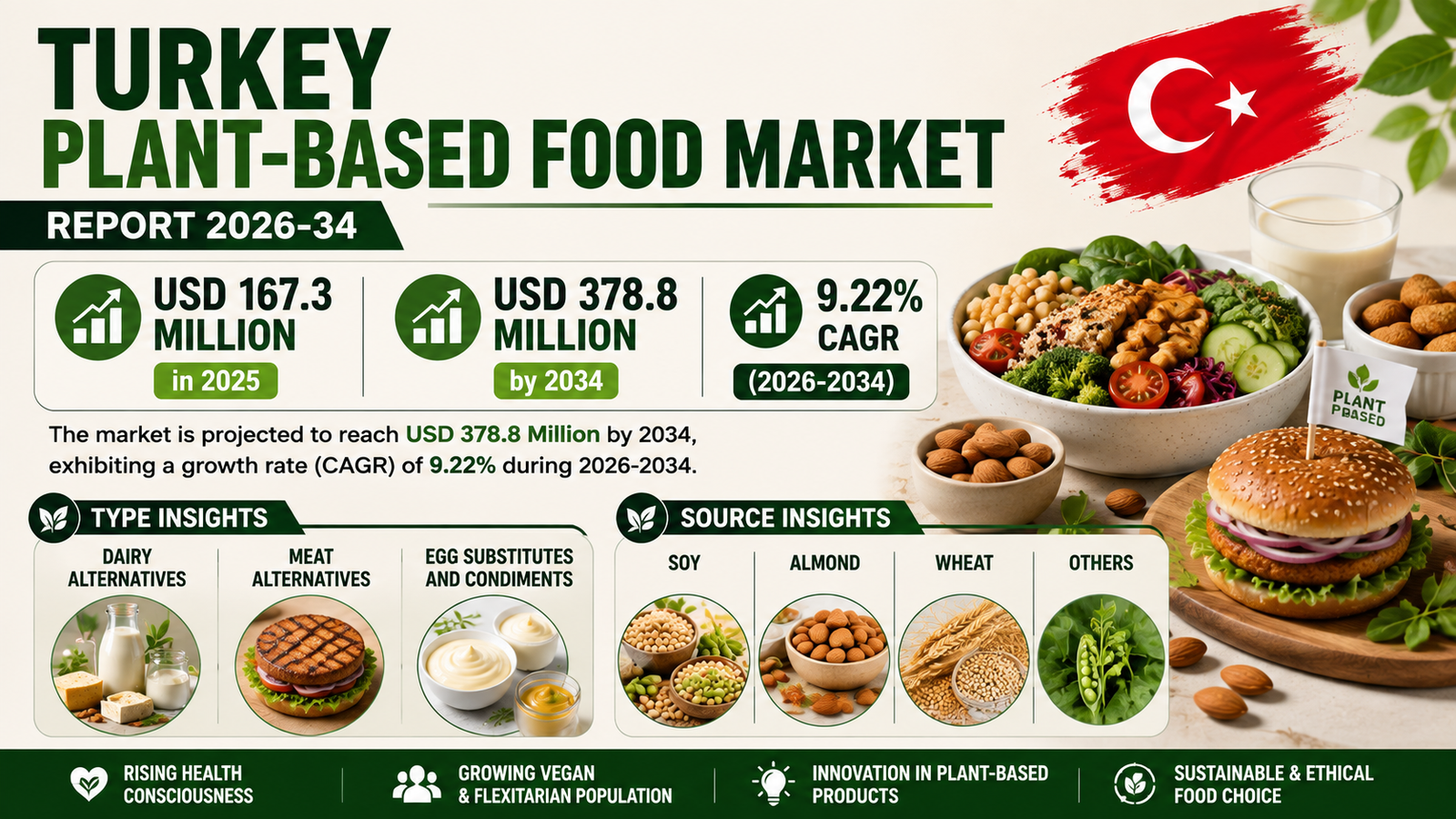
The Turkey plant-based food market supported by rising health consciousness, changing dietary preferences, sustainability awareness, and growing demand for dairy alternatives, meat-free products, and functional snacks. Turkey plant-based food market size reached USD 167.3 Million in 2025. Looking forward, the market is projected to reach USD 378.8 Million by 2034, exhibiting a growth rate (CAGR) of 9.22% during 2026-2034. Consumer interest is strengthening across retail, food service, and online channels, while domestic and international brands continue expanding product portfolios and innovation capabilities.
How AI is Reshaping the Future of Turkey Plant-Based Food Market?
- AI-powered consumer analytics are helping food companies identify preferences for plant-based dairy, meat alternatives, protein-rich snacks, and functional foods, enabling more targeted product development and marketing strategies.
- AI-supported product development can accelerate formulation testing by analyzing ingredients, nutritional profiles, taste preferences, and consumer feedback, helping manufacturers create products with improved texture, protein content, and nutritional value.
- Companies can use AI-powered social media analytics to identify changing consumer attitudes toward vegan, vegetarian, sustainable, and flexitarian diets, allowing brands to personalize campaigns and improve customer engagement.
- AI-enabled e-commerce platforms can recommend plant-based products based on previous purchases, dietary preferences, nutritional requirements, and browsing behavior, supporting greater product discovery across online grocery channels.
- AI can also strengthen supply chain management by improving demand forecasting, inventory planning, procurement, and distribution, helping plant-based food manufacturers respond efficiently to changing demand for soy, almond, wheat, and other plant-based ingredients.
Grab a sample PDF of this report:
Market Growth Factors:
The Turkey plant-based food market is driven by increasing consumer interest in healthier and more flexible eating patterns. A consumer perception survey involving 508 people in Turkey found that 59% consumed plant-based foods more than once a week, while 44% reported increasing their consumption compared with the previous year. In addition, 90% of respondents expressed a positive attitude toward plant-based foods. These trends are encouraging manufacturers to expand dairy alternatives, meat substitutes, egg replacements, and functional snacks.
Sustainability and environmental awareness are also influencing purchasing decisions across the Turkey plant-based food market. Turkey has approximately 12,000 plant species, including around 4,000 endemic species, creating a substantial biodiversity base for research into plant-derived ingredients and alternative proteins. Industry representatives have highlighted Turkey’s growing potential as a research and development hub for plant-based protein products, while manufacturers increasingly focus on sustainable sourcing, innovative formulations, and export-oriented product development.
Government agricultural support is strengthening the broader supply ecosystem for plant-based food production. Turkey’s Ministry of Agriculture and Forestry introduced a new agricultural support model covering plant production, with additional support for planned production, suitable cultivation in water-constrained areas, and the use of domestic seeds. Separately, rural development support programs provide grants for investments involving the processing, packaging, and storage of plant-based agricultural products. These measures can improve raw material availability and encourage investment across plant-based food value chains.
Market Segmentation:
Type Insights:
- Dairy Alternatives
- Meat Alternatives
- Egg Substitutes and Condiments
- Others
Source Insights:
- Soy
- Almond
- Wheat
- Others
Distribution Channel Insights:
- Supermarkets and Hypermarkets
- Convenience Stores
- Online Stores
- Others
Regional Insights:
- Marmara
- Central Anatolia
- Mediterranean
- Aegean
- Southeastern Anatolia
- Black Sea
- Eastern Anatolia
Recent Developement & News:
- December 2024: Veggy, a Turkish plant-based meat alternative producer, introduced Veggy Kids, a range of vegetable-based burgers and nuggets designed for children. The company indicated plans to expand the products internationally, reflecting increasing attention toward plant-based options for younger consumers.
- September 2025: Turkish plant-based food brand Itz Nutz secured USD 535,000 in investment to accelerate research and development, introduce new cashew-based dairy alternatives, and expand export channels. The company also planned B2B partnerships with hotels, restaurants, and chain markets, supporting broader commercialization of plant-based products.
- March 2026: ACTA Consultancy Trading announced TRAIA, a sunflower seed-based high-protein vegan snack positioned as a new plant-based option in Turkey. The product is vegan, gluten-free, high in protein, and rich in fiber, with plans for distribution through leading retail chains.
If you require any specific information that is not covered currently within the scope of the report, we will provide the same as a part of the customization.
About Us
IMARC Group is a global management consulting firm that helps the world’s most ambitious changemakers to create a lasting impact. The company provides a comprehensive suite of market entry and expansion services. IMARC offerings include thorough market assessment, feasibility studies, company incorporation assistance, factory setup support, regulatory approvals and licensing navigation, branding, marketing and sales strategies, competitive landscape and benchmarking analyses, pricing and cost research, and procurement research.
Contact Us
IMARC Group,
134 N 4th St. Brooklyn, NY 11249, USA,
Email: sales@imarcgroup.com
Tel No: (D) +91 120 433 0800
United States: +1-201971-6302