Dark skin can develop acne scars and uneven pigmentation in ways that require thoughtful treatment planning. Microneedling has attracted attention because it works by stimulating collagen production rather than aggressively removing the skin’s surface. For people considering Microneedling for Acne Scars in Abu Dhabi, an important question is whether the treatment is suitable for darker skin tones. Current dermatology guidance states that microneedling can be used across all skin tones, while research on skin of color suggests that it may offer a favorable approach compared with some resurfacing procedures. The key is selecting an appropriate treatment plan based on the skin’s characteristics and the type of acne scarring present.
Why Dark Skin Needs Individualized Acne Scar Treatment
Darker skin contains more melanin, which gives it greater natural pigmentation. This does not mean that microneedling is unsuitable. Instead, it highlights why treatment should be carefully customized to the individual rather than applying identical settings to every skin tone.
Acne itself can also leave behind different types of marks. A depressed scar changes the texture of the skin, while a flat brown or dark mark is primarily a pigmentation concern. Microneedling is particularly relevant to atrophic acne scars because its primary mechanism involves collagen remodeling. Correctly identifying the concern helps establish whether collagen stimulation is likely to provide the desired improvement.
Research examining microneedling in skin of color has found evidence of its usefulness for conditions including scarring and acne, with reviews suggesting that it may have advantages compared with more aggressive resurfacing approaches in darker skin types.
Is Microneedling Safe for Dark Skin?
Microneedling is generally considered suitable for all skin tones when appropriately performed. The American Academy of Dermatology specifically states that microneedling can be safely used across different skin tones, including darker complexions.
One reason microneedling can be attractive for darker skin is that it relies on controlled mechanical stimulation rather than intentionally removing broad areas of the skin’s surface. This distinction can be important when considering treatments for people with higher levels of melanin.
However, suitability does not mean that every treatment setting is appropriate for every person. Needle depth, treatment intensity, technique, skin condition, and scar structure all need to be considered. A carefully customized approach is more appropriate than assuming that one standard protocol works equally well for every complexion.
How Microneedling Improves Acne Scars
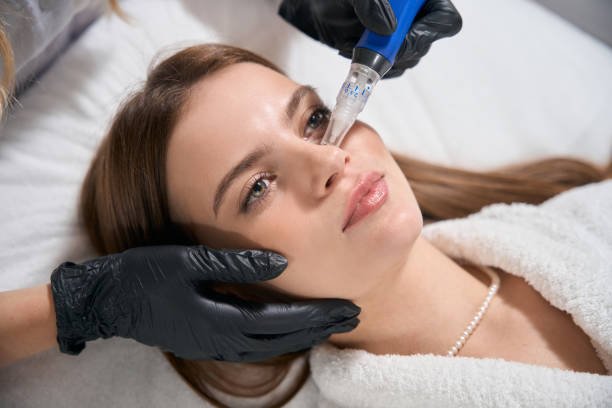
Microneedling creates controlled microscopic channels in the skin. These channels initiate a natural repair process that encourages collagen production and remodeling. Over time, newly formed collagen can improve the structure around depressed acne scars, making uneven areas appear smoother.
This process is particularly relevant to rolling scars and certain boxcar scars, which create visible depressions in the skin. As collagen remodeling progresses, the contrast between scarred and surrounding skin may become less pronounced.
Microneedling does not simply polish away the surface of an acne scar. Instead, it works within the skin to encourage gradual structural improvement. This is why results typically develop over several weeks and months rather than immediately after a treatment.
Can Microneedling Help Dark Acne Marks?
It is important to distinguish acne scars from post-acne pigmentation. A scar changes the physical texture of the skin, whereas a dark mark can remain completely flat while appearing brown, gray, or darker than the surrounding complexion.
Microneedling is primarily associated with improving textural acne scars through collagen induction. Although treatment may contribute to a more even-looking complexion, it should not automatically be considered a universal solution for every pigmentation concern.
This distinction is especially important for dark skin because acne-related discoloration can be prominent even when there is little or no textural scarring. A treatment assessment should therefore determine whether the primary concern is an indentation, pigmentation, or a combination of both.
Why Treatment Technique Matters on Dark Skin
The safety and effectiveness of microneedling depend substantially on how the treatment is performed. Appropriate needle depth and controlled movement help ensure that the treatment targets the intended tissue without unnecessarily increasing the intensity.
Dark skin does not require avoiding microneedling altogether. Instead, it requires thoughtful treatment planning. The American Academy of Dermatology notes that professional microneedling can improve acne scars while also emphasizing the importance of appropriate medical assessment and technique.
The thickness of facial skin can also vary across different areas. Consequently, treatment parameters may need to be adjusted according to the location and characteristics of the scars.
What About Pigmentation Changes?
Pigmentation deserves particular attention when treating darker skin. Skin of color can be more prone to noticeable changes in pigmentation after inflammation or injury, which makes appropriate treatment selection important.
Research on microneedling in skin of color suggests that the technique may have a favorable profile compared with some conventional resurfacing procedures. However, this does not mean that pigmentation considerations can be ignored. Treatment should be planned around the person’s existing pigmentation, skin condition, and history of how the skin responds to procedures.
Sun protection is also an important part of maintaining an even complexion following acne-scar treatment. Consistent protection helps preserve the appearance of the skin while collagen remodeling takes place.
Which Acne Scars Are Best Suited to Microneedling?
Microneedling is most commonly used for atrophic acne scars, which are depressions caused by changes to the underlying skin structure. Rolling scars can respond as collagen remodeling gradually improves their contours, while some boxcar scars may also become less noticeable.
Very narrow and deeply defined scars can behave differently. Likewise, raised scars have a different structure from depressed scars and should not automatically be approached with the same technique.
Because several scar types can appear on the same face, an assessment is valuable before treatment. Identifying the individual scar pattern makes it easier to determine whether microneedling is likely to provide meaningful textural improvement.
Does Dark Skin Need a Different Microneedling Depth?
There is no single needle depth that should be used simply because someone has dark skin. Treatment depth is determined by several factors, including scar depth, skin thickness, facial location, and the intended treatment response.
The goal is controlled collagen stimulation rather than maximum penetration. Deeper treatment is not automatically better, and using excessive depth can be counterproductive. A personalized approach allows the treatment intensity to match the actual structure of the acne scars.
This is particularly important because facial skin varies considerably between regions. A depth suitable for one area may not be appropriate for another.
How Many Sessions Are Usually Needed?
Microneedling for acne scars commonly involves more than one treatment because collagen remodeling is a gradual biological process. The number and spacing of sessions depend on the severity of scarring, skin characteristics, treatment goals, and the response observed after earlier sessions.
The American Academy of Dermatology notes that multiple microneedling sessions may be needed for acne-scar improvement, with results becoming increasingly visible as collagen production continues.
Patience is therefore an important part of the treatment process. The appearance of the skin immediately after a session does not represent the completed result.
How to Approach Microneedling for Dark Skin
The best approach is individualized treatment based on the actual condition of the skin rather than skin tone alone. A professional assessment can distinguish between depressed scars and pigmentation, identify the scar types present, and determine whether microneedling is appropriate.
The procedure should be performed using controlled technique and suitable treatment parameters, followed by an appropriate recovery plan. Protecting the skin from excessive sun exposure and allowing sufficient time between treatments can support the gradual collagen-remodeling process.
Overall, darker skin should not automatically be considered unsuitable for microneedling. Current evidence and dermatology guidance support its use across skin tones when appropriately selected and performed.
Frequently Asked Questions
Is microneedling good for dark skin?
Yes. Microneedling is considered suitable for all skin tones, including darker skin. Its mechanical collagen-stimulation approach makes it a useful option for many people with atrophic acne scars when treatment is appropriately customized.
Can microneedling remove acne scars on dark skin?
Microneedling can improve the appearance and texture of suitable atrophic acne scars, but complete removal cannot be guaranteed. Results depend on the scar type, depth, skin characteristics, and treatment plan.
Does microneedling cause pigmentation changes in dark skin?
Dark skin requires careful treatment planning because pigmentation can be particularly noticeable. Research suggests microneedling may have a favorable profile for skin of color, but individual skin characteristics should still be considered before treatment.
Is microneedling suitable for deep acne scars on dark skin?
Some deeper atrophic scars can improve with collagen remodeling, but the response depends on their structure. Very narrow or structurally complex scars may respond differently from broad depressed scars.
How long does it take to see microneedling results on dark skin?
Results develop gradually as the skin produces and remodels collagen. Some improvement may become noticeable within several weeks, while more substantial changes can continue developing over several months and across multiple treatment sessions.