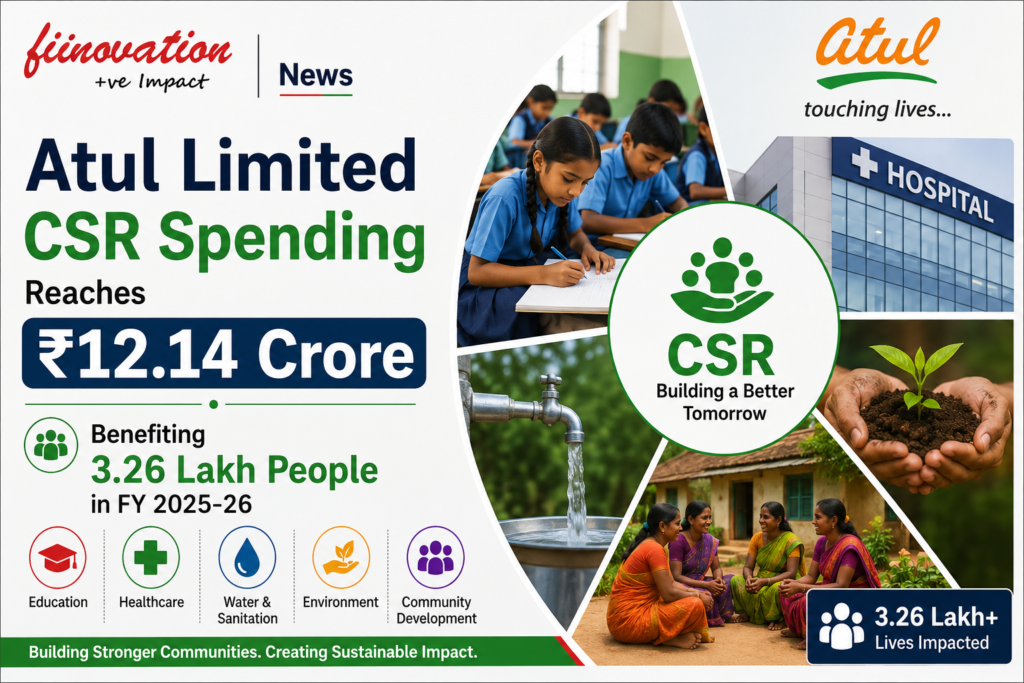
Corporate Social Responsibility (CSR) has become an important part of how businesses contribute to communities and support sustainable development. In this context, Atul Limited’s CSR initiatives during FY 2025-26 highlight the growing importance of structured social investment in India. The company reportedly spent ₹12.14 crore on CSR activities, with its initiatives reaching approximately 3.26 lakh beneficiaries. This development reflects how corporate resources can be directed toward education, healthcare, livelihoods, community welfare, and other areas that influence long-term social progress.
Atul Limited’s CSR Commitment in FY 2025-26
Atul Limited’s CSR spending of ₹12.14 crore demonstrates the company’s continued focus on community-oriented development. Rather than viewing CSR only as a statutory obligation, businesses increasingly use their CSR programmes to address local development challenges and create measurable social outcomes.
The reach of 3.26 lakh beneficiaries is particularly significant because it indicates the scale at which CSR programmes can influence communities. Effective CSR is not simply about the amount of money invested; it also depends on identifying genuine community needs, designing appropriate interventions, implementing projects efficiently, and monitoring outcomes.
Atul Limited’s latest CSR performance therefore provides an example of how corporate funding can support broader development objectives while creating value for communities.
Why CSR Spending Matters For Community Development
India has a large and diverse population with varying social and economic needs. Government programmes, NGOs, and community organisations play an important role in addressing these challenges, but corporate participation can provide additional resources, expertise, technology, and management capabilities.
CSR funding can contribute to several development areas, including :
Education and school infrastructure
Healthcare and preventive health programmes
Skill development and employment opportunities
Women and child development
Rural development
Environmental sustainability
Water and sanitation
Livelihood development
Community infrastructure
When CSR projects are aligned with local requirements, they can create benefits that continue beyond the duration of a particular project.
Reaching 3.26 Lakh Beneficiaries through CSR
One of the key highlights of Atul Limited’s FY 2025-26 CSR performance is the reported reach of 3.26 lakh beneficiaries. Beneficiary reach is an important indicator when evaluating the scale of a social programme, although the quality and sustainability of the impact are equally important.
For CSR programmes to generate meaningful outcomes, companies and implementation partners need to understand who is being supported and what changes the intervention is expected to create. A project supporting thousands of people can become more effective when it includes clear objectives, baseline assessments, regular monitoring, and impact measurement.
This is where professional CSR consulting and project management can add value. Organisations such as Fiinovation focus on areas such as CSR project planning, implementation support, monitoring and evaluation, impact assessment, and social-sector programme management.
The Importance of Strategic CSR Planning
Effective CSR spending begins with strategic planning. Companies need to identify development priorities, understand the communities they aim to support, and determine which interventions can generate sustainable outcomes.
A strategic CSR framework generally includes several stages. The first is a needs assessment , which helps identify the most pressing challenges within a target community. This may involve studying education levels, healthcare access, livelihoods, sanitation, water availability, or other socioeconomic indicators.
The next stage involves project design. CSR programmes should have measurable objectives, defined beneficiary groups, implementation timelines, budgets, and expected outcomes. Selecting experienced NGO or implementation partners can further strengthen project execution.
Finally, monitoring and evaluation help determine whether a project is delivering the intended results.
Measuring CSR Impact Beyond Spending
The ₹12.14 crore CSR expenditure provides an important financial indicator, but CSR performance should not be measured only through expenditure. The larger question is what changed because of the investment.
For example, an education project should ideally examine indicators such as school attendance, learning outcomes, access to educational resources, teacher capacity, and student retention. Similarly, a healthcare initiative can evaluate improvements in awareness, screening, treatment access, and health-seeking behaviour.
This approach moves CSR from input-based reporting to outcome-based development.
Impact assessment can help companies understand whether their interventions are producing meaningful and sustainable benefits. It can also help identify areas where projects should be redesigned or expanded.
Role of CSR Consultants in Maximising Social Impact
As CSR programmes become more sophisticated, companies increasingly require specialised expertise to manage social investments effectively. CSR consultants in India can support organisations throughout the project lifecycle.
Their role may include CSR strategy development, project identification, NGO due diligence, need assessment, baseline studies, programme management, monitoring and evaluation, and impact assessment.
For companies making substantial CSR investments , professional guidance can help ensure that resources are directed toward relevant interventions and that project performance is properly documented.
The growing importance of data-driven CSR also means that companies are increasingly interested in measurable indicators. Data can help CSR teams compare project performance, understand beneficiary outcomes, and make informed decisions about future investments.
Building Sustainable Communities Through Corporate Responsibility
The broader significance of Atul Limited’s CSR spending lies in the potential for corporate investments to contribute to sustainable community development. CSR programmes can create stronger outcomes when they are designed with community participation and aligned with local development priorities.
Sustainability should remain central to CSR planning. A short-term intervention may provide immediate assistance, but long-term programmes can help communities develop the knowledge, skills, infrastructure, and resources needed to become more self-reliant.
For example, skill development initiatives can improve employability, while livelihood programmes can strengthen household income. Education interventions can improve opportunities for young people, while healthcare programmes can contribute to healthier communities.
The Growing CSR Landscape in India
India’s CSR ecosystem continues to evolve as companies, NGOs, consultants, government institutions, and communities collaborate on social development. The focus is gradually shifting from simply fulfilling CSR expenditure requirements toward creating measurable and sustainable impact.
Companies are also increasingly considering environmental, social, and governance (ESG) priorities while developing their broader sustainability strategies. Although CSR and ESG are distinct concepts, both reflect the growing expectation that businesses should consider their wider social and environmental responsibilities.
Atul Limited’s reported CSR investment of ₹12.14 crore and beneficiary reach of 3.26 lakh during FY 2025-26 can therefore be viewed within this larger transformation of corporate responsibility in India.
Conclusion
Atul Limited’s ₹12.14 crore CSR spending in FY 2025-26, reportedly benefiting 3.26 lakh people, highlights the potential of corporate investment to support social development at scale. The initiative demonstrates why CSR programmes need to combine adequate funding with effective planning, implementation, monitoring, and impact measurement.
For companies looking to maximise the value of their CSR investments , the emphasis should increasingly be on community needs, measurable outcomes, transparency, sustainability, and long-term impact. As India’s CSR ecosystem continues to mature, strategic partnerships between corporates, NGOs, CSR consultants , and communities can play an important role in addressing development challenges.
The Atul Limited CSR example reinforces a broader message: successful CSR is not defined only by how much a company spends, but by how effectively that investment creates meaningful and lasting change for the people and communities it serves.