
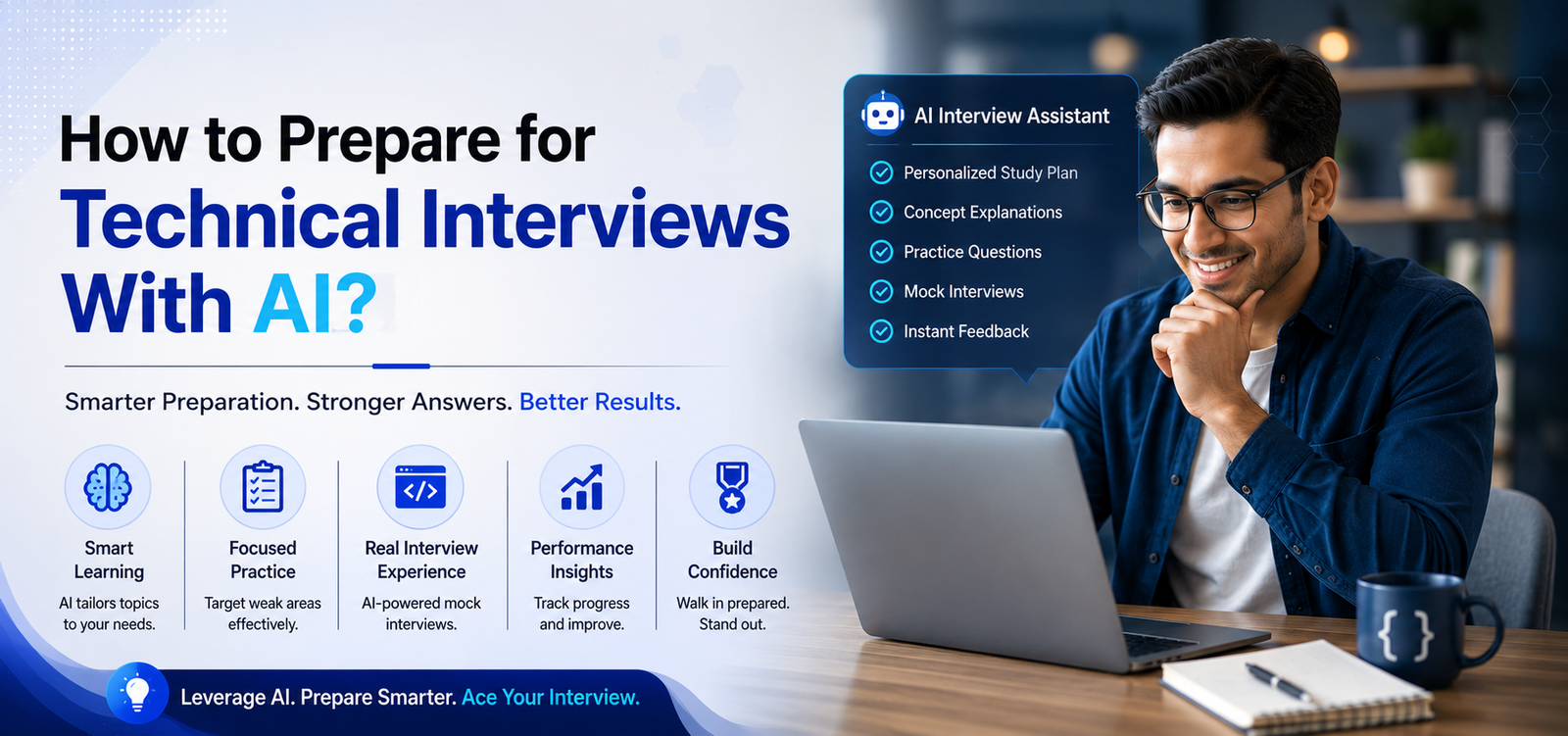
AI can make technical interview preparation more structured, varied, and responsive to individual weaknesses. Candidates can use it to generate questions, simulate interviews, review code, challenge system designs, practice explanations, and analyze recurring mistakes. However, the strongest preparation still depends on independent reasoning, technical accuracy, communication, and realistic practice under time pressure.
Use AI as a training partner rather than a substitute for competence. By combining deliberate practice with responsible AI assistance, candidates can enter technical interviews better prepared to reason clearly, explain decisions, handle follow-up questions, and solve unfamiliar problems.
Build a Technical Interview Preparation Plan
A strong preparation process starts with a clear picture of the role. Different technical positions emphasize different skills, so candidates should align practice with the responsibilities they expect to discuss.
Identify the Skills the Role Requires
Review the job description and separate requirements into technical categories. These may include data structures, algorithms, databases, system design, programming languages, cloud concepts, debugging, testing, security, or architecture.
Next, rate each area based on your current confidence. Mark topics as strong, moderate, or weak. This simple assessment creates a practical priority list.
Set Measurable Practice Goals
Turn broad goals into specific actions. Instead of planning to “practice coding,” schedule tasks such as solving three array problems, explaining one database concept aloud, or designing a small service within a fixed time.
Consequently, measurable goals make progress easier to track. Keep a record of problems attempted, errors made, concepts that caused difficulty, and questions that required outside help. This record can also shape later AI practice sessions.
Use AI to Generate Relevant Practice Questions
AI can produce a large variety of technical questions quickly. However, quality depends on the instructions and constraints provided by the candidate.
Create Role-Specific Questions
Ask AI to generate questions based on the target position, experience level, technologies, and interview format. Request a mix of straightforward, intermediate, and challenging problems so practice does not remain predictable.
Request Progressive Difficulty
Practice should become harder as competence improves. Therefore, ask AI to increase complexity gradually rather than producing advanced questions from the beginning.
A useful progression can move from concept recall to implementation, debugging, optimization, and design tradeoffs.
Practice Coding Problems Without Immediate Help
AI becomes most valuable when candidates use it after attempting problems independently. Asking for a solution immediately can create false confidence.
Set a Fixed Problem-Solving Window
Give yourself a defined period to interpret the problem, identify constraints, develop an approach, and write code. During that period, avoid requesting hints unless the interview format normally allows them.
After the time limit, review your work. Identify where reasoning broke down before asking AI for assistance. This process helps separate knowledge gaps from time-management problems.
Ask for Hints Instead of Solutions
When stuck, request one hint at a time. A useful prompt might ask for a question that directs attention toward the relevant concept without revealing the implementation.
Moreover, ask AI to evaluate your approach before providing an alternative. This preserves the reasoning process and helps you see why an approach succeeds or fails.
Use AI for Code Review
Once you complete a solution, AI can act as a structured reviewer. The review should focus on correctness, complexity, edge cases, readability, and maintainability.
Check Time and Space Complexity
Ask for an analysis of the algorithm’s time and space complexity, then verify the reasoning yourself. Do not accept a complexity label without examining how the algorithm behaves as input size increases.
For instance, identify loops, nested operations, recursive calls, sorting steps, and data structures that affect memory usage. Consequently, candidates become better prepared to explain performance decisions during an interview.
Test Edge Cases
Ask AI to suggest unusual inputs, boundary conditions, invalid values, duplicate elements, empty collections, and large datasets.
However, test these cases yourself. The objective is to strengthen defensive reasoning, not outsource verification.
Strengthen Technical Communication With AI
Technical interviews often reward candidates who can explain their thinking clearly. AI can simulate a skeptical interviewer and expose gaps in explanations.
Practice Thinking Aloud
During practice, explain what you are doing before writing code. State assumptions, clarify constraints, describe possible approaches, and explain why you selected one.
Then ask AI to review the explanation for missing reasoning or unclear language.
Practice Follow-Up Questions
Interviewers frequently ask why a solution works, what happens at scale, or how an alternative approach would change the result. Therefore, ask AI to challenge each solution with follow-up questions.
Useful prompts can request questions about complexity, scalability, failure cases, testing, security, maintainability, and tradeoffs. Answer each question without looking at generated responses first.
Prepare for System Design Interviews
System design interviews require a different preparation strategy because they evaluate architectural thinking rather than a single correct implementation.
Practice Requirement Clarification
Before designing a system, identify users, traffic, data volume, latency expectations, availability requirements, and major constraints. AI can simulate a stakeholder or interviewer who reveals requirements gradually.
This exercise teaches candidates to ask useful questions before choosing technologies. Moreover, it discourages premature architecture decisions based on familiar patterns.
Discuss Tradeoffs
A strong design explanation should address alternatives. For example, candidates may need to compare synchronous and asynchronous processing, relational and non-relational storage, centralized and distributed architectures, or caching strategies.
Ask AI to challenge your choices and present reasonable alternatives. Then explain why your selected design fits the stated requirements. The ability to defend tradeoffs often matters more than naming every available technology.
Simulate a Real Technical Interview
A mock interview should recreate pressure, timing, ambiguity, and follow-up questions. AI can provide a convenient simulation, but candidates should establish strict rules.
Use an Online AI Interview Assistant Carefully
An online ai interview assistant can simulate interviewer prompts, ask follow-up questions, and structure practice sessions. However, candidates should use such tools for preparation rather than relying on them during an assessment when external assistance violates interview rules.
Set the assistant to behave like a realistic interviewer. Ask it to avoid giving unsolicited hints, interrupt when explanations become unclear, and request justification for technical decisions. Such constraints make practice more demanding and useful.
Add Time Pressure
Real interviews rarely provide unlimited time. Therefore, assign realistic limits to coding problems, design exercises, and behavioral explanations.
After each session, review where time disappeared. Candidates may spend too long interpreting requirements, coding before planning, or explaining low-value details.
Practice Debugging Scenarios
Debugging questions test how candidates investigate failures rather than how quickly they write new code. AI can generate realistic scenarios involving broken functions, incorrect queries, performance problems, memory issues, and API failures.
Trace Problems Systematically
Start by reproducing the issue, identifying expected behavior, isolating the failure, and testing hypotheses. Avoid changing multiple variables simultaneously because that can hide the actual cause.
Afterward, ask AI to challenge your debugging sequence. It can suggest overlooked hypotheses or ask why one diagnostic step should precede another.
Explain the Root Cause
Once you identify a problem, describe the root cause, impact, fix, and prevention strategy. This structure demonstrates technical ownership and communication.
Furthermore, discuss testing that could prevent recurrence. Interviewers often value candidates who think beyond the immediate patch and consider reliability over time.
Use AI to Strengthen Weak Concepts
AI can provide explanations at different levels of difficulty, but candidates should verify important technical information through authoritative documentation and established technical references outside the AI system.
Ask for Multiple Explanations
If a concept feels confusing, request an explanation using a practical example, a technical explanation, and a concise interview response. Comparing these versions can reveal which parts remain unclear.
Then restate the concept without assistance. This final step matters because recognition does not always translate into recall under pressure.
Connect Concepts to Real Problems
Technical knowledge becomes more useful when candidates can connect concepts to practical situations. Ask AI to create scenarios that require selecting an appropriate technique and defending the decision.
For example, rather than memorizing caching definitions, practice deciding when caching helps, what should be cached, how invalidation works, and what happens when cached data becomes stale.
Prepare for Behavioral and Technical Questions Together
Technical interviews often combine engineering questions with discussions about teamwork, ownership, failures, prioritization, and communication. Candidates should prepare for both dimensions. That balance keeps preparation practical, focused, and closely aligned overall.
Build Concise Stories
Prepare several examples involving difficult technical problems, disagreements, production incidents, project decisions, mistakes, and successful improvements. Each story should emphasize the situation, your actions, technical reasoning, and measurable outcome.
AI can help identify vague statements or missing details. Nevertheless, keep the final stories truthful and specific to your own work.
Practice Technical Follow-Ups
Interviewers may move from a behavioral story into technical questions. If you describe a performance improvement, they may ask how you measured it, what bottleneck existed, or which alternatives you rejected.
Consequently, review the technical details behind every project you mention. Do not rely on polished wording if you cannot defend the underlying engineering decisions.
Create an AI-Assisted Study Schedule
A structured schedule prevents preparation from becoming a random collection of coding exercises. Divide practice across knowledge, implementation, communication, and mock interviews.
A balanced weekly cycle might include:
- Coding problem practice on several days.
- System design sessions at least once or twice.
- Technical concept review based on identified weaknesses.
- Mock interviews with strict time limits.
- Code review and debugging exercises.
- Communication practice using technical explanations.
- A final review of recurring mistakes.
Adjust the schedule according to the interview date and role requirements. Moreover, increase simulation frequency as the interview approaches while maintaining enough time for targeted skill improvement.
Track Mistakes Instead of Just Scores
Scores can show progress, but mistakes reveal what needs attention. Maintain a mistake log with categories such as misunderstanding requirements, choosing an inefficient algorithm, missing edge cases, weak explanations, or poor time management.
Review the log regularly. Patterns often emerge after several sessions. For example, repeated errors with complexity analysis may indicate a conceptual weakness, while repeated unfinished problems may signal poor planning.
Use AI to categorize recurring errors, but confirm its interpretation yourself. The goal involves creating a sharper preparation strategy rather than collecting more data.
Avoid Common AI Preparation Mistakes
AI can accelerate practice, yet poor usage can weaken preparation. Candidates should recognize the difference between assistance and substitution.
Do Not Memorize Generated Answers
Generated solutions can contain mistakes, unnecessary complexity, or assumptions that do not fit the interview problem. Memorizing them also makes it harder to adapt when an interviewer changes the constraints.
Instead, focus on principles. Rebuild solutions from first principles and explain each decision without looking at generated material.
Do Not Let AI Solve Every Problem
If AI supplies every hint, solution, and explanation, your independent problem-solving ability receives too little practice. Therefore, create boundaries around assistance.
A useful rule involves attempting first, requesting limited help second, and reviewing the complete solution only after serious effort. This preserves productive difficulty.
Do Not Ignore Technical Accuracy
AI can produce confident but incorrect statements. Verify critical claims, especially around language behavior, framework details, database guarantees, security practices, and system architecture.
Furthermore, test code whenever possible. A plausible explanation does not guarantee executable correctness.
Protect Sensitive Information During Preparation
Candidates should avoid placing confidential employer information, proprietary source code, private customer data, credentials, internal architecture diagrams, or restricted documentation into general-purpose AI systems.
Replace sensitive details with fictional examples. Remove names, identifiers, secrets, and proprietary values before requesting assistance. This approach preserves the learning value while reducing unnecessary exposure.
Evaluate Progress Before Interview Day
The final preparation stage should measure readiness rather than simply increase activity. Conduct a realistic mock interview without assistance, then evaluate performance across several dimensions.
Consider these questions:
- Did I clarify requirements before solving?
- Could I explain my approach clearly?
- Did I consider edge cases?
- Could I analyze complexity accurately?
- Did I respond calmly to follow-up questions?
- Could I defend technical tradeoffs?
- Did I recover effectively after making a mistake?
- Did I finish within the available time?
Use the results to target the final practice sessions. Moreover, avoid introducing large new topics immediately before the interview unless the role clearly requires them.
Build Interview Confidence Through Independent Practice
Confidence comes from repeated evidence that you can solve problems without external support. AI can increase the quantity and variety of practice, but independent performance remains the strongest readiness test.
Schedule several sessions in which you use no AI assistance. Treat each session like the real interview. Afterward, use AI for reflection, error analysis, and targeted practice rather than for replacing the work you should perform yourself.
This balance creates a healthier preparation cycle: attempt, review, correct, repeat, and retest.
Conclusion
AI can make technical interview preparation more structured, varied, and responsive to individual weaknesses. Candidates can use it to generate questions, simulate interviews, review code, challenge system designs, practice explanations, and analyze recurring mistakes. However, the strongest preparation still depends on independent reasoning, technical accuracy, communication, and realistic practice under time pressure. Use AI as a training partner rather than a substitute for competence. By combining deliberate practice with responsible AI assistance, candidates can enter technical interviews better prepared to reason clearly, explain decisions, handle follow-up questions, and solve unfamiliar problems.
FAQs
What should I ask AI when preparing for a technical interview?
Ask AI to generate role-specific coding problems, system design scenarios, debugging exercises, technical follow-ups, and mock interview questions. Provide the expected experience level and technologies. Additionally, ask for hints before complete solutions and request feedback on your reasoning. This approach keeps preparation challenging while making practice more targeted.
Can AI help with coding interview preparation?
Yes. AI can generate coding problems, provide controlled hints, review submitted code, identify edge cases, analyze complexity, and create variations of the same challenge. However, candidates should attempt each problem independently before requesting assistance. That process develops transferable reasoning skills instead of encouraging dependence on generated solutions.
How can AI improve technical interview communication?
AI can act as a simulated interviewer and ask candidates to explain assumptions, algorithms, architecture decisions, tradeoffs, and failure scenarios. Afterward, it can identify unclear explanations or missing reasoning. Candidates should then repeat the explanation without assistance. This cycle improves clarity, structure, and confidence during technical discussions.
Should I use AI during an actual technical interview?
Only when the interview rules explicitly permit it. Many technical assessments restrict external assistance, and violating those rules can create serious professional consequences. Candidates should use AI primarily during preparation unless the interviewer clearly authorizes its use. Always follow the assessment instructions and disclose assistance when required.
Can AI help with system design interview preparation?
AI can generate realistic architecture scenarios, introduce changing requirements, challenge design decisions, and ask questions about scalability, reliability, security, storage, networking, and cost. Candidates should still create designs independently and defend their tradeoffs. AI works best as a demanding reviewer rather than as the designer of the entire solution.
How often should I practice with AI before an interview?
Practice frequency should reflect your current skill level, interview date, and role complexity. Consistent sessions usually provide more value than occasional long sessions. Combine coding, design, communication, debugging, and mock interviews. As the interview approaches, increase realistic simulations while preserving time for correcting recurring weaknesses.
How can I prevent AI from making my preparation too easy?
Set strict rules. Attempt problems before requesting hints, limit the number of hints, avoid immediate solutions, and complete some mock interviews without assistance. You can also instruct AI to challenge your reasoning instead of correcting every mistake. These boundaries preserve productive difficulty and encourage independent problem-solving.
Is AI-generated technical information always accurate?
No. AI systems can produce incorrect, incomplete, or outdated information while presenting it confidently. Verify important technical claims through reliable documentation and trusted technical sources. Test code and question assumptions before incorporating generated information into your preparation. Accuracy matters particularly for programming language behavior, security, databases, and architecture.
What information should I avoid sharing with AI during preparation?
Avoid confidential source code, credentials, private customer information, proprietary designs, internal documentation, unreleased product details, and other restricted company information. Replace sensitive details with fictional examples whenever possible. Removing identifying information also reduces unnecessary exposure. Candidates should follow their employer’s policies before using external AI services with work-related material.
What is the best way to measure technical interview readiness?
Use realistic mock interviews without assistance and evaluate problem solving, communication, coding accuracy, complexity analysis, system design, debugging, time management, and response to follow-up questions. Track recurring mistakes rather than focusing only on scores. When performance remains consistent across several realistic sessions, preparation becomes easier to assess objectively.