
Introduction
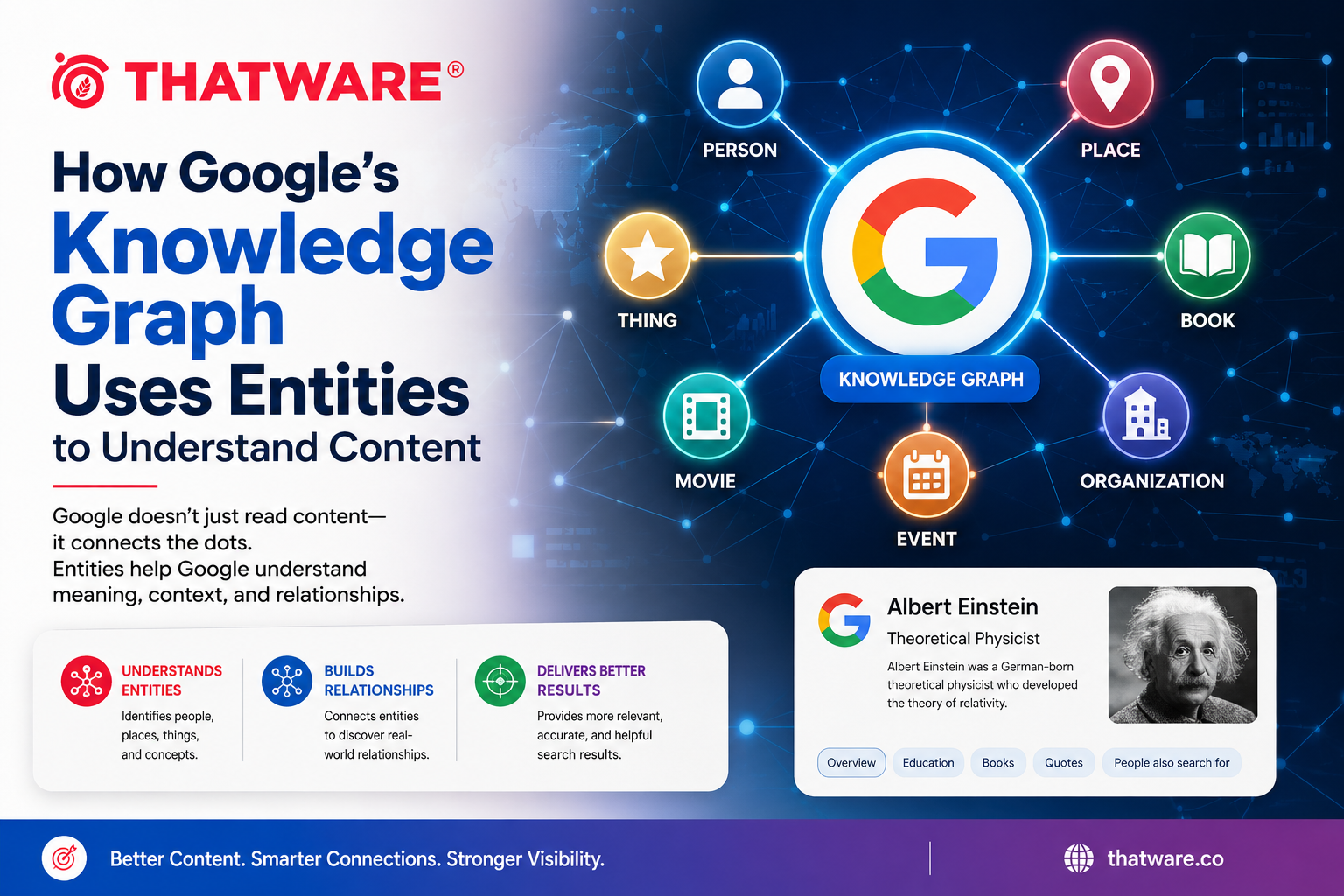
Search engines have evolved far beyond matching keywords on a page. Today, Google focuses on understanding the meaning behind content, the relationship between concepts, and how information connects across the web. This evolution is largely driven by Google’s Knowledge Graph, a sophisticated database that identifies people, places, organizations, products, and ideas as entities instead of isolated keywords.
This shift makes Entity Optimization an essential component of modern SEO strategies. Rather than simply repeating target phrases, businesses need to create content that clearly defines topics, demonstrates expertise, and establishes meaningful relationships between relevant concepts. As Google’s algorithms become increasingly semantic, optimizing entities helps search engines better interpret your website while improving visibility across Google Search, AI-powered search platforms, and answer engines.
This guide explains how Google’s Knowledge Graph works, why entities matter, and how businesses can leverage entity-focused optimization to strengthen their online authority.
What Is Google’s Knowledge Graph?
Google’s Knowledge Graph is an extensive database that stores information about millions of real-world entities and the relationships between them.
Instead of treating every search as a collection of words, Google identifies:
- People
- Companies
- Products
- Services
- Locations
- Organizations
- Events
- Technologies
- Concepts
For example, when someone searches for “SEO,” Google doesn’t simply match pages containing the word. It understands related concepts such as:
- Search engines
- Ranking algorithms
- Website optimization
- Structured data
- Technical SEO
- User experience
This contextual understanding enables Google to deliver more relevant search results while reducing ambiguity.
Understanding Entity Optimization
Entity Optimization is the process of helping search engines clearly identify the primary topics your website discusses and how those topics relate to other trusted entities across the internet.
Unlike traditional keyword optimization, entity-focused optimization emphasizes:
- Topic clarity
- Context
- Relationships
- Expertise
- Authority
- Structured information
Rather than optimizing for individual keywords alone, websites organize information so Google’s algorithms understand the overall meaning of each page.
This improves how pages appear in:
- Organic search
- AI-generated answers
- Featured snippets
- Knowledge panels
- Voice search
- Entity-based recommendations
How Google Uses Entities to Understand Content
Google evaluates far more than page text when determining relevance.
Some important signals include:
1. Context Rather Than Exact Keywords
Modern algorithms analyze surrounding content to determine what a page is actually about.
For example, a page discussing:
- crawling
- indexing
- backlinks
- structured data
helps Google understand that the topic relates to search engine optimization even without excessive keyword repetition.
2. Relationship Between Entities
Google connects related concepts together.
For example:
- Search Engine → Google
- SEO → Rankings
- Website → Crawling
- Content → User Intent
The stronger these relationships appear throughout your content, the easier it becomes for Google to classify your website accurately.
3. Authority Signals
Search engines also evaluate whether trusted sources recognize your business or website as an authority on a subject.
These signals include:
- Consistent brand mentions
- Quality backlinks
- Expert-written content
- Structured data
- Citations across authoritative websites
Over time, these signals contribute to stronger topical authority.
The Role of Semantic SEO in Modern Search
Traditional keyword optimization alone is no longer sufficient.
Semantic SEO helps search engines understand the intent behind content by naturally incorporating related concepts, synonyms, and contextual information.
Instead of creating multiple pages targeting nearly identical keywords, semantic optimization encourages comprehensive content that answers related user questions within a single topic.
Benefits include:
- Better search relevance
- Improved user experience
- Higher engagement
- Greater visibility in AI-powered search
- Enhanced topical authority
Google increasingly rewards websites that demonstrate complete topic coverage rather than isolated keyword targeting.
How Knowledge Graph SEO Strengthens Website Visibility
A well-developed Knowledge Graph SEO strategy helps Google associate your brand with recognized industry topics.
Effective implementation includes:
- Structured schema markup
- Consistent business information
- Internal topic clusters
- Author expertise
- High-quality backlinks
- Entity-rich content
When Google’s Knowledge Graph better understands your business, your content becomes more eligible for enhanced search features and AI-generated answers.
How Entity Authority Improves Search Rankings
Search engines don’t just identify entities—they also evaluate how authoritative they are. Entity Authority reflects the trust, expertise, and credibility associated with a brand, person, organization, or topic.
A strong entity profile can help your website:
- Improve topical relevance
- Increase trust signals
- Enhance E-E-A-T (Experience, Expertise, Authoritativeness, Trustworthiness)
- Earn more featured snippets
- Improve visibility across AI-powered search platforms
- Strengthen organic rankings over time
Google determines authority through multiple signals, including:
- High-quality backlinks from trusted websites
- Consistent brand mentions across authoritative sources
- Well-structured content that demonstrates expertise
- Accurate schema markup
- Positive user engagement metrics
The more Google associates your brand with a specific topic, the stronger your entity becomes within its Knowledge Graph.
How ThatWare LLP Implements Entity SEO
At ThatWare LLP, entity-focused optimization goes beyond traditional keyword targeting. Instead of creating isolated content, the strategy focuses on building a connected ecosystem that search engines can easily understand.
The process includes:
Comprehensive Topic Research
Every topic is mapped with closely related concepts to ensure complete coverage rather than fragmented information.
Content Clustering
Related articles are connected through logical internal linking, allowing Google to understand topical relationships.
Structured Data Implementation
Schema markup helps search engines accurately identify:
- Organizations
- Services
- Authors
- Articles
- FAQs
- Products
- Local business information
Brand Entity Development
Building consistent business information across authoritative platforms strengthens Google’s understanding of the brand.
AI Search Optimization
Entity-focused content improves discoverability across emerging AI search platforms, including conversational search engines that rely heavily on semantic understanding.
Best Practices for Effective Entity Optimization
Businesses looking to improve search visibility should focus on the following best practices.
1. Define Clear Primary Topics
Every page should focus on one primary topic supported by closely related concepts.
Avoid combining multiple unrelated subjects on the same page.
2. Build Strong Internal Linking
Internal links help Google understand how topics relate to one another.
For example:
- Service pages
- Blog articles
- Case studies
- Guides
- Industry resources
should naturally connect whenever relevant.
3. Use Structured Data
Schema markup provides additional context that search engines cannot always infer from plain text.
Common schema types include:
- Organization
- Article
- FAQ
- Breadcrumb
- Person
- LocalBusiness
- Product
4. Publish Comprehensive Content
Instead of producing many thin pages targeting similar keywords, create in-depth resources that fully answer user questions.
Comprehensive content improves:
- User engagement
- Time on page
- Topical authority
- Crawl efficiency
5. Maintain Consistent Brand Information
Ensure your business name, contact details, social profiles, and company information remain consistent across every online platform.
Consistency strengthens entity recognition.
Common Entity SEO Mistakes to Avoid
Many websites struggle because they continue relying on outdated SEO practices.
Avoid these common mistakes:
- Excessive keyword repetition
- Creating duplicate topic pages
- Weak internal linking
- Missing schema markup
- Inconsistent business information
- Publishing shallow content
- Ignoring semantic relationships
- Poor content organization
These issues make it harder for Google’s algorithms to understand your expertise.
The Future of Search Is Entity-Based
Google continues investing heavily in AI and semantic understanding.
Instead of asking:
“Does this page contain the keyword?”
Modern algorithms ask:
- Is this page trustworthy?
- Does it comprehensively answer the question?
- Is this brand recognized within the industry?
- How does this topic connect with related entities?
As AI search engines continue evolving, entity-focused optimization will become even more important than traditional keyword strategies.
Businesses adopting entity-based SEO today are better positioned for future algorithm updates and AI-powered search experiences.
Conclusion
Google’s Knowledge Graph has fundamentally changed how search engines evaluate content. Success now depends on helping Google understand the meaning behind your website rather than simply matching keywords.
By implementing Entity Optimization, businesses can improve topical relevance, strengthen authority, and create content that aligns with modern semantic search principles. Combined with quality content, structured data, strategic internal linking, and consistent branding, an entity-first approach provides long-term SEO benefits that extend beyond traditional rankings.
If you’re looking to improve your website’s visibility through advanced entity-based strategies, ThatWare LLP offers specialized SEO solutions designed for Google’s evolving search ecosystem and AI-powered search platforms.
Frequently Asked Questions (FAQs)
What is an entity in SEO?
An entity is a uniquely identifiable person, place, organization, product, concept, or event that search engines recognize and understand independently of keywords.
Why is Entity Optimization important?
It helps search engines better understand your content, improves topical relevance, strengthens authority, and increases visibility in both traditional and AI-powered search.
How does Google’s Knowledge Graph work?
Google’s Knowledge Graph stores information about entities and their relationships, allowing search engines to provide more accurate and contextually relevant search results.
Can entity-based SEO improve AI search visibility?
Yes. AI search platforms rely heavily on semantic understanding, making entity-focused optimization increasingly valuable for improving discoverability.
How does schema markup support entity recognition?
Structured data provides explicit information about your content, helping search engines identify organizations, services, products, authors, and other important entities more accurately.