
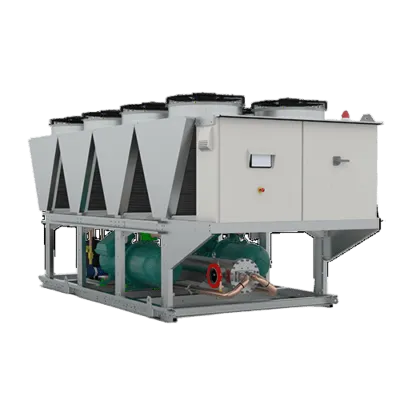
Overview –Screw chillers use a twin-screw compressor to handle large, constant cooling loads that smaller compressors can’t handle. This is the standard choice for manufacturing plants, data centers and chemical processing facilities that need reliable cooling around the clock.
This blog covers:
- Introduction
- What a Screw Chiller Is
- How a Screw Chiller Works
- Key Components of a Screw Chiller
- Where Screw Chillers Are Used
- Frequently Asked Questions
Introduction
Facilities running large, nonstop cooling loads eventually outgrow scroll or reciprocating chillers. Screw Chillers are built for that next step up — more capacity, steady running, and a longer working life under heavy use. Here’s how they actually work and what’s inside one.
What a Screw Chiller Is?
A screw chiller is an industrial cooling system built around a twin-screw compressor. Instead of the two spiral elements used in a scroll compressor, it uses two interlocking helical rotors. As the rotors turn together, they trap refrigerant gas between them and squeeze it down along the length of the screws, raising its pressure.
This setup handles heavy, continuous loads better than smaller compressor types. Fewer units are needed to cover the same capacity, and the compressor holds up well running for long stretches — something scroll compressors just aren’t built for.If you’re new to industrial cooling systems, you can also read our Screw Chiller Overview to understand the basics, types, and benefits before exploring how the system works.
How a Screw Chiller Works?
The basic refrigeration cycle is the same one every chiller runs on. What’s different is the compression stage:
- Compression – refrigerant gas enters the compressor, where the two rotors mesh and gradually shrink the space around the gas, raising its pressure and temperature.
- Condensation – the hot, high-pressure gas moves to the condenser, where it gives off heat to either ambient air (air cooled) or a water loop (water cooled) and turns back into a liquid.
- Expansion – the liquid refrigerant passes through an expansion valve, which drops its pressure and temperature sharply before it reaches the evaporator.
- Evaporation – the cold refrigerant pulls heat out of the process water or air moving through the evaporator, cooling it down while the refrigerant turns back into gas.
- Repeat – the gas heads back to the compressor and the cycle starts again.
Because the two screws mesh continuously, the compressor runs smoothly without the pulsing you get from a reciprocating compressor. That’s a big part of why screw chillers run quieter and with less vibration at larger capacities.
Key Components of a Screw Chiller
A handful of components decide how well a screw chiller performs and how long it lasts:
- Twin-screw compressor – the core of the machine. Build quality here has the biggest impact on reliability and lifespan.
- Condenser – gets rid of heat from the refrigerant, either through air across a coil or through a water loop, depending on the setup.
- Evaporator – pulls heat out of the process fluid and puts it into the refrigerant. This is where the actual cooling happens.
- Expansion valve – controls refrigerant flow into the evaporator and creates the pressure drop that makes cooling possible.
- Microprocessor controls – track system parameters and allow remote monitoring and data logging on newer units.
- Variable capacity control – lets the compressor adjust its output to match the load instead of always running flat out, which saves energy.
The performance of these components directly affects cooling efficiency, energy consumption, and long-term reliability. Learn more about selecting the right system in our Screw Chillers Guide.
Where Screw Chillers Are Used?
Screw chillers show up anywhere cooling loads are big, constant, or both:
- Manufacturing and industrial process cooling
- Chemical and pharmaceutical processing
- Data centers that need round-the-clock cooling
- Food and beverage production
- Power plants
- Large commercial buildings and hospitals
In all of these settings, the same thing pushes facilities toward screw compressors over scroll or reciprocating options: high capacity, long duty cycles, and the need for equipment that just keeps running.If you’re comparing different industrial cooling options or planning a new installation, check out our complete Screw Chillers Guide to learn how to choose the right chilling solution for your application.
Coolstar India, based in Bulandshahr, Uttar Pradesh, builds screw chillers alongside scroll, reciprocating, air cooled, and water cooled configurations, plus complete chilling plants. As a trusted Screw Chillers Manufacturer, Coolstar fits its units with microprocessor controls, variable capacity control, and eco-friendly refrigerants, built to run for years with minimal upkeep. For help picking or sizing a screw chiller for your facility, get in touch with the Coolstar India team.
Frequently Asked Questions
How is a screw chiller different from a scroll chiller? A screw chiller uses two interlocking helical rotors. A scroll chiller uses two spiral elements. Screw compressors generally handle bigger, steadier loads, while scroll compressors work better for smaller, variable loads.
Can a screw chiller be air cooled or water cooled? Yes. The compressor type and the cooling method are separate choices, so screw chillers come in both air cooled and water cooled versions depending on water access and installation setup.
What capacity range do screw chillers usually cover? They’re generally used for moderate to large cooling loads, well past what a single scroll compressor can efficiently handle. Exact capacity comes down to the specific model.
How much maintenance does a screw chiller need? Less than you’d expect for its capacity, but it’s not zero. Regular checks on refrigerant levels, compressor oil, and controls are still needed to avoid unplanned downtime.
