
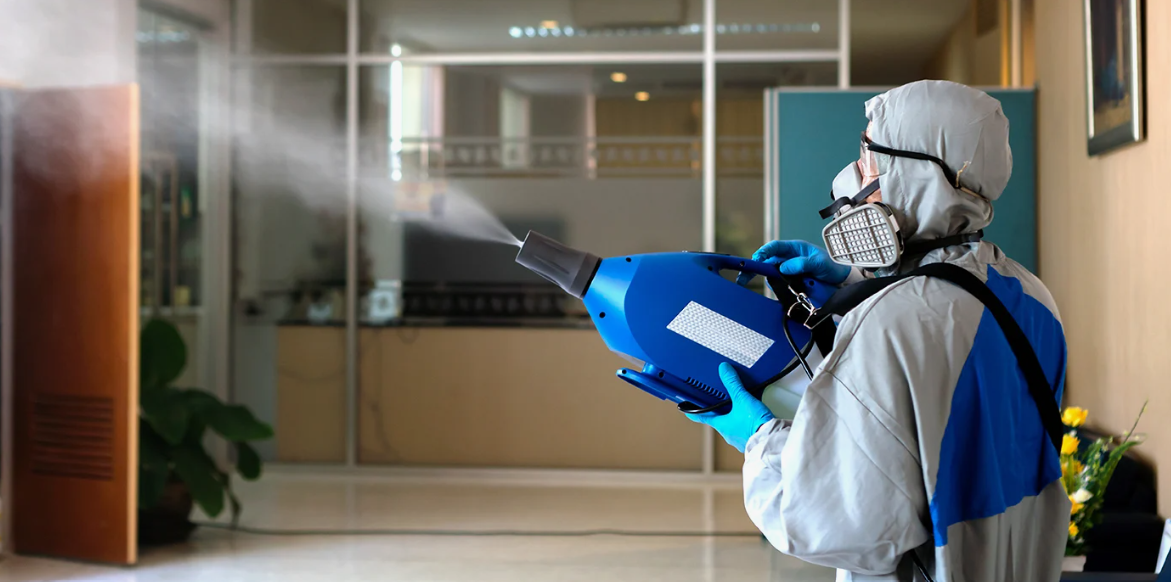
Most talk about electrostatic cleaning centers on surfaces, but the air in a room carries germs too, and the two problems are linked. Air decontamination electrostatic methods use the same basic physics that make a sprayer coat a chair evenly, applied to the particles floating around instead. This article looks at how those ideas cross over, what the newer tools claim to do, and where a careful buyer should keep their guard up.
Surfaces & the Air Around Them
Start with the link between the two. Germs do not stay put. When someone wipes a desk, walks across a room, or runs a fan, particles that were sitting on a surface get stirred back into the air, and particles in the air settle onto surfaces. Cleaning one without the other leaves a gap.
This is why surface work and air quality are part of the same conversation. A thorough surface disinfection lowers the reservoir of germs that can get kicked back up, so the air has less to carry. Electrostatic surface spraying helps here by covering more area evenly, which shrinks that reservoir faster than spot-wiping does.
How Electrostatic Ideas Apply to Air
The physics that make a charged droplet cling to a chair also work on airborne particles. Give a particle an electrical charge and it will be drawn toward an oppositely charged surface or plate, which is the idea behind electrostatic disinfection services Concord NC.
Electrostatic Precipitators
The oldest version of this is the electrostatic precipitator. Air passes through a chamber where particles pick up a charge, then get pulled onto collector plates that carry the opposite charge. Dust, smoke, and some larger germs stick to the plates instead of staying in the air. These have been used in industrial settings for decades and show up in some building air systems.
Charged Filtration & Ionization
The particles are charged so they clump together and get caught more easily by a filter, or so they fall out of the air onto surfaces. Bipolar ionization is one of the marketed versions, sending charged ions into a space to make particles gather and drop. The core idea is the same as the sprayer, just aimed at the air.
Where Surface Spraying Still Carries Weight
For all the buzz around air devices, surface work remains the steadier win. A germ on a doorknob is one you can reliably reach and kill with a rated disinfectant and enough dwell time. A germ drifting in the air is a moving target, and the tools for catching it vary a lot in how well they perform.
That is why many providers lead with surface disinfection and treat air handling as a support piece. Legacy Shines Services, a cleaning provider in Concord, North Carolina, uses electrostatic application to coat surfaces evenly across offices and other facilities, which cuts the pool of germs that can end up airborne in the first place. Clean surfaces do quiet work for the air without any special device.
What to Watch For
Air decontamination is an area where the marketing sometimes runs ahead of the proof. Some devices promise dramatic drops in airborne germs, but the results depend heavily on the size of the room, the airflow, and how the unit is set up. A tool that performs well in a sealed test chamber may do far less in a busy open office.
A few questions keep a buyer honest. Does the maker have independent testing, not just in-house numbers. Does the claim match the real conditions of the space. And does the device produce anything unwanted, since some ionizing units can generate ozone, which carries its own health concerns. Healthy skepticism is the right posture until the evidence is clear.
Where Ventilation Fits
No discussion of air decontamination is complete without the plainest tool of all, which is moving air. Good ventilation dilutes airborne germs by swapping stale indoor air for fresh, and filtration in the building’s system catches particles as the air cycles through. These basics do a lot of quiet work, and they do it with technology that is well proven rather than freshly marketed.
Electrostatic and charged-particle devices are best thought of as add-ons to that foundation, not replacements for it. A room with poor airflow and a fancy ionizer is worse off than a room with steady ventilation and no gadget at all. When buyers weigh an air device, the first question is how well the basics are handled, since a charged-particle tool works better in a space that already breathes well. A device cannot keep up if the room never trades its stale air for fresh. Layering a proven base with a well-tested add-on beats betting everything on a single unit, and it usually costs less than chasing the newest gadget on the market.
Pairing Air & Surface Work
The sensible approach treats air and surfaces as one system rather than betting everything on a single gadget. Good ventilation and filtration handle a share of the airborne load, and thorough surface disinfection keeps the reservoir low so there is less to circulate. Electrostatic methods contribute on both ends, coating surfaces evenly and, in some systems, helping pull particles out of the air.
No single tool clears a room of germs on its own. The buildings that get the best air results layer their methods, lean on the ones with solid evidence, and stay wary of any device that promises more than it can show. A charged plate, a good filter, steady airflow, and clean surfaces each carry part of the load, and together they do far more than any one of them alone.
The Takeaway
Electrostatic thinking has real uses in air decontamination, from long-proven precipitators to newer charged-particle devices, and it ties back neatly to the surface spraying that most people already know. The strongest, most reliable piece of the puzzle is still keeping surfaces clean, since that lowers what the air has to carry. Treat the flashier air devices as helpers to weigh on the evidence, not as a substitute for the basics, and the whole space breathes easier.