
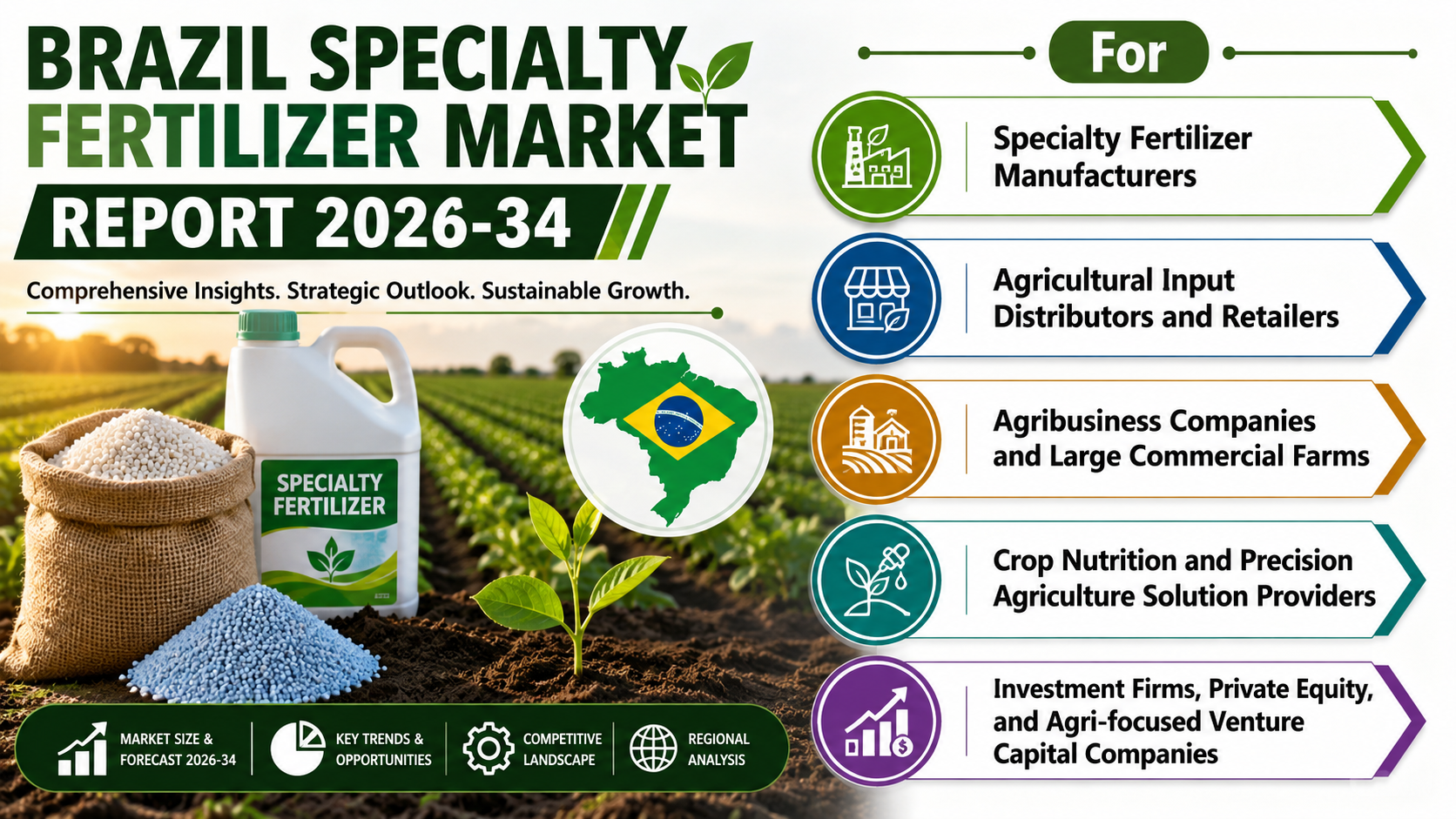
Brazil’s status as a global breadbasket is driving a massive transition toward high-efficiency plant nutrition. According to the latest market data from IMARC Group, the Brazil specialty fertilizer market size reached an impressive valuation of USD 989.2 Million in 2025.
As farmers increasingly adopt targeted crop-nutrition regimes to optimize yields and comply with international export standards, the market is projected to reach an outstanding USD 1,823.1 Million by 2034. This represents a steady, robust compound annual growth rate (CAGR) of 7.03% during the forecast period of 2026–2034.
Key Market Growth Drivers:
The strong expansion of the specialty plant nutrition industry in Brazil is sustained by several key agricultural and technological drivers:
1. Expanding Agriculture, Crop Diversity, and Export Demands
Brazil is a leading global exporter of key agricultural commodities, including soybeans, corn, and sugarcane. Meeting the requirements of international buyers requires not only massive production volumes but also strict compliance with residue and quality standards. Specialty fertilizers are custom-formulated to meet these precise plant needs, correcting specific soil deficiencies and maximizing yield without over-applying raw elements.
2. The Rapid Rise of Precision Agriculture
The integration of digital technology on Brazilian farms is revolutionizing how agrochemicals and fertilizers are applied. Brazilian farmers are increasingly utilizing precision agriculture techniques – including GPS guidance, soil sensors, and drone data mapping. These tools allow for hyper-targeted, variable-rate applications of nutrients. By applying specialty inputs like controlled release fertilizers (CRFs) and water soluble formulas exactly where and when they are needed, farmers significantly cut down on resource waste.
3. Accelerated Shift Toward Bio-Based and Organic Farming Inputs
Global demand for residue-free produce and stricter international import standards are driving a massive shift toward biologicals and organic farming methods in Brazil. The rising use of bio-based inputs – derived from natural materials like microbial inoculants, plant extracts, and organic compost – is reducing the overall reliance on synthetic chemical alternatives. To stay competitive, major crop nutrition producers are expanding their local production of organic-certified specialty fertilizers, enhancing nutrient absorption while meeting environmental sustainability goals.
Key Market Segmentation:
The specialty crop nutrition ecosystem is highly diversified to address distinct crop requirements and soil conditions across Brazil’s agricultural frontiers.
Segment by Speciality Type:
The delivery mechanism of specialty fertilizers is crucial for improving nutrient uptake and reducing environmental runoff:
- Controlled Release Fertilizers (CRF): This includes advanced polymer coated, polymer-sulfur coated, and other specialized coated options that release nutrients slowly over a designated period, aligning perfectly with a crop’s growth cycle.
- Water Soluble Fertilizers: Ideal for rapid absorption, these are highly utilized in advanced modern irrigation systems.
- Liquid Fertilizers: Highly popular for their ease of mixing and uniform application.
- Slow Release Fertilizers (SRF): Providing a steady stream of basic plant nutrition while protecting sensitive root zones.
Segment by Application Mode:
Specialty fertilizers are applied utilizing three primary pathways, each catering to specific developmental stages:
- Fertigation: The process of applying water-soluble fertilizers directly through an irrigation system, popular in high-value horticultural setups.
- Foliar: Spraying liquid nutrients directly onto crop leaves for rapid corrective action during critical growth phases.
- Soil: Direct soil applications designed for baseline nutrient enrichment and slow-release root feeding.
Segment by Crop Type:
While specialty inputs benefit all plant life, their primary economic targets include:
- Field Crops: Heavily dominated by massive soybean, sugarcane, and corn plantations.
- Horticultural Crops: Serving high-value fruit, vegetable, and coffee operations.
- Turf and Ornamental: Niche applications in commercial landscaping and professional turf management.
Regional Breakdown:
Because Brazil features highly diverse microclimates and soil profiles, regional demand for specialty fertilizers varies significantly:
- Central-West: The crown jewel of Brazilian grain production. This region features massive commercial soy and corn operations, which heavily drive the regional consumption of bulk controlled-release fertilizers and specialized soil conditioners.
- Southeast: A major hub for sugarcane, coffee, and horticultural crops. Farmers in states like Minas Gerais and São Paulo rely extensively on advanced foliar sprays and automated fertigation systems to optimize crop quality for global markets.
- South: Known for highly mechanized, family-owned commercial farming and strong cooperative networks, ensuring swift local adoption of innovative bio-based nutrition products.
- Northeast & North: Expanding agricultural frontiers (such as the MATOPIBA region) showing rising demand for soil-enrichment specialty fertilizers to prepare native soils for intensive seasonal cultivation.
Sample Request For Your Business
Competitive Landscape: Key Players in the Market
The competitive ecosystem of the Brazilian specialty fertilizer sector is highly dynamic, featuring a strategic mix of international chemical giants and local specialty blenders. Key market players focus heavily on expanding their regional manufacturing footprints, acquiring biological innovators, and providing customized, crop-specific blending services to differentiate themselves.
Recent News:
The ongoing growth of the specialty fertilizer sector is highlighted by major corporate developments and expansions inside Brazil:
- Corporate Acquisitions (ICL Group & Nitro 1000): In February 2024, global specialty minerals company ICL acquired Brazilian biologicals firm Nitro 1000 for USD 30 Million. This strategic move significantly strengthens ICL’s presence in Brazil’s agricultural inputs market, allowing them to target massive soybean, corn, and sugarcane operations with sustainable biological alternatives.
- New Manufacturing Facilities (Haifa Group): In February 2025, Haifa Group expanded its footprint by launching a new blending facility in Uberlândia, Minas Gerais. The facility is designed to produce its Multicote controlled-release fertilizers, offering an annual capacity of 5,000 to 7,000 tonnes of custom formulations tailored to specific local soil conditions.
- Market Consolidations and Financial Pressures: Proving the competitive nature of the market, local producer Rifertil filed for bankruptcy protection in April 2025, citing USD 112.7 Million (R647.9mn) in debt. The company faced sudden pressures due to falling global fertilizer prices, severe droughts in its primary market of Goiás, customer defaults, and currency fluctuations.
About Us:
IMARC Group is a global management consulting firm that helps the world’s most ambitious changemakers to create a lasting impact. The company provide a comprehensive suite of market entry and expansion services. IMARC offerings include thorough market assessment, feasibility studies, company incorporation assistance, factory setup support, regulatory approvals and licensing navigation, branding, marketing and sales strategies, competitive landscape and benchmarking analyses, pricing and cost research, and procurement research.
Contact Us:
IMARC Group‚
134 N 4th St‚ Brooklyn‚ NY 11249‚ US
Email: sales@imarcgroup․com
Tel No: (D) +91 120 433 0800
United States: (+1–201–971–6302)