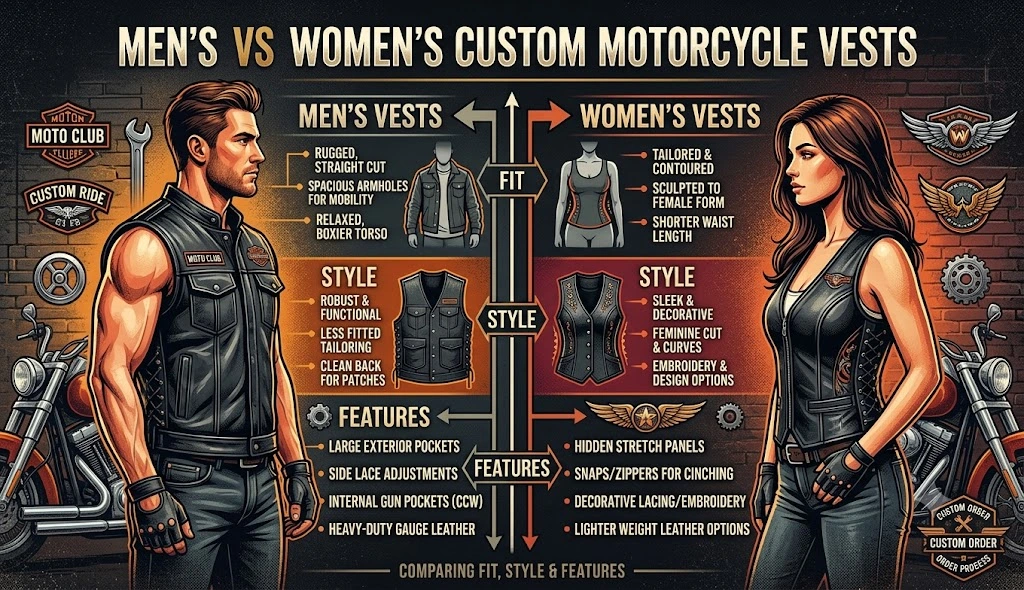
Walk into a custom motorcycle vest shop and you’ll see two options: men’s and women’s. They might look similar from across the room, both are leather, both have pockets, both scream biker culture. But put them side-by-side and the differences become obvious.
Those differences aren’t just cosmetic. A men’s custom motorcycle vest built for a male body won’t fit a woman properly, and vice versa. The proportions, cut, and construction are fundamentally different because male and female bodies are shaped differently.
Here’s what actually separates men’s and women’s custom vests, from fit and style to features and construction, and why choosing the right one matters.
Why Gender-Specific Vests Actually Matter
Some brands try the “unisex” approach or just make smaller versions of men’s vests and call them women’s. This doesn’t work. Men and women have different body proportions that require different patterns and construction.
- Men typically have: Broader shoulders, narrower hips, straight torso, longer torso length, wider chest, minimal waist definition.
- Women typically have: Narrower shoulders, wider hips, defined waist, shorter torso, fuller bust, curves requiring contouring.
A properly well designed women’s custom motorcycle vest accounts for these differences from the pattern stage, not as an afterthought.
Fit Differences: How Men’s and Women’s Vests Are Cut
Shoulder Construction
- Men’s custom motorcycle vests: Shoulder seams sit wider to accommodate broader shoulder width. The armholes are positioned for wider-set shoulders and typically cut higher.
- Women’s custom motorcycle vests: Shoulder seams are narrower and positioned for female shoulder width. Armholes account for narrower shoulders and are often cut slightly lower for comfort.
- Why it matters: Shoulders that don’t fit correctly cause the entire vest to sit wrong, pulling, gaping, or restricting movement.
Torso Shaping
- Real Leather biker vests for men: Cut straight from chest to hem with minimal waist definition. The goal is a boxy, masculine silhouette that fits over broader frames.
- Leather motorcycle vests for women: Feature darts or curved seams that taper at the waist and accommodate the bust and hips. This creates a flattering, contoured fit instead of a shapeless box.
- Why it matters: A straight-cut vest on a curvy body gaps at the waist and pulls tight at the bust and hips. A tapered vest on a straight body looks baggy.
Length and Proportion
- Men’s vests: Typically longer through the torso to accommodate male height-to-torso ratios. The back panel extends lower to cover the belt line even when leaning forward.
- Women’s vests: Often slightly shorter in overall length but maintain proper coverage. Proportioned for shorter average torso length while still providing full back coverage.
- Why it matters: A vest that’s too long looks sloppy and bunches when sitting. Too short exposes your lower back when riding.
Style Differences: Aesthetic and Design
While both men’s and women’s custom vests share classic biker aesthetics, subtle design differences reflect different style preferences.
Premium men’s custom motorcycle vest styling:
- Bolder, heavier hardware (larger zippers, chunkier snaps)
- Wider panels and thicker leather weights
- Masculine detailing (broader straps, larger pockets)
- Traditional biker club styling
- Emphasis on rugged, tough appearance
Premium women’s custom motorcycle vest styling:
- Proportional hardware (appropriately sized for smaller frames)
- Leather weights that balance protection and flexibility
- Feminine detailing without sacrificing function
- Classic biker style adapted for female proportions
- Balance between tough and tailored
Custom options for both:
- Patch placement and sizing
- Embroidery and graphics
- Stud and rivet patterns
- Fringe, lacing, or concho details
- Color choices and finishes
Feature Comparisons
Most functional features appear in both men’s and women’s vests, but placement and sizing differ.
Pockets
- Men’s vests: Pockets positioned lower on the torso for male proportions. Interior pockets sized for larger hands reaching in from a straighter body angle.
- Women’s vests: Pocket placement accounts for bust and waist curves. Interior pockets positioned for easier access considering female body shape.
Side Laces and Adjustability
- Men’s vests: Side laces provide 2-4 inches of adjustment, primarily for different layering needs or weight fluctuations.
- Women’s vests: Side laces are crucial for accommodating waist-to-hip ratio differences. They allow customization for different body shapes and provide more adjustment range.
Armor Pockets
- Men’s vests: Back armor pockets sized and positioned for male spine length and shoulder width.
- Women’s vests: Back armor pockets positioned for shorter torso length and narrower shoulder width, ensuring proper spine protection alignment.
Construction Differences
Beyond fit and style, construction methods differ based on how each vest needs to perform on different body types.
Leather selection:
- Men’s vests: Often use heavier leather (1.2-1.4mm) for durability and structure
- Women’s vests: May use slightly lighter leather (1.0-1.2mm) for comfort while maintaining protection
Stitching and seams:
- Men’s vests: Straight seams with reinforcement at stress points
- Women’s vests: Curved seams and darts requiring more complex stitching for proper shaping
Hardware placement:
- Men’s vests: Snaps and zippers positioned for straight torso access
- Women’s vests: Hardware placed to avoid interference with bust and contoured waist
Lining options:
- Both offer similar lining choices (satin, mesh, thermal)
- Women’s linings often include more detailed finishing around curves
Custom Options: What’s Different
Both men’s and women’s custom vests offer personalization, but some considerations differ.
For men’s custom motorcycle vests:
- Broader back panels accommodate larger patches and graphics
- Sizing customization often focuses on chest and shoulder width
- Custom details tend toward traditional club aesthetics
For women’s custom motorcycle vests:
- Curved panels require careful patch placement and sizing
- Sizing customization addresses waist-to-hip ratios and bust fit
- Custom details balance feminine touches with biker credibility
Common custom options for both:
- Leather type and color selection
- Patch placement and design
- Hardware choices (antique brass, nickel, black oxide)
- Lining material and color
- Side lace style and color
- Embroidery and graphic work
Sizing Considerations
- Well fit men’s leather motorcycle vests: Size primarily by chest measurement. Standard sizing assumes proportional shoulder width and torso length for that chest size.
- Slim fit women’s leather motorcycle vests: Size by bust measurement but account for waist and hip measurements. Quality brands offer multiple fit options (regular, curvy, petite, tall) recognizing women’s bodies vary more in proportions.
- For both: Custom vests allow precise measurements addressing individual body types that don’t fit standard sizing charts.
Common Mistakes to Avoid
- Buying a small men’s vest for a woman: Even the smallest men’s vest has male proportions, wide shoulders, straight cut, no waist shaping. It won’t fit correctly.
- Assuming “unisex” means it fits everyone: Unisex usually means “men’s cut in smaller sizes.” Women rarely get proper fit from unisex vests.
- Ignoring body type within gender: Not all men have the same build. Not all women have the same curves. Custom vests exist because standard sizing doesn’t work for everyone.
- Choosing style over fit: A vest that doesn’t fit properly looks bad regardless of how cool the design is. Fit first, style second.
Final Thoughts
The difference between men’s and women’s custom motorcycle vests isn’t about marketing or arbitrary gender labels. It’s about basic anatomy and how clothing needs to be constructed differently to fit different body types properly.
A properly fitted vest, whether you’re male or female, sits correctly at the shoulders, follows your body’s natural shape without pulling or gaping, allows full range of motion, and looks intentional instead of sloppy.
If you’re ordering custom, take advantage of the opportunity to get measurements right. Don’t settle for “close enough” when you can get exactly right.
Your vest should fit your body, not someone else’s idea of what your body should be shaped like.